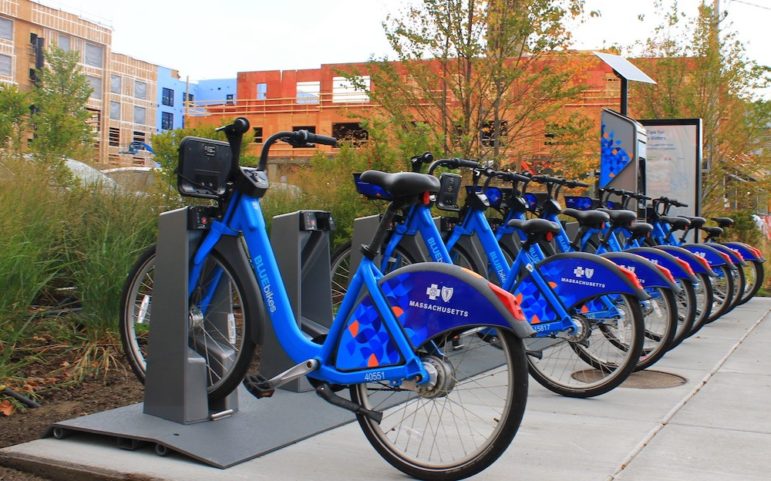
Arsenal Yards The Bluebikes station outside Arsenal Yards.
With Watertown’s contract with the Bluebikes bicycle share company expiring, City officials hope to sign a more favorable agreement.
The contract ends in early 2026, and City Manager George Proakis told the City Council he hopes to sign a several year agreement.
“This particular contract is a five year agreement with two optional two year renewals for a maximum term of nine years, which is designed to enhance service delivery, strengthen the sponsorship system, to make the system work better and support continued operations and stability in the bikeshare system here in Watertown,” Proakis said.
Because the contract is longer than three years, the City Council had to vote to allow the City staff to enter into an agreement. At its Dec. 9 meeting, the Council voted unanimously to give permission for the new contract to be negotiated and enter an agreement.
When Watertown first entered into an agreement in 2020, the community was added onto the core of the system that started in Boston, Cambridge, and Somerville, said Steve Magoon, the Assistant City Manager for Community Development and Planning. The new contract is a regional one, being coordinated by the Metropolitan Area Planning Council (MAPC).
“We didn’t get as beneficial an arrangement with Bluebikes,” Magoon said. With this opportunity, MAPC has put it out to bid on a regional basis, so all the communities are gonna be treated similarly, and it’ll be a much better contract arrangement for Watertown with us with this proposal.”
The first contract required the City to pay the operational costs of the bikes and dock stations, unless a certain ridership level was reached.
“We don’t get the revenue from riders, that goes to Lyft. With this new contract, while it’s not been finalized and signed, obviously, it is looking like that operational cost to the communities will go away,” Magoon said. “That’s pretty significant the way it’s structured now. Operational costs are paid depending on the ridership of the docks and basically how many riders you get. And while some of the stations met that threshold in Watertown, most of them don’t. So we would end up paying to lift an operational cost each year.”
Another way the original communities benefited was they would receive revenue from advertising on their Bluebikes stations, Magoon said. While Watertown had the opportunity to negotiate advertising, it proved difficult.
“So those communities really got the benefit of that. Again, doing it now on a regional basis, all the communities involved will get the benefit of that,” Magoon said. “It will lower the operational costs to communities like Watertown, and it’ll just be more of a capital cost associated with buying a station and locating it in the community, which will be much, much more beneficial to us as a community.”
Some the Bluebikes stations in Watertown were paid for by the City, and others were established using developer contributions or grants, Magoon said.