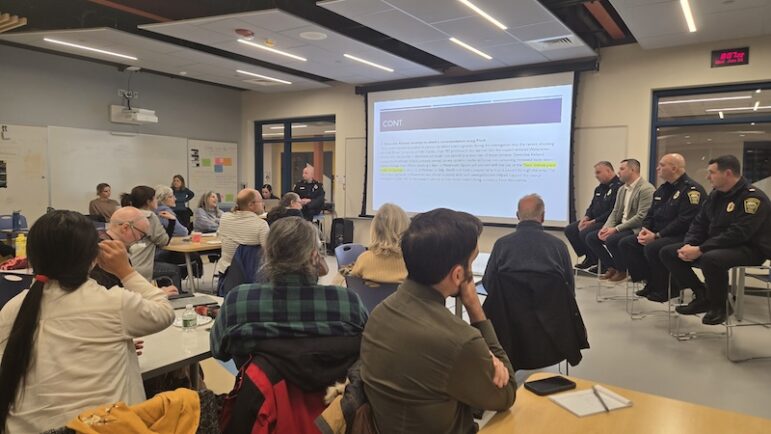
A room full of residents expressed their concerns about the Watertown Police Department’s proposed use of Flock Safety cameras in town, with the biggest issues about how the images collected by the license plate capturing system would be used outside Watertown and who would have access. As the debate over whether cameras should be used in the City, legislation at the state level could help reduce concerns.
The Flock cameras were one of several technologies available to the Watertown Police discussed during the Tech Talk at Hosmer School on Wednesday night. While body cameras, tasers, an AI-assisted police bulletin network, and other equipment interested the 30 or so in attendance, the Flock cameras garnered the most attention in the meeting that lasted nearly three hours.
The system has gained headlines recently as more police departments add them in the Boston area, and some are removing them. The Watertown Police Department received approval for funding to install eight Flock cameras in town, and cameras in other communities have helped locate suspects in some serious crimes in Watertown, said Watertown Police Chief Justin Hanrahan.
In one case, Flock cameras in Lynn helped locate two suspects who had kicked in the doors of two homes in Watertown, where they attacked one resident. In another case, Cambridge Police provided the WPD with the identity of a suspect who had stolen thousands of dollars in donations from St. Patrick’s Church. Watertown Police sent out a bulletin with a license plate captured on a home security camera, which the Cambridge authorities recognized.
Some communities have removed cameras due to concerns about how the images collected are used and which law enforcement can use them. The ACLU of Massachusetts reached out to Watertown, and other communities, providing a letter with concerns including that the typical contract language provided by Flock allows the data collected to be shared with law enforcement agencies around the country and at all levels.
In December, the Cambridge City Council voted to remove its Flock cameras after they said the company violated the terms of the contract. Cambridge had turned off cameras while discussing concerns about how the data is used, and then Flock installed two cameras that had been ordered but not put into place and did not inform the City of Cambridge.
Residents said that their biggest concern is that the data could be used by Federal agencies, including the Department of Homeland Security, and ICE, as part of the Trump Administration’s effort to enforce immigration laws. Others worried that the images could be used in cases in other states to punish people for something that is legal in Massachusetts but not in other states, such as abortion and marijuana use.
The images collected by Flock are stored in computer servers owned by the company. Some added that their concern is not limited to Flock cameras, but any data being collected but not stored by the Watertown Police.
Meeting attendees said they had discovered similar concerns in other parts of the country. Another concern is how secure the Flock system is after a journalist posted a video about how they can be hacked in 30 seconds.
Hanrahan noted that the Watertown Police first began looking at using the cameras more than a year ago. That was before some of the concerns about the Flock system had made headlines, and prior to changes at the Federal level.
Councilor Tony Palomba told the audience that he believes the Council did not properly vet the cameras when the proposal came before the Council last spring during the budget hearings.
“When this came to us and we heard the Police Department’s presentation on their budget, we did not flag this. We blew it,” Palomba said. “We did not look carefully enough at the proposal to put these cameras and to pay the $24,000+ per year in the contract. … And then when the full budget came to us, we passed it. So I just wanted to acknowledge my error.”
Exactly how the decision on whether to install the Flock cameras would be made was another question. Attendees also asked whether their concerns were being heard. Also, they asked where the cameras would be placed if approved.
Hanrahan said that the plan is to install eight cameras on main thoroughfares in Watertown.
The ultimate decision would be made by the City Council, said the three Councilors who attended the Tech Talk.
“The (City) Charter doesn’t put the City Manager in charge of policy. It puts the City Council in charge, and the City Council employs the City Manager,” said Councilor John Gannon. “So any policy direction will come from the elected representatives. There will be meetings in the process, but ultimately, decisions on policies like this will come from the City Council.”
Councilor Nicole Gardner said City Council President Mark Sideris plans to send the discussion of the Flock cameras to a City Council Committee, but has not determined which committee or committees.
“There will be many opportunities, if that’s the case, for people to give input. I encourage you to come to meetings. I encourage you to talk to your councilors. We need to hear from you, because it will eventually come before the Council,” Gardner said.
Residents also asked about how the cameras would be used. Hanrahan said a policy for the Flock camera use is being developed. In December, City Manager George Proakis said the policy is being drafted, and said that the Watertown Police would only share images with other law enforcement agencies in Massachusetts, and not with law enforcement outside of the state or at the federal level. He added that police departments would have to prove that the request is part of a criminal investigation. Similarly, when Watertown Police access the images from Flock, they would have to document the case or investigation, and the use would be audited by a captain in the WPD.
The matter of how to handle Flock and other license plate reading readers is being considered at the State House. Watertown State Rep. Steve Owens is lead sponsor on House Bill H.3755, called “An Act Establishing Driver Privacy Protections,” that would establish statewide rules, so that every community does not have to come up with its own rules.
“We are trying to put guardrails around the process. Right now, there aren’t any guardrails and each community is fending for themselves against this large for-profit corporation,” Owens said. “And sometimes some communities are better armed than others to figure out what protections they might have.”
Owens said Massachusetts does not have a lot of data privacy laws, and has instead relied on consumer protection laws. Those laws were not written with the current technology or political landscape in mind. He added that the legislation will look at how it will be implemented, such as where the cameras are installed.
“If we only put cameras in certain neighborhoods, that means certain people are going to be hit more often, caught in this dragnet, more often,” Owens said.
Owens said he hopes that the legislation will reach the Governor’s office for approval by the end of the year.