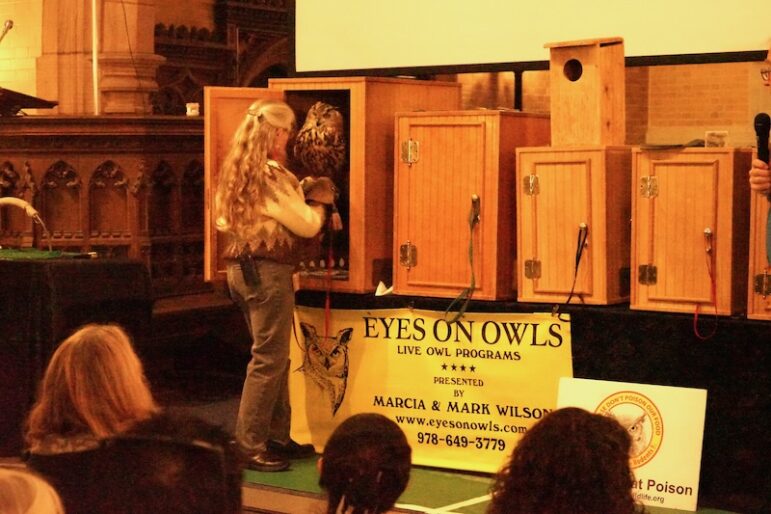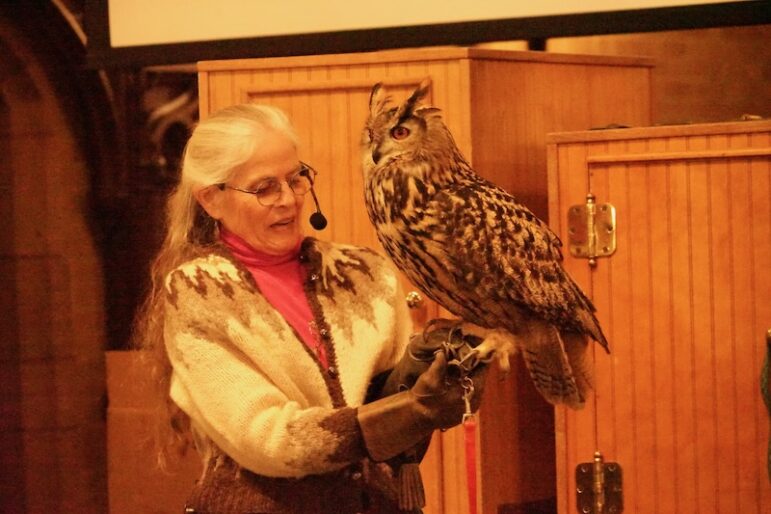
Mount Auburn Cemetery recently welcomed a couple who have devoted their lives to observing and caring for owls. They have traveled around New England in search of the raptors, from Crane Beach in Ipswich to Rye, New Hampshire, to Nantucket, and have ventured as far as Alaska, Serbia and Nunavut in the north of Canada to catch a glimpse of owls.
Mark and Marcia Wilson presented Eyes on Owls on March 21 at Story Chapel, a program that Mount Auburn Cemetery has hosted since 1997.
The Wilsons rescue owls and other birds of prey around New England, including one that got caught in a soccer net after catching a rabbit. When the owl could not fly away after being cut out of the net, the Wilsons took it to a wildlife clinic where they found it had sprained its wings. After five days’ rest, the owl recovered and they let it go, but not before returning the rabbit, which Marcia had frozen to keep it for the owl.
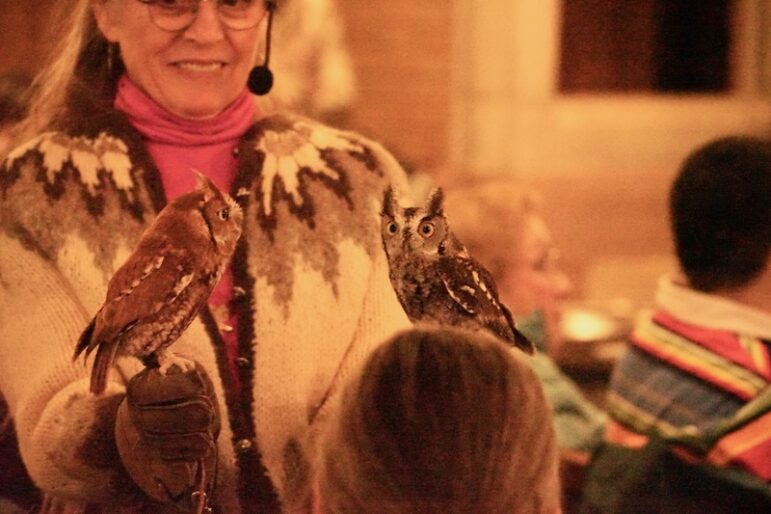
They have licenses from the U.S. Fish and Wildlife Service in New England. Marcia and Mark also care for owls that cannot live in the wild because they have been injured, or because they have become used to living with humans. They care for 15 owls and two other birds of prey, which they bring to the Eyes on Owls presentations.
The bird travel in wooden boxes, and have a tether to keep them from trying to fly away. When Marcia opens the door of the box, a bird emerges. The Wilsons brought a pair of Eastern Screech Owls, a Barred Owl, a Barn Owl, a Great Horned Owl, a Eurasian Eagle Owl (one of the largest in the world), as well as an American Kestrel.
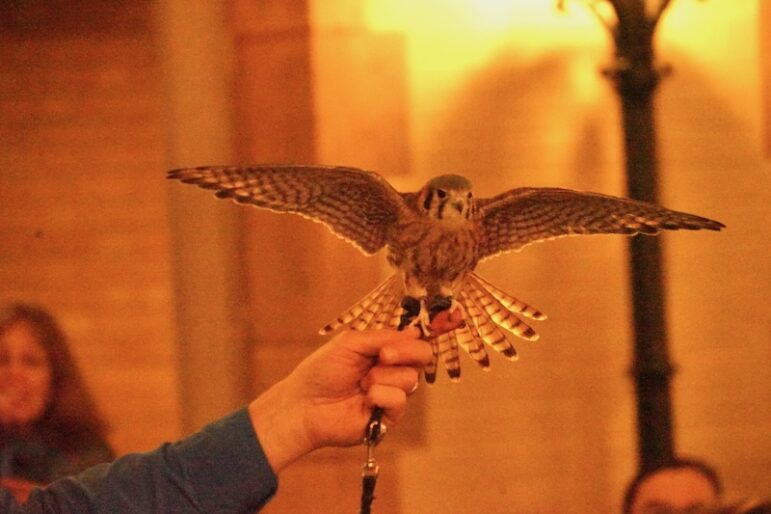
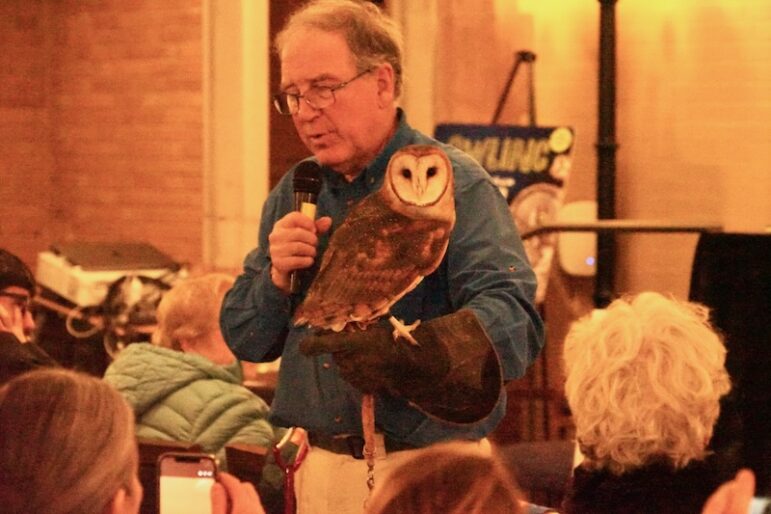
The Wilsons walked around with the owls on their arms so that people in the Story Chapel could get a close look at the birds.
The Wilsons travel far and wide in search of owls, and so that Mark can capture them on his camera. They’ve been to the Arctic six times in search of snowy owls. Some of the photos were used during the slide show in the beginning of the Eyes on Owls program.
Mark has written two books, “Owling” and “The Snowy Owl Scientist,” which he sells to raise money to help cover the Wilsons spend on frozen mice and rats to feed their owls. Last year the Wilsons spent $12,000 on the frozen rodents.
The Wilsons also talked about how people can observe owls in the wild. Owls show up in all sorts of places, including the Christmas tree at Faneuil Hall, which dined on rodents and pigeons in the area, Mark said.
Multiple owls can be found in the Watertown area, including Mount Auburn Cemetery, including the Eastern Screech Owl, which can be found in holes in trees. They are small owls that can be brown or grey.
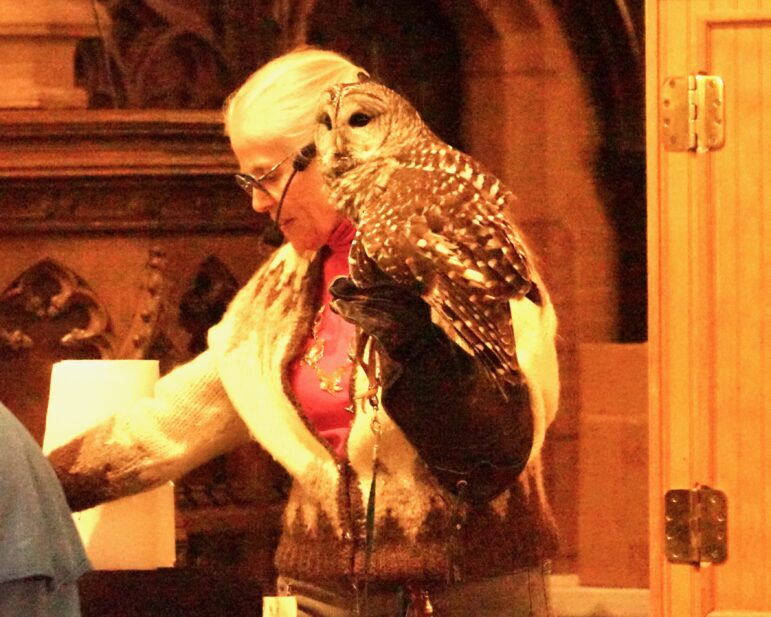
Another is the Barred Owl, which Mark said do not nest in the Cemetery but show up periodically, including in the fall and winter. They are named for the brown stripes of feathers on their fronts.
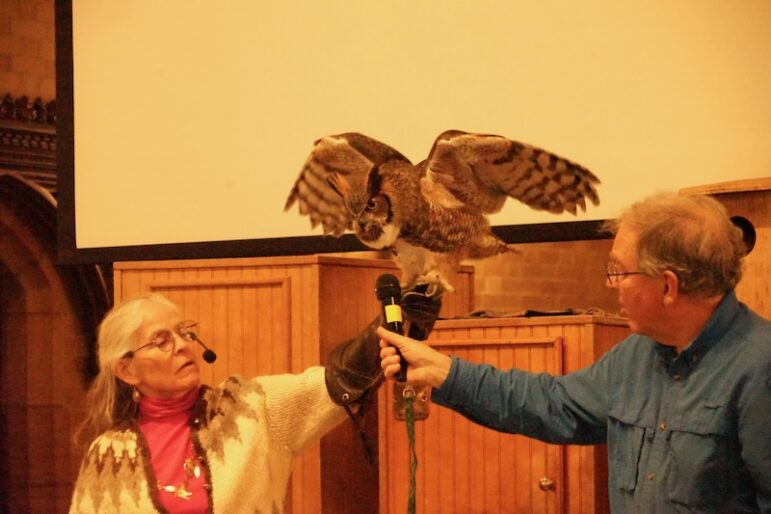
Great Horned Owls, named for the two tufts of feathers on either side of their heads, do not make their own nests, they use ones made by other large birds, including blue herons. A pair made a nest at the Cemetery in 2011.
Barn Owls are not common in the Watertown area, but can be found in Massachusetts and are recognizable by their white, heart-shaped faces.
When looking for owls, Mark said to look in trees for the wash, the white coating of owl droppings, which will be found where owls sit. You can also find pellets, which are the bones, feathers and other non-digestible parts of their prey.
Nighttime is not a good time to see owls, but it is a good time to hear them. The Wilsons demonstrated the calls of multiple owls at the event at the Cemetery. Hear examples of owl calls at the Mass Audubon website.
People can help owls by putting up owl boxes in which they can nest, Mark said, as well as avoiding second generation rodenticides which can harm owls when they eat animals that have consumed the poison.