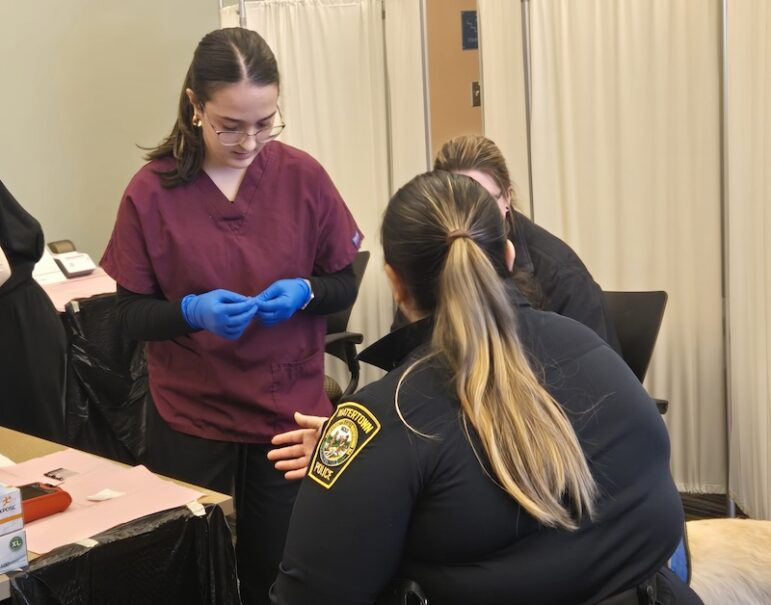
City employees had the opportunity to get free checkups from some aspiring medical professionals during a clinic run by the Watertown High School Medical Assisting Program.
The students learned to take vitals, take a blood test, and other procedures as part of the program that was added a few years ago, said teacher Melissa Burke.
“So these are our students who have committed to doing full three years on top of their regular high school curriculum, doing medical assisting training,” Burke said, adding that after they have completing the course the students can take the exam for national medical assisting certification.
Workers for the Watertown Public Schools, as well as the Police and Fire, Public departments received invitations to get a free checkup. The students previously ran smaller clinics for WHS staff, but this was the first time they offered one for people outside the school, Burke said.
“It gives our students a great hands-on experience outside of working with each other, and it really gives them that feeling of, this is what I’m going to do in a medical office,” Burke said. “And it’s, of course, we love our first responders, we love our town employees, so this is the one way we can give back.”
Junior Dayana Cosajay was in charge of vision tests at the clinic. She took some medical assisting classes as a freshman and decided to join the certificate pathway as a sophomore. Eventually she plans to work somewhere in the medical field. Cosajay said she enjoys the classes.
“Our classes are really fast paced, but we do take a lot of time with each topic to know for everyone to really learn it,” Cosajay said.
Junior Leah Solari conducted some eyesight checks and took blood pressures of the people who stopped by. She has learned a variety of skills in class.
“We learned how to do vitals, basic vitals, like blood pressure, height and weight, stuff like that,” “We spent a lot of time learning phlebotomy, which is taking blood.”
Before they do procedures with needles on real patients, they practice on fake arms.
Solari knew she wanted to be part of the Medical Assisting program as a freshman, and she has her eyes set on a medical career.
“My dream is to be a pediatrician,” she said.

One of the patients at the clinic was Watertown School Resources Officer Anna Margaryan.
“It’s nice to get checked in and just kind of get a threshold of where you are,” Margaryan said. “So if there are concerns, or if there’s something that might be a red flag, then I would just go ahead and schedule a real doctor’s appointment.”
The student’s performance impressed her.
“The kids are great,” Margaryan said. “They kept explaining the process to me, and they took really good care of me. So I only have one little band aid on, nothing hurt, and they were so professional. I’m so proud of them.”
The Medical Assisting Program is one of three Chapter 74 Pathways at Watertown High School, along with engineering and radio and television broadcasting, Burke said. The Watertown Public Schools had to apply to the state’s Department of Elementary and Secondary Education (DESE) to get approval. WHS can have up to 15 students per grade level in the Medical Assisting Pathway, Burke said, and currently there are 17 total sophomores, juniors and seniors, and 12 freshmen have applied to join the pathway.
The program is growing, and recently added a second teacher, Giselle Medina, according to Burke.
“It’s been growing year over year,” Burke said.
The classes can also be taken by students who are not part of the pathway.
“The unique thing that we do at Watertown High is we have these pathways, but we also offer these programs as electives for students that maybe just want to get a little taste and are not ready to commit to a career just yet, but give themselves a little taste of the medical field, or radio and TV broadcasting or engineering,” Burke said.