Eleven years ago, 25 life science companies had facilities in Watertown. Today, more than four times that many companies are located in the City, making it one of Massachusetts’ life science hubs.
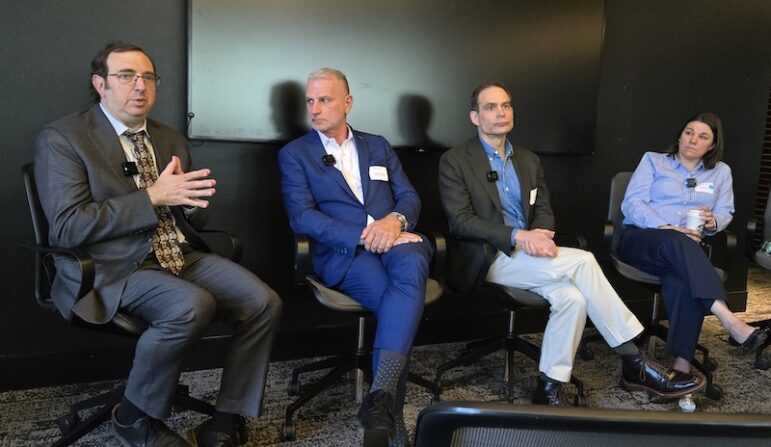
On March 10, the Charles River Regional Chamber‘s life science panel, “Watertown’s Life Science Future,” looked at how the City became one of the hottest centers for biotechs, and what’s next. The discussion was led by Boston Business Journal life science reporter Hannah Green.
The event was held at 100 Forge, the nine-story life science building at Arsenal Yards developed by Boylston Properties. Mark Deschenes, president of Boylston Properties, remembered that when the company arrived the life science industry in Watertown was in its infancy. It was mostly located nearby at 480 and 500 Arsenal Street. At the time, he said, Boylston Properties was a “reluctant life science developer.”
“We developed a Linx building across the street, which we had redeveloped as a creative office space,” Deschenes said. “We spent almost two years marketing that. We had 46 tours of the office space by various tenants that we talked to and courted for a long time. We were reluctant to actually do life sciences at that at that building.”
Boyslton finally found a company interested in relocating to the Linx building, but there was a catch.
“It was really C4 that came in and wanted to create a life science presence here,” Deschenes said. “We had developed a certain portion of that building that could accommodate life science, about 55,000 square feet. That’s what they needed. We thought it was perfect. Unfortunately, that’s not the space they wanted. So we went back to the drawing board and restructured the building in order to be able to accommodate that.”
Since then Boylston has built life science space in its biggest development, Arsenal Yards, creating a total of 435,000 sq. ft. of lab space in multiple buildings including the historic Arsenal building where Marshall’s is located. That is just a portion of the 2.9 million sq. ft. of life science space built in Watertown from 2015 to 2026, according to the report by WatertownBio.
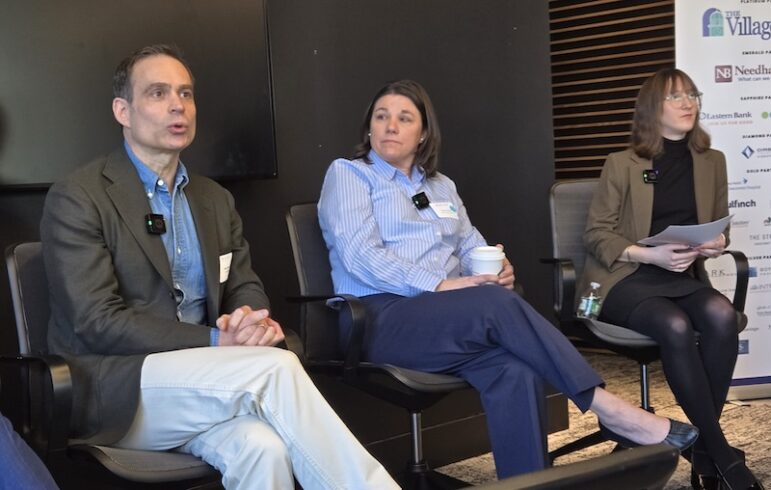
Kelly Schick, Chief People Officer at C4 Therapeutics, said the company moved in before Arsenal Yards was built, but saw the vision of a place where multiple life science companies would be located and workers would bump into each other while grabbing a coffee or having lunch.
“We had a founder that was willing to take risks. He wanted to do big things. He wasn’t afraid to do something different. And that’s what C4 was built off of,” Schick said. “And so moving to Watertown, we were promised Watertown as kind of an up and coming city, a place that was going to be built, where those bump ins would happen, where all of that would eventually get there, and it did.”
Creating a critical mass of life science companies was an important step, said Philip Borden, CEO of Labshares.
“It is so hard to create a critical mass of biotechs. Every community would love to have that critical mass,” Borden said. “And what Watertown actually has is that critical mass. There are dozens of companies here now. In a way that begets success in this industry, because people want to be where there are other scientists around there, they can exchange ideas. And Watertown has succeeded with that.”
Labshares is located in Nonantum, but when the company looked to expand it searched around the area and landed at 66 Galen. Kendall Square in Cambridge is the original life science hub, but Watertown has some advantages, Borden said.
“Kendall Square is great again, but it’s awfully expensive to be there. And so being in Watertown, it’s not that it’s cheap here, but in Kendall is a lot more,” Borden said. “And, (Watertown) we think of it as lying in, we call it sort of the Goldilocks zone of the Greater Boston biotech area. So it’s not too far out and therefore hard to get talented people to come to your location. But it’s not too close to Kendall Square where there’s expensive real estate and no parking, and it’s really hard to drive in every single day if you’re you know, if you don’t have the public transportation.”
The movement of life science companies to town did not happen by mistake, said City Manager George Proakis. It was a strategy made by Watertown, in part, to find a way to finance the City budget.
“I don’t want anyone to think that this just miraculously appeared overnight. It was a very thoughtful, consistent strategy started in the City Council,” Proakis said. “Watertown was at an inflection point where they made a decision that new commercial growth, rather than sort of chasing Prop. 2 1/2 overrides, was the strategy for building our tax base and making it work and work in a way that made the most sense.”
Watertown rezoned the area around the Arsenal and Watertown malls, as well as along Pleasant Street, Proakis said.
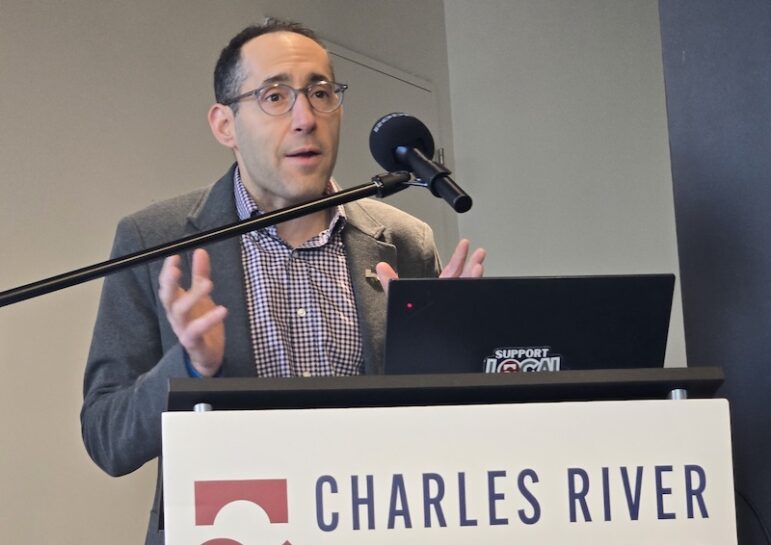
The life science industry has been a priority at the state level for nearly two decades, said Eric Paley, State Secretary of Economic Development, who also spoke at the Chamber event. In 2008, Massachusetts had eight of the top 20 life science companies in the world, he said, and today the state boasts 19 of the top 20. The effort started when Deval Patrick was in office.
“In 2008 the Patrick Administration had the first sort of Life Sciences 1.0 strategy and created the Mass. Life Sciences Center, which I’m honored today to be the chair of in this new job,” Paley said. “Based on that first commitment, the Baker Administration made another major commitment to life sciences, and then the Healey administration has again tripled down with another billion dollar commitment over the next 10 years to the Mass. Life Sciences Center.”
Paley noted that in 2025 Massachusetts had the fastest growing GDP of any state. While the sector has slowed, Paley said there are signs of growth in life science.
“As big as that number was for venture capital in 2024, the idea that anyone in 2024 raised more than in 2021 is pretty extraordinary, because that’s just not true in any sector,” he said, adding “It seems like ’24 was really anomalous, at least compared to all the other data we’ve seen. So ’25 certainly wasn’t bad. And the second half of ’25 we see as really encouraging.”
While companies continue to move to Watertown, the rate is not as high as the boom years of 2022 to 2024, when companies moved to town and venture capital funding was flowing. Developers put up new buildings even before securing a tenant.
In the last couple years, the industry has slowed significantly. The City has 11 permitted life science buildings which have not started construction. Deschenes does not expect to see any more speculative developments.
“When we were here in 2021 there was demand, and we built for the demand. …” Deschenes said. “We wouldn’t build that speculatively. It’s hard to kind of justify it right now with the supply that’s out there.”
Boyslton recently saw a good sign when a tenant, Mariana Oncology, was purchased by life science giant Novartis.
“We were terrified because we thought that meant that they were essentially going to take them, put them into their space in Kendall Square, and essentially surplus the space,” Deschenes said. “But Novartis saw the value in being here, and their employees also saw the value in being here. And I think that it was their employees who convinced them that they really needed to remain here. And they’re expanding into 30,000 sq. ft. of 500 Forge and have had conversations with us about even further expansion.”
When asked what can Watertown do to continue to attract life science companies, the panel said lifting the City’s profile as a life science hub would help.
Schick said that Watertown still does not have the name recognition among job seekers.
“Most of our candidates, or a lot of our candidates, don’t know about Watertown, or haven’t experienced it in the last couple of years. And so when they do get here, we do talk about it, they’re surprised, pleasantly surprised, and very happy to see all of the connections that they can make while they’re here, the conveniences that are within this community,” Schick said. “But we do often get the questions: What is there to do in Watertown? What is it like? Wow, I haven’t been there in so long. And so there is a bit of marketing that we do, both from a candidate side and when they come in and do orientation, as well.”
Borden said he would like to see more publicity for Watertown being a place to be for life science.
“I think one of the struggles that we sometimes have is that we have companies who may not be as familiar with this area” Borden said. “And they think Kendall Square is really where I need to be, in Cambridge and maybe even the Seaport. Watertown still does not have the brand yet of those other locations. I think being able to brand Watertown as the new home for emerging companies, boy, that’s really the branding that you want.”
As for the buildings themselves, Borden said when Labshares was seeking a new space, they wanted a place that felt alive.
“The headlines in the Boston Business Journal or in the (Boston) Globe, just the last couple of days, it’s all about all these vacant lab buildings,” Borden said. “That is tough, and it’s going to continue, frankly, to be tough unfortunately for a lot of those empty buildings. And so we didn’t want to be the anchor and sole tenant of an empty building. We wanted to be in a place that had vibrancy, that had activity.”
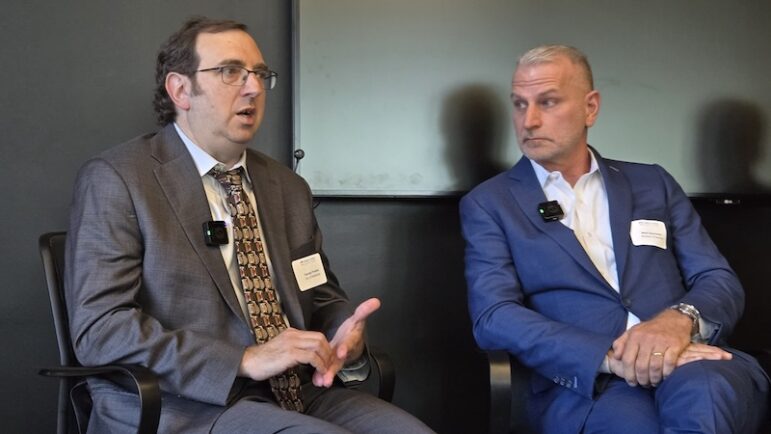
Green asked Proakis whether Watertown had put too much emphasis on one industry. One community where he used to work, Lowell, made two big economic bets — the textile industry and Wang Microsystems. Both left that City. He does not see the same situation in Watertown.
“Biotech is a world where the ups and downs of those businesses occur all the time. But we’re so diversified, even within life sciences, that one failed clinical trial isn’t the end of it for Watertown. There’s another technology, another idea, another strategy, another company coming,” Proakis said. “If there are other versions of growth sectors in the state that we can diversify into, as well, our door is open and we’re happy to do that, too. Give us a call. We’ll work to try to find a way to make it happen.”
At a recent event hosted by the Watertown Business Coalition Proakis said he is hopeful about the possibility of climate tech or tough tech firms expanding into Watertown.
Paley said the biggest challenge for life science, and the state as a whole, is affordability. Massachusetts is the second most expensive state in the country. He added that the cost of housing prices is the biggest concern. The MBTA Communities act has helped make an impact on that.
“The governor, when she came into office, (the Administration) did a study. They said we need 222,000 new houses,” Paley said. “We’ve gotten commitment, since, for 100,000.”
Before the discussion, the Chamber played a video made by Sam Ghilardi, founder of WatertownBio, that provided an overview of the group’s recent 2025 Watertown Life Science Industry Report. See the 10-minute presentation here.
Watch the entire panel discussing, courtesy of Watertown Cable Access TV, by clicking here.