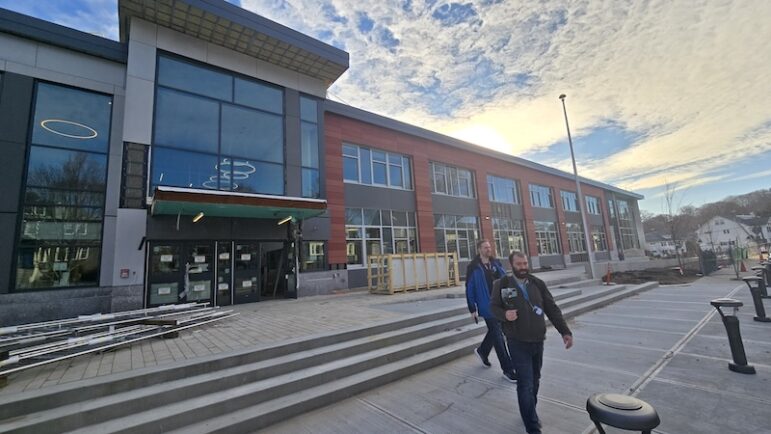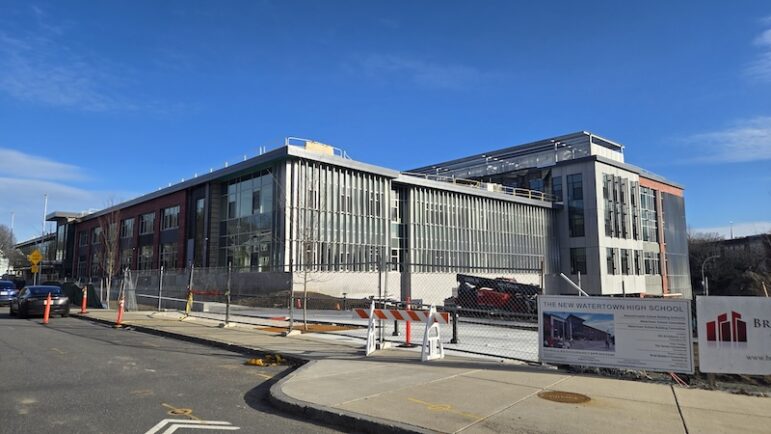
Wednesday afternoon, School Committee members, City Councilors and others got to see the new classrooms, theater, gym, and media center that will be enjoyed by Watertown High School students starting in September.
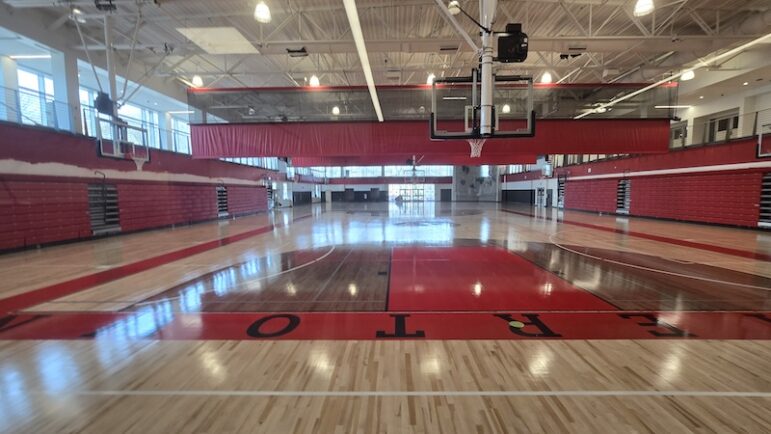
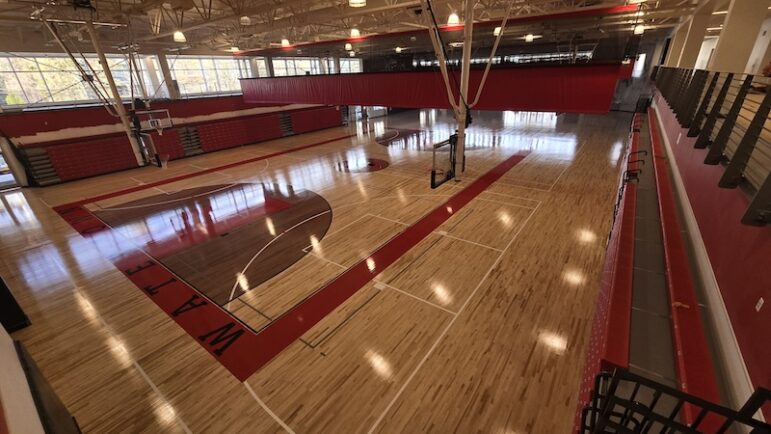
The school is taking shape, with the walls and floor covering completed on the upper floors of the four-story structure, and a fresh coat of varnish still drying on the floor of the gymnasium at the new Watertown High School.
Construction should be completed in the next few months, said Christy Murphy of owner project management firm Vertex.
“We are really marching towards a May substantial completion and towards the move in June,” Murphy said.
The original goal was to complete construction in time for the school to make the move from the Moxley modular school over April break, but the work schedule did not work out. One reason was some defects in the top layer of the concrete floors, which have since been shaved down and sealed.
Construction Site Manager Laurie Soave said all the floor remediation has been completed, and floor tiles have been installed in the upper floors. The wall treatments, with patches of red and grey, have also been installed in some levels. So have the “W”s around the school which come in a variety of forms: covered in fabric, made from wood, and even a green bushy one.
“That is freeze dried moss — freeze dried,” Soave said.
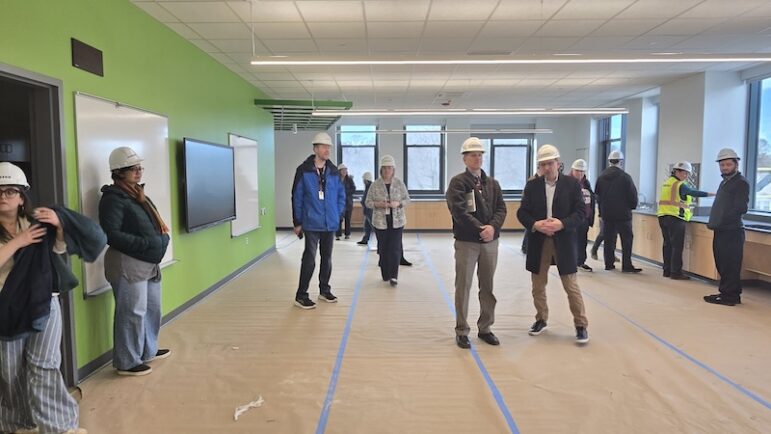
The group looked inside a typical classroom, which can seat up to 28, Soave said, but the average class sizes is around 21 according to Superintendent Dede Galdston. The science classrooms are much larger, and the chemistry rooms have chemical hoods so students can do experiments, Soave said.
The wide expanse of the new gym can be seen from the walking track that circles above it. The new home floor of the Raiders has red borders, a W in the middle with a script Raiders on top, and the area inside the three point arc has a darker stain than the rest of the court.
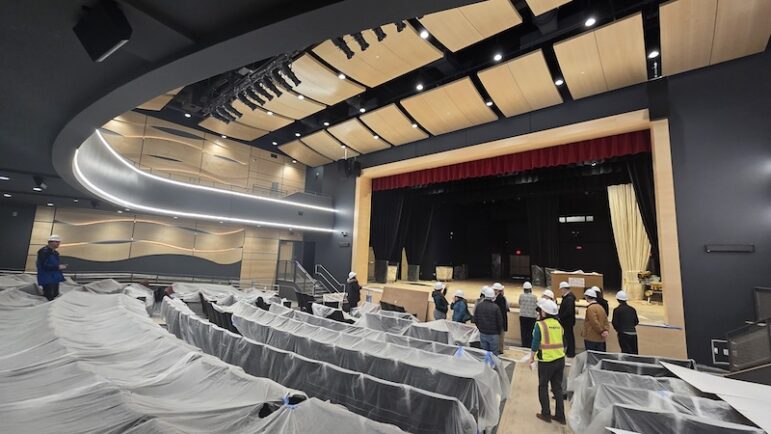
The new theater looks ready to host a show, with seats installed, lighting hanging above, and large acoustic panels made from maple around the room. With a main floor and a balcony, the facility will seat 480.
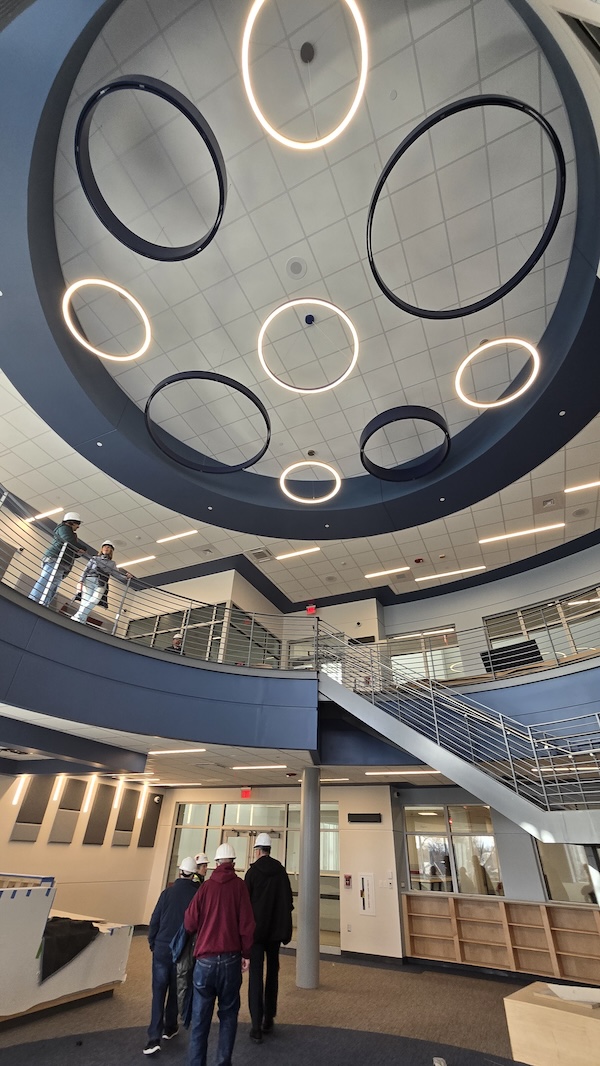
Split into two floors, the new media center will have books, computers, and a fab lab makerspace. None of the furniture has been installed, but it will have bookshelves on the first floor, Galdston said. While it is not called a library, books will still be a big part of the offerings.
“We are not moving away (from books), but (the staff) certainly will take this opportunity to go through their books and cull some of them, either old or outdated or whatever,” Galdston said. “There’ll be less, but not dramatically less.”
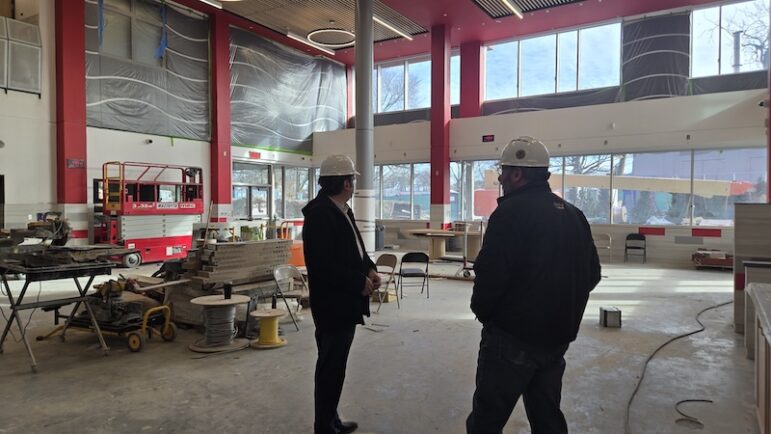
Another two-tiered facility will be the cafeteria. The first plans just envisioned the large seating area on school’s bottom floor, which overlooks a patio where students can dine during warmer weather.
Designers took advantage of an area overlooking the cafeteria that would have been empty space, said City Council President Mark Sideris, who chairs the School Building Committee.
“So we did a change order where we have to cut a door in over there, because you have to have a second means of egress,” Sideris said. “And then we’re going to have see the railing across all of this, and then we’re going to have seating.”
The cafeteria seats 250, and students will dine in three shifts, Galdston said.
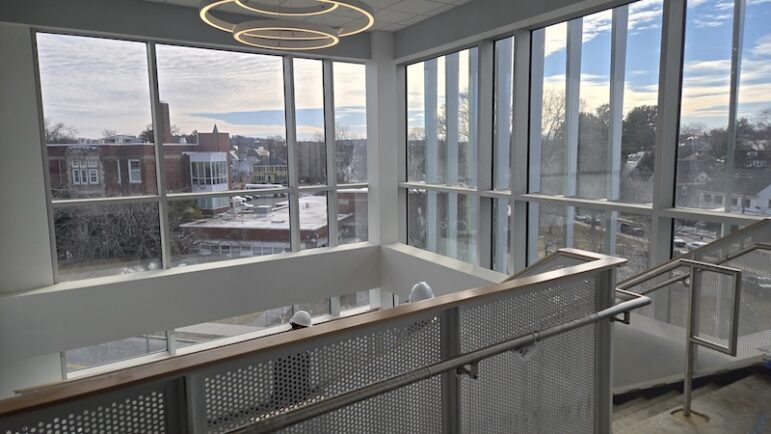
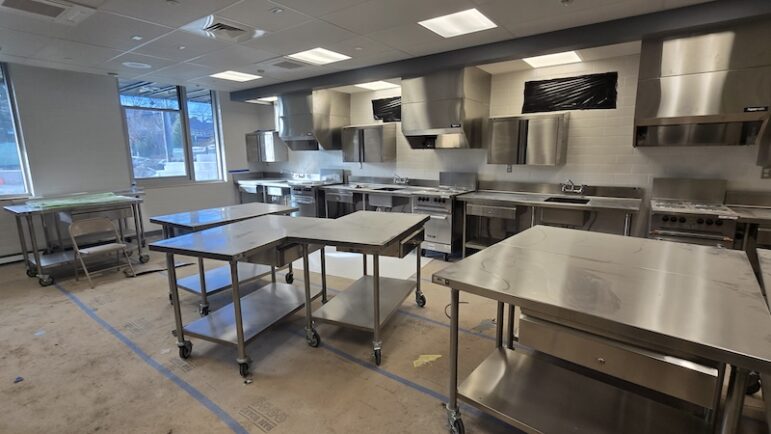
On the same level as the cafeteria will be the WHS Career and Technical Education programs, which include engineering, television and radio broadcasting, medical assisting and a new culinary arts program. The school also will have a woodworking room.
Joining the tour was City Manager George Proakis. He promised the City Council he would limit borrowing on the project to $150 million, even as construction and material costs rose during the Pandemic. He said he is confident the project will not exceed that budget.
“Where the bumps in cost on this project were all in that timeframe where we were finishing up design and going out to bid, and even the bids came in where the final estimates were, but the final estimates were high because it was in that COVID inflationary period,” Proakis said.
Part of the project cost will be covered by state reimbursement from the Massachusetts School Building Authority (MSBA). When the reimbursement figure was calculated, Proakis said, the number was based on pre-COVID costs. Meanwhile the MSBA raised the reimbursement rates for other projects that were designed post-COVID. Watertown got some help from the State Legislature.
“Thanks to some work by Will Brownsberger and Jason Lewis in the State Senate, they shook MSBA for a pool of money that basically was designed to be specifically for projects like us,” Proakis said. “In Jason’s case, he had the Stoneham folks calling him every day complaining, showing our budget that we’re basically in this space between the two. So we got extra money there, and then we’re able to make some strategic utilization investments during the growth years.”
The $200 million project is being funded by $150 million in bonds, about $54 million from the MSBA, and the contingency costs is coming from a contingency fund set up by they City Council, Proakis said.