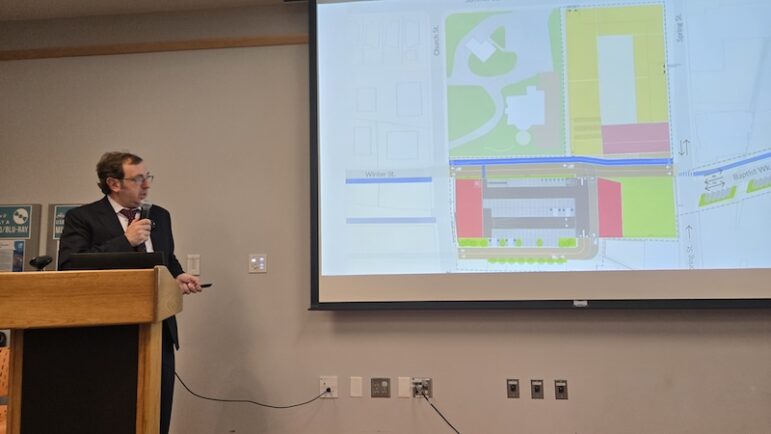
Monday night, the public got the first glimpse of a possible future for the parking lot behind CVS, the Armenian Museum of America and other businesses in Watertown Square, and it may include a multi-story garage built by the City and a residential building constructed by a private developer.
City Manager George Proakis spoke to a packed room at the Watertown Free Public Library. He discussed a variety of topics, including how the Watertown Square planning got to Monday’s meeting, designing the new look intersection, and the main event: the Demonstration Project that would be built on the Municipal Parking Lot.
Due to constraints, such as the City of Cambridge’s water supply line that runs under the parking lot, Proakis said the likely layout would be to put the garage on the area in back of the Armenian Museum of America. This would require removing the Gray Block commercial building that includes Tresca’s Eating Place, Salon Sabrina, and Grays Laundromat. The current lot has 267 spaces.
“Our rough estimate is that doing the garage on this lot is at least an increase of 100 parking spaces, maybe up to 180 depending upon how high are you planning this,” said Proakis. “I think we tested four and five story garages.”
Details about the parking garage, such as parking rates and free spaces, have not been decided yet, Proakis said. He added, however, that he does not want the parking lot to be a place for people to park their car so they can commute to work. There could be short term spaces for things like picking up a prescription or grabbing take-out meals, and Proakis said some garages have a period of free parking before the fees kick in. Other decisions to be made include whether to allow overnight parking for surrounding residential buildings, and if so, which ones. He added that Watertown Square businesses would likely be able to purchase passes for employees to park in the garage.
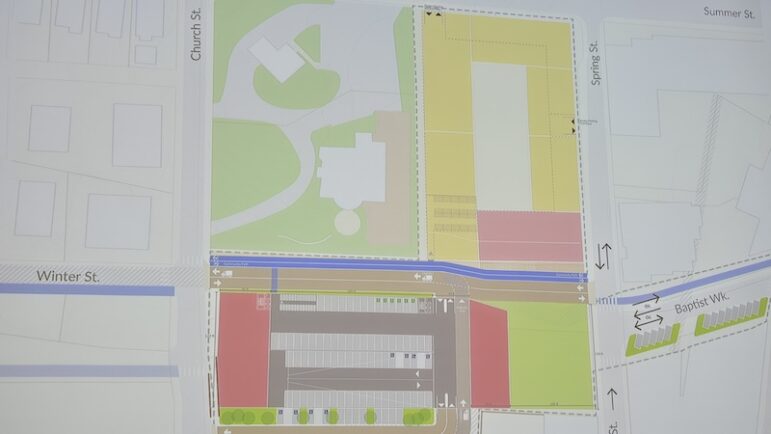
The residential building would be built along Spring Street, and include part of the parking lot, as well as privately owned buildings, including the former Registry of Motor Vehicles (the brick building on the north side of the parking lot, along Spring Street), and some houses on Spring and Summer streets.
The size of the residential building was not discussed. The properties in the area designated for the residential development fall in both the Watertown Square 3 (WSQ3) and Watertown Square 2 (WSQ2). In WSQ3, buildings can be up to six stories, with the top story stepped back; and WSQ2 allows up to five stories, with the top story stepped back.
A public open space would be created along what is now the edge of the parking lot along Spring Street. Proakis said there would be ground-floor retail in both the garage and the residential building, facing the public open space.
A section of the Watertown Community Path was shown running along Baptist Walk from Mt. Auburn Street to Spring Street, and running east-west through the property in an area that is now just north of the Gray Block.
Proakis added that the First Parish Church and the Watertown Savings drive-through branch are not part of the project area.
Options for Development
Proakis outlined five options to approach the project, but said the most viable ones are to have a private developer construct the residential building and the City oversee construction of the garage. Another option would be to leave it as is.
Proakis said the City could try to acquire the properties, or work with a developer who owns or has an agreement with the property owners. Proakis said his preferred option is to partner with a developer who is working with private property owners.
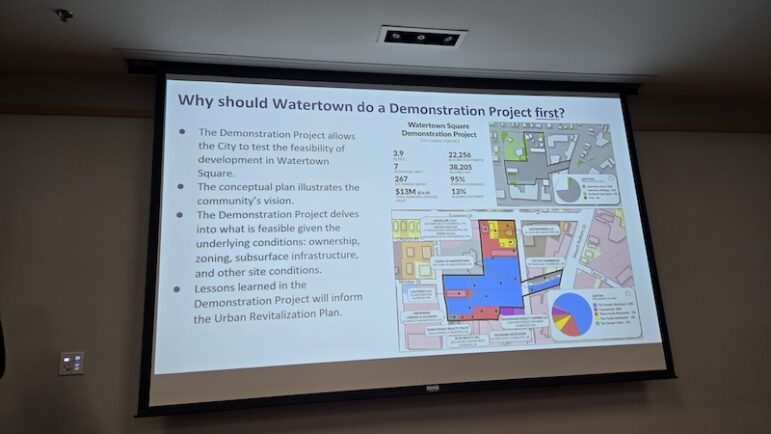
The City has already identified a likely partner, Hg80 Real Estate, which has an agreement with all but one of the properties where the residential building is envisioned. The firm built Assembly Row in Somerville, and other work include projects in Bethesda, Maryland, and Norfolk, Virginia.
Since the City of Watertown adopted the new zoning for Watertown Square, which included incentives to build multi-story residential buildings, City officials have heard from multiple developers interested in what could be possible. One of the developers was Hg80, Proakis said.
“The Hg80 folks approached us and said, we have a relationship here with this owner, and we’re looking at doing something, and where are we going to go with that?” Proakis said. “So in early 2026 now, if you’ve been following your City Council agendas, you’ll probably see that there’s been a couple of executive sessions with the City Council earlier this calendar year talking about the demonstration project plan, and in early 2026 we reviewed options with the Council to discuss a partnership with Hg80.”
Proakis had some “informal conversations” with the firm from January to March, but then he stopped.
“I stopped because what I wanted to do is I wanted to get out of this public meeting, introduce this idea to the public and make sure that everybody knows what’s going on,” Proakis said. “Because at the end of the day, these are decisions that should be made in light of the public, with everybody understanding what’s going on. There is no signed agreement with the developer, the City administration, the Council is committed to nothing yet. We’re here to propose an idea, but the benefits of the partnership include coordinating infrastructure solutions, faster project completion, shared risks that I think will reduce risk overall, and a project that will be more affordable to both sides.”
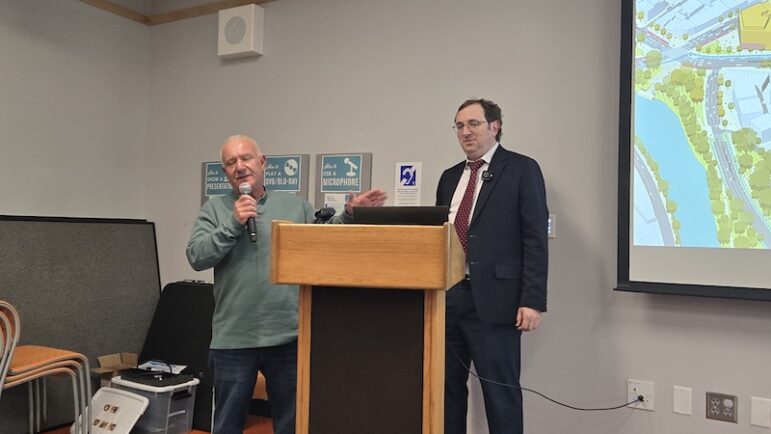
City Council President Mark Sideris added that the decision is far from done.
“I’ve been told that this decision has already been made. It has not. The City Council, under our leadership, will have very public hearings and public discussions and take your feedback, even after the next open house, even after the comment cards, we will listen,” Sideris said. “We are here. We will have as many public meetings as we need to go through this process, and I just wanted to make sure that you were reassured that this is not a decision that has been made and it’s not a decision that’s going to be made lightly. I can assure you that myself and my colleagues are taking this very seriously, and we’re here to listen to your questions and concerns.”
What is a Demonstration Project?
The Demonstration Project is a test case, of sorts, for the larger Revitalization Plan. In September, the City Council voted to proceed with planning for a Revitalization Plan, which would include a larger portion of the Watertown Square area. Proakis mentioned the parking lots behind the Watertown Library (owned by the City), and the lot behind the former Santander Bank (privately owned).
The City Council will act as the Redevelopment Authority for the project. The Council was passed the powers of a Redevelopment Authority from the one that oversaw the reuse of the U.S. Army Arsenal Property. A Redevelop Authority serves as the operating agency and the urban renewal agency, which can join partnerships, conduct development activities, and engage in renewal projects, Proakis said.
“So rather than having meetings, and establishing a separate board to do all of this, the City Council has all of these steps,” Proakis said. “And rather than setting up a separate Redevelopment Authority staff or anything of that sort, my team — the City Manager and Community Development and Planning and the folks here — can be the Redevelopment Authority staff in a circumstance where we do this in Watertown. Simply put, the way it would work here is that the Council has the control. The Council has the decision making points. The Council decides what to do, when to do it, how to do it.”
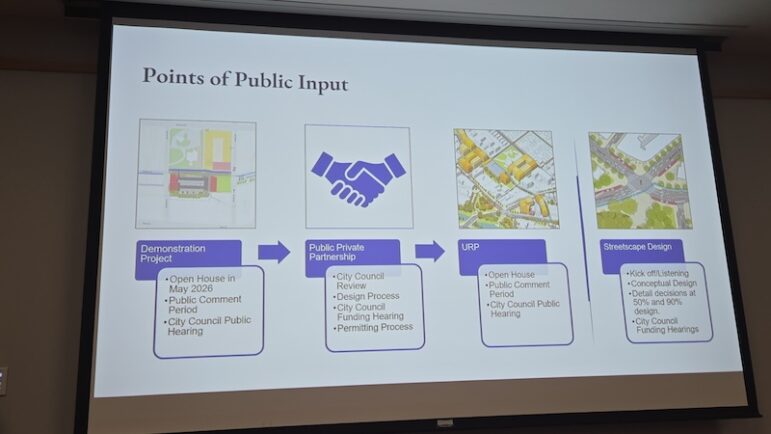
Details of the proposal will be released this week, possibly as soon as April 8. Proakis said the City will host an open house in May for the community to learn more and give their input about the proposal.
“The plan is in draft form, so we can make some tweaks to it if we want, present it to the Council sometime this calendar year and work with them to move at the speed they want,” Proakis said.