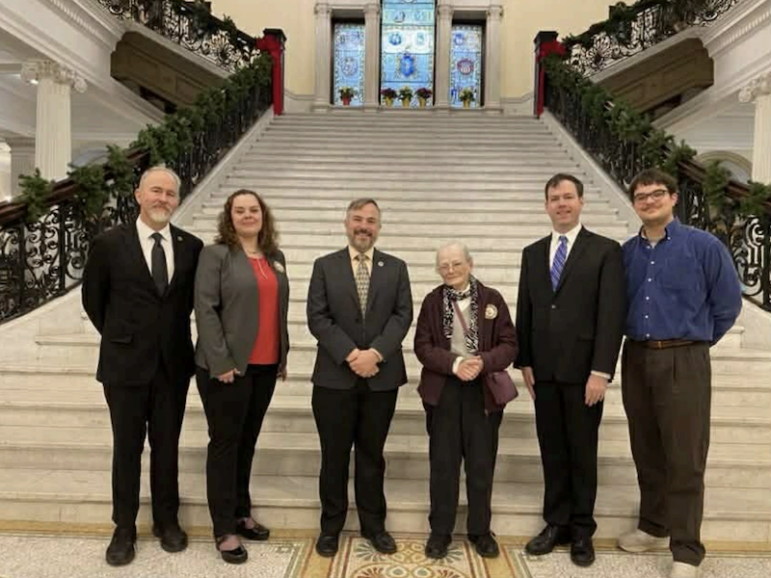
Watertown historian and author Marilynne Roach who has researched the Salem Witch Trials recently testified at the State House for a bill that would exonerate the eight people, including two with ties to Watertown, found guilty of being alleged witches before the Salem 1692 panic.
Roach has written multiple books about the Witch Trials in Massachusetts, and wanted to find a way to give those found guilty some justice.
“A few months ago I spoke with Rep. Steven Owens at one of his regular visits to the Senior Center to ask about getting a bill to clear the names of the people found guilty of witchcraft before the well-known Salem outbreak,” Roach said. “Needless to say, the verdicts were based on faulty evidence. Two of the eight cases have a Watertown tie-in.”
Owens introduced the bill, and in November, Roach and several other concerned citizens spoke before the Joint Judicial Committee at the State House. Others joined virtually or sent written statements in favor of Bill H-1927.
“We really appreciate Rep. Owens’s genuine interest in the cause and in history in general,” Roach said.
During the testimony on Nov. 25, 2025, Roach said:
“Although they are not alive and present after over three centuries to feel satisfaction at a reversal of the verdict that killed them, clearing their names is not only right, but would also give us, the living, a firmer ground to speak from when we deplore the actions of other nations, other cultures (and some individuals in our own country) because witch persecutions are still happening, mostly (though not exclusively) targeting woman and children — victims who are scorned, incarcerated, and even killed — today, now.”
“Passing Bill H-1927 would allow a voice to the voiceless, the known and the nameless ones of our shared history whose records are lost, an acknowledgement allowing the dead to make a difference so that their unnecessary deaths may not have been wholly wasted.”
Roche also provided the following letter:
Letter
Although the last of the alleged “witches” found guilty during the infamous Salem witch trials of 1692 was cleared of the charge in 2022, the names and reputations of eight known suspects unfairly convicted in Massachusetts before that outbreak (two with Watertown ties) still deserve exoneration.
Thanks to Representative Steven Owens (29th Middlesex) and his staff, the Joint Committee on the Judiciary considered House Bill 1927 on Tuesday, November 25: “An Act exonerating certain individuals accused of witchcraft in colonial Massachusetts.”
As part of the Massachusetts Witch Hunt Justice Project five supporters of the proposed bill spoke in person in favor of the act: Watertown writer, historian, and current President of the Historical Society of Watertown Marilynne Roach; Sarah Jack of Colorado, witch hunts podcaster co-host, executive director of the non-profit End Witch Hunts, and witch trials descendant; Daniel Gagnon, Danvers author, Board of Directors member of the Rebecca Nurse Homestead Museum in Danvers, and Chairman of the Town of Danvers’ Salem Village Historic District Commission; Antonio Infante of Danvers, Rebecca Nurse Homestead volunteer; and David Allen Lambert of Stoughton, head genealogist at the New England Historic Genealogy Society and witch trial descendant.
Speaking virtually were Sally Kerans, Representative for Danvers (formerly Salem Village); and Dr. Leo Igwe of Nigeria who itemized the countries where witchcraft persecutions still occur and the horrific tortures inflicted on the suspects. Said Dr. Igwe, “Based on my decades of academic experience and activism, I confirm that your favorable consideration of this bill will surely resonate with the contemporary victims of superstitious fear and their families.”
More supporters have submitted written statements, and over 2,800 people have signed a petition in favor of exoneration.
Representative Owens met with the group of supporters after their testimony and gave them a private tour of the House Chamber with its mural of Judge Samuel Sewall making a personal apology for his part in the 1692 trials.
Other states have similar exoneration movements. Connecticut cleared its supposed “witches” in 2023 while supporters in Maryland and New Hampshire are currently working on similar projects.
The act would clear eight known suspects.
1648 – Margaret Jones of Charlestown, a healer whose blunt advice unnerved some of her patients. (Samuel and Alice Stratton of Watertown who spoke in defense of Jones were nearly suspected themselves and had to apologize publicly for contradicting the magistrates.)
Between 1647 & 1651 – Elizabeth Kendall of Cambridge (now part of Newton) was hanged for bewitching a Watertown child to death. Too late, her accuser proved to be the nurse whose negligence led to the baby’s death.
c. 1650 – Alice Lake of Dorchester, in a depressed state over the death of one of her children, denied being a witch but felt she deserved to die because of a failed abortion before her marriage.
1652 – Hugh Parsons of Springfield, a man often at odds with his neighbors, was accused along with his wife Mary, who (possibly suffering from post-partum depression) confessed to killing her own child. Mary died in jail. Hugh was convicted of witchcraft but, oddly, the General Court overturned the conviction whereupon he left for Rhode Island.
1656 – Trouble began for Anne Hibbins of Boston with a quarrel between herself and the contractors working on her house. After being widowed, she was tried and convicted, her case referred to a higher court due to doubts among the magistrate but convicted again.
1656, 1673, 1680 – Eunice Cole of Hampton (later in New Hampshire, part of Massachusetts) was known for odd behavior and suspected of shape-shifting and attempting to lure children. She was frequently tried yet acquitted. New Hampshire citizens are still working to clear her name.
1680 – Elizabeth Morse of Newbury suffered through poltergeist-like activity in her house which caused an adult neighbor to experience fits and visions. Although she was tried and convicted, the governor and assistants reduced her sentence to a form of house arrest.
1688 – Goodwife Glover of Boston (her first name no longer known) was a Gaelic- speaking Irish Catholic whose sharp words when accused of stealing laundry from the Goodwin family escalated into witchcraft accusations after the Goodwin children began having convulsions and seeing menacing apparitions.
Useful links:
Massachusetts Witch Trials website
Change.org petition (click here)
The Thing About Salem (podcast)
The Thing About Witch Hunts (podcast)
Massachusetts Witch-Hunt Justice Project
End Witch Hunts (501(c)3)
Marilynne Roach
Bravo to everyone! Thank you for correcting the history story and all the efforts made to get it done.