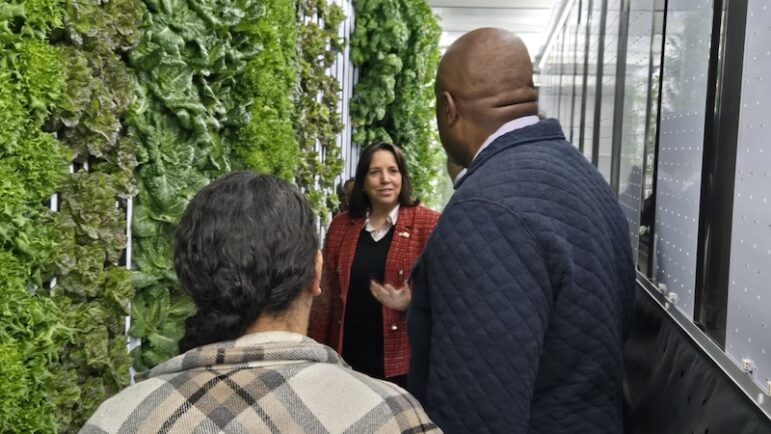
The white box container sitting in the parking lot of the Watertown Public Schools’ administration building has smooth metal walls on the outside, but inside the walls have a lush floor-to-ceiling covering of green plants. The freight container is not just a teaching tool but also provides fresh produce for students around the district.
Known as a Freight Farm, the container is filled with walls outfitted with equipment to water and nourish hundreds of plants, and lights to help them grow. When up to full production it will produce all the greens used in salads and other dishes served in Watertown’s five public schools.
The Watertown Public Schools recently received a $82,946 FRESH (Farming Reinforces Education and Student Health) grant, much of which will be used to fund the Freight Farm. As part of the official announcement of the grant, a bevy of state officials visited Lowell School on Feb. 5, including Lt. Gov. Kim Driscoll.
Before the speeches, members of Watertown High School’s High-Tech Farming class showed the delegation how the Freight Farm works.
“So what we have is we have these different tanks that have nutrients built into the water,” said WHS senior William Powazinik. “And so when the water goes through this line up here, it comes out of the emitters for soil and water they just go right into seeds.”
The students harvested one of the plants, which had a big crown of leaves but a small root system.
“Basically they are searching for water and since we are watering them they don’t need to grow,” said WHS senior Ana DaSilva.
Driscoll said the Freight Farm can produce the same size crop as a large piece of farm land.
“This freight farm is really a trailer, but inside it has a whole hydroponics facility that is equal to two and a half acres of land space that can grow green leafy vegetables,” Driscoll said. “It’s terrific to see just the technology behind it, but I think most importantly, the enthusiasm for the students or what they can grow from a seedling all the way through to being ready to harvest lots of different varieties of lettuce and other spices and green herbs and green leafy vegetables. So it was terrific to see that. Watertown is really ahead of the curve.”
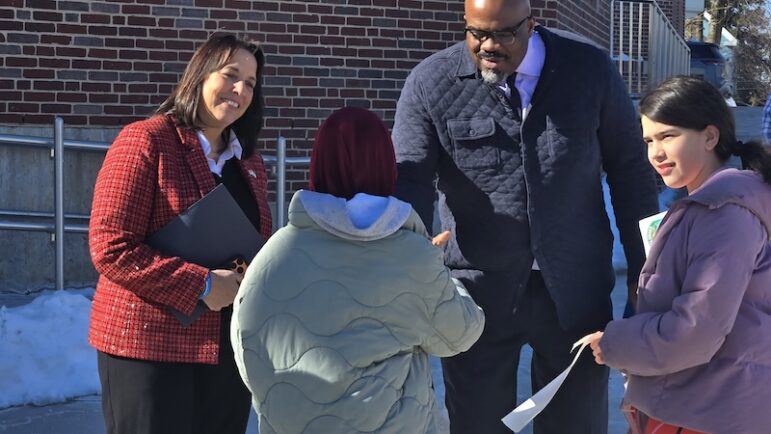
The event at Lowell School celebrated the $1.2 million investment in 24 school districts and 10 early education programs across the Commonwealth, said Secretary of Education Patrick Tutwiler.
“These new grantees, with that $1.2 million investment, join more than 60 districts already participating in Mass. FRESH which is reaching over 200,000 students with meaningful farm food and STEM based education,” Tutwiler said.
Students in Watetown have been growing crops in school gardens for more than a decade, but Superintendent Dede Galdston said the seed for the idea for the Freight Farm was sewen during a visit she made to a Watertown classroom.
“When I began my journey here in Watertown nine years ago, one of the first things that struck me was the pride that our schools took in their gardens. Every school had one,” Galdston said. “In one high school classroom is where it all begins for me. I noticed a small hydroponic setup tucked in a corner, and at that moment I thought what if we could bring this kind of learning to scale and make it available to students year round, and now we have our first round of students just started last week in our high tech farming class.”
The High-Tech Farming class is taught by Evan Nabel. He has taught special education sciences and general education biology at the High School for 10 years, and had a bit of experience with hydroponics before getting into the Freight Farm.
The 24 students, in two classes, are the first group to take High-Tech Farming. The class just began a couple weeks ago, Nabel said. Prior to that, he spent the first semester getting to know how the Freight Farm’s computerized system worked.
“I’ve played with some hydroponics before in my classroom, but this is the first time at this scale, and this farm itself, with so many different systems in play, took a little while to slowly build up into growing a full wall like this,” Nabel said. “I had all semester one to get this operational. So from September over to January, I’ve been in here solo. We’re now with students ready to go full operational and get all four walls growing. So we’re gonna really ramp up.”
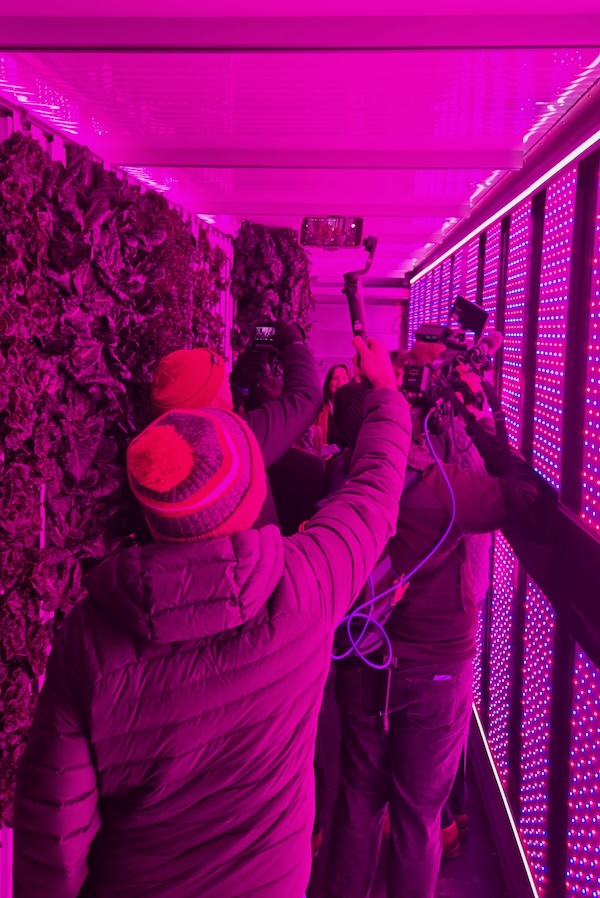
Each wall has 800 plants on it, Nabel said, mostly leafy greens for salads — Red Oak Leaf, Upright Oak Leaf, Batavia, Red Gem, Romaine and Green Summercrisap — plus some herbs like basil and parsley.
The veggies end up in salads, taco bowls and other dishes in lunches at schools, said WHS Principal Joel Giacobozzi.
‘The kids are excited to see the hard work that they put in, make actual results in our cafeteria and our cafeteria staff is amazing. They can make a great meal out of anything,” Giacobozzi said. “And just so happens, they have fresh ingredients that are made by their peers. It’s a really impressive thing what they’ve done, and they’ve scaled it up so quickly.”
The Watertown Schools food services try to source food as locally as possible, said Brandon Rabbit, director of School Nutrition for the Watertown Public Schools. Last year, Watertown got about 40 percent of its produce locally sourced, which is from around the state and the region. Now that percentage is even higher. The schools use 70 to 80 pounds of greens per week which can now be sourced entirely from the Freight Farm.
“So they’re our largest lettuce vendor now. It doesn’t get any more local than that,” Rabbit said. “Students are actually growing the lettuce, harvesting the lettuce, and then eating the lettuce, and then composting anything left over. So it’s a full circle.”
Another addition this year, Rabbit said, is Halal chicken wings from Maine Family Farms.
“We have a large Muslim population, and also it is local in the region, so it hits all the boxes,” Rabbit said. “We’re able to make those purchases, because the price per meal for the food cost is higher buying stuff like that, but we’re investing back in our students.”
Rabbit said the district’s food program encourages students to eat healthy meals.
“They all have to take a fruit or vegetable on their tray,” Rabbit said. “They learn from a young age.”
Seeing Watertown’s Freight Farm and hearing about how the produce was used impressed Pedro Martinez, Commissioner of the Department of Elementary and Secondary Education.
“What I love is that you’re not only providing students with free, nutritious food, but you give them hands-on lessons that are relevant to their lives, and they’ll help them become thoughtful decision makers,” Martinez said. “The fact we have a culinary program and a high tech farming program doesn’t get better than that. We want to make sure our students understand where food comes from, and that’s why it’s so important to make sure that we’re providing our students with healthy foods.”

Watertown’s district-wide School Garden program started 14 years ago. Judy Fallows became the first coordinator.
“Before that, a lot of people were trying to make it happen, but it was happening with specific teachers in specific schools, and then when that person left — the parent, the teacher — the thing would fall apart,” Fallows said.
Now all three elementary schools and the middle school have school gardens.
Fallows retired in December 2024, and in March 2025 Jackie Cefola was hired as the next coordinator. A big part of the job is weaving what’s happening in the gardens into what’s going on in the classroom.
“In the elementary schools right now, we have connected what we’re growing in the garden to the science curriculum and also sometimes to history or other aspects of what they’re learning in school,” Cefola said. “And so my job is to make sure that students have access to learning opportunities outside.”
In an example of a lesson, students use amaranth from the garden to learn about science, Cefola said.
“So I had fourth graders harvest amaranth this year because they were learning about internal and external plant structures and science,” Cefola said. “And instead of just learning in the classroom, they were able to also learn by pulling plants out by the roots, seeing the root system, seeing the leaves, seeing the seeds, and thinking about how it’s all connected.”
Cefola also plans what to plant and when.
“Right now we actually are trying to keep growing kale during winter, and the way that we do that is we have a little mini hoop house that’s set up in a raised bed,” Cefola said. “Right now the hoop house is covered by snow, but it’s insulated. So I haven’t seen the kale in about a month, but I’m crossing my fingers and toes that it’s still growing, and that we can have our first harvest of kale in March.”
Meanwhile, students are planting seeds indoors which will be planted in the outdoor gardens when the weather is right.
“We’re starting with a round of peas. So the first grade will be planting peas and learning about the basics of what plants need and what peas need,” Cefola said. “That’ll happen in late March or early April, so that can be planted before the thaw. And then we’ll also be doing radishes with second grade and some other things.”