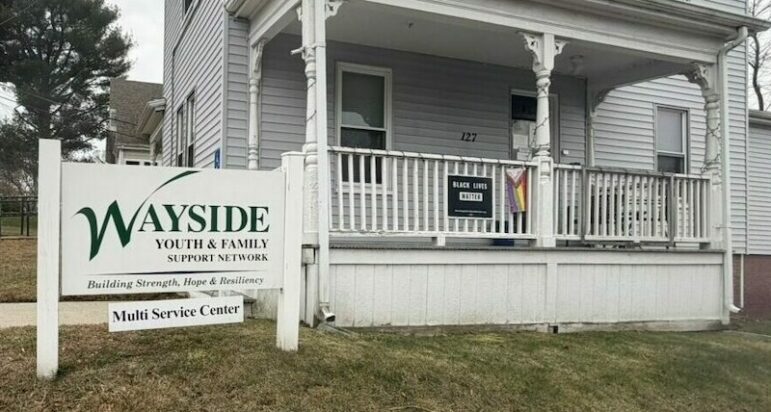
The Wayside Multi-Service Center momentarily saw one-third of its budget disappear, with the removal of a federal grant. While the grant was restored within days, Sophia Suarez-Friedman, Program Director for Wayside Multi-Service Center, said it was both a stark reminder and a heartening response.
The Substance Abuse and Mental Health Services (SAMHSA) grant accounts for a large portion of the Wayside’s program in Watertown. It is used to support youth with trauma in Watertown and Waltham, and their families.
“It’s over a third of our staffing and budget at the moment, so it was definitely really scary to have it go away so suddenly,” Suarez-Friedman said.
In mid-January, Wayside and other organizations that receive the federal grant received an email in the middle of the night saying that the SAMHSA grant had been terminated, effective immediately.
“There was no warning more than just understanding the current climate that we’re in,” Suarez-Friedman said. “But no actual warning.”
If the SAMHSA grant had gone away, the staff members working at the Multi-Service Center would likely have been able to move to other work within Wayside (which has nine locations in Eastern Massachusetts and served more than 6,800 people in 200 communities in 2024), Suarez-Friedman said, “but we would have lost them here at the Multi in Watertown.”
The grant funds programs to help youth who have experienced trauma. The Wayside Multi-Service Center supports youth ages 6 to 22 in Watertown and Waltham who have experienced trauma, she said. and provides supportive counseling for the youth and their families. Currently, the Wayside Multi-Service Center serves about 45 clients in this area.
“Trauma can be anywhere from the loss of a loved one, it could be witnessing or experiencing a natural disaster or violence,” Suarez-Friedman said. “But we also see trauma as being the negative response that some people had due to the pandemic, and living with hunger — not knowing when you’re getting food — or having uncertainty around your housing. Or immigrating, whether it’s because you experienced something traumatic in your home country or that maybe the process of immigrating was traumatic.”
Wayside often fills the gaps in coverage or services, Suarez-Friedman said, such as treating someone when there is a long wait list for outpatient therapy, working with families whose insurance does not cover therapy, or helping connect people to other resources such as family housing and food assistance.
For about 24 hours, the funding for this program was gone, Suarez-Friedman said.
“It was actually really heartening for me. It was really impressive how much advocacy there was nationally. Because this was a national cut. It’s a federal grant. So it was really far reaching,” Suarez-Friedman said. “And so there was a ton of advocacy with legislators, and amongst the grantees and Wayside. I felt very supported by our senior leadership, our CEO (Sara McCabe) and our VP of Government Relations (Aaliyah Bannister-Batie). And I reached out to (State Rep.) Steve Owens, who connected us to (U.S. Sen.) Ed Markey’s office very quickly.”
Seeing how fragile federal grants can be was a good reminder for Suarez-Friedman.
“I’m always looking for other grant opportunities for continuing our existing programs should they end, or when they end, because they have end dates, and also for new programming,” she said.
Wayside receives some funding from the City of Watertown, and also has some state contracts as well as private funding, such as from the Watertown Community Foundation. Wayside also seeks new grant opportunities.
“I just put in an application for another large, private funder, and so I’m hopeful for that one, but we won’t learn until June,” Suarez-Friedman said. “So we’re always looking for other opportunities because of how, how immediately funding can be taken away.”
Finding private funds often provides more flexibility, Suarez-Friedman said.
“What I love most about the Wayside Multi is how much we are, grassroots social work, a community organization,” she said. “We’re figuring out what the community needs and just doing it. I really think that. When we get private funding, or more flexible funding like that, we get to do exactly what’s needed, versus what a grant is telling us to do.”
The Wayside Multi-Service Center has not done large-scale community fundraising, Suarez-Friedman said, but the people can donate to the organization.
This Center has provided invaluable services to the people of Watertown and the surrounding area for decades. I was honored to serve as Vice-President of the Board of Directors from 1979-1981 when it was managed by the Town of Watertown. Very glad to hear that the grant was restored. We can’t even stop being vigilant in these times of Trump and MAGA.