Marilynne Roach, president of the Historical Society of Watertown, and State Rep. Steve Owens recently joined the reenactment and commemoration of an event that helped turn the tide of the American Revolution.
In February the anniversary of Henry Knox and his “Noble Train of Artillery,” when cannons were hauled from Lake Champlain in New York to Boston, was celebrated and Roach took part in parts of the nearby celebration. The commemoration started in Upstate New York in December.
“It’s been going on for months, the months it took Knox to do what he did, from New York all the way to Dorchester,” Roach said. “There have been events all along the route, in Massachusetts, Revolution 250’s group of organizations coordinated events going on with the Revolution’s anniversary,” Roach said. “The one in Cambridge, commemorating the leg of the journey that went through four towns — Weston, Waltham, Watertown and Cambridge, they did theirs on the last day of February.”
When organizers contacted City Hall, Roach was approached to take part in the ceremony, which was held at the Cambridge Public Library’s Main Branch. She found out, however, that the horses drawing cannons would precede the ceremony, beginning at a church across from the Cambridge Common.
“I went first to the Christ Church where George Washington worshiped when he was staying at the Longfellow House,” Roach said. “It was great. A real neat old church, and a fife and drum group and some reenactors, men and women in 18th century clothing, and most especially the horses.”
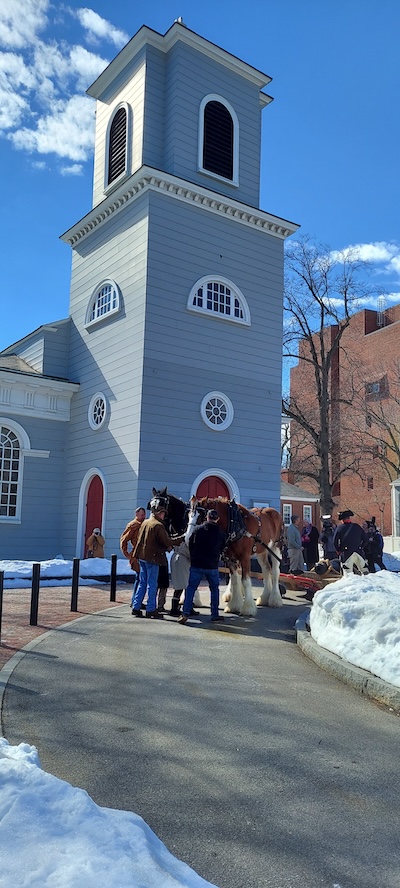
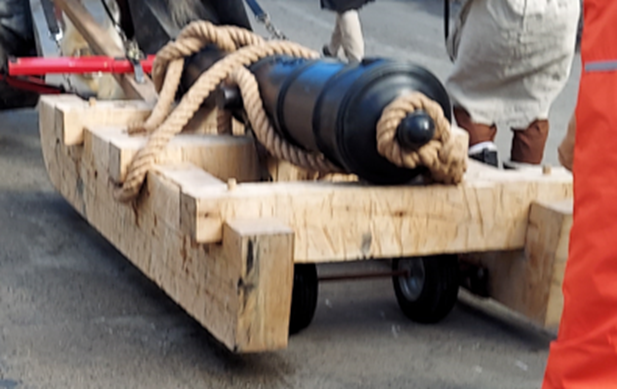
Two large Clydesdale horses were harnessed to sleds that carried the replica cannon. The sled, created by a vocational school in New York, had wheels on it so it could navigate the asphalt streets. The route between the church and the library went through the underpass near Harvard Yard escorted by Cambridge Police escorted us on foot and in cruisers.
“We went around the statue of Charles Sumner in front of Harvard Gate and down toward the underpass. They stopped traffic on that half of it,” Roach said.
The fifes and drums didn’t play through the tunnel, and Roach said the “big beautiful horses” seemed unfazed. The same could not be said for onlookers when the procession emerged from the underpass.
“We came up into daylight and Harvard students were leaning over the pedestrian walk and taking pictures with their phones,” Roach said. “And fife and drums struck up again, and proceeded about three blocks further to the library. We went inside and the horses then stood there being admired by people.”
During the two minutes she was given to speak during the ceremony, Roach made sure to mention Watertown’s big celebration during the 250th anniversary of the Revolution. On July 18, the Historical Society will host Treaty Day. While the group holds a commemoration each year, in 2026 it will be at the Mosesian Center for the Arts, and they expect hundreds of members of the St. John’s (a.k.a. Maliseet) and Mi’kmaq Tribes, the groups with which the newly created United States signed its first treaty.
Roach reminisced about another reenactment that took place half a century prior, including in Watertown.
“I went down to the end of Marshall Street and from the sidewalk took photos,” Roach said. “The group camped overnight in front of the East Junior High School now Brigham House.”
The next day, the group headed to Cambridge for a ceremony on Cambridge Common marking when the cannons were presented to George Washington. That year, they used oxen, instead of horses. Roach said at the time Knox and his compatriots rented horses or oxen from farmers along the way, whichever was available. In 1976, Roach also attended the ceremony in Cambridge, and saw how slow progress must have been two centuries earlier.
“I wanted to see what happened in Cambridge and took the street car down to Cambridge and got stuck in traffic,” Roach said.
The team of oxen took their time moving along the route.
“There was a line of cars behind it,” Roach said. “The street car driver was seething. His schedule was all shot to heck. I tried to explain that they would veer off on Brattle Street because Mt. Auburn Street had not extended at that point (in 1776).”
After getting past the slow moving animals, the streetcar sped down the route faster than Roach can ever recall. She made it to the Cambridge Common half an hour before the reenactors arrived.
This year, Roach also took in the celebrations of the final leg of the journey, starting in South Boston and going up Dorchester Heights.
“It was a bigger procession with more fife and drums, bagpipe troupes, Masons in full regalia, sailors from the U.S.S. Constitution and other reenactors,” Roach said. “There were two teams of Clydesdales, the ones I remembered and a slightly darker pair, each pulling a replica cannon. And there were four oxen, two each on yoke pulling equipment — that was impressive.”
The final section was a steep hill up to the spot where the Continental Army put up fortifications and mounted the cannons overlooking Boston. A ramp was built to allow the horses and oxen to get up the hill.
“I followed them up the hill. It was a beautiful day. It rained earlier and then sky blue and the sun came out as we came up to the top of the hill,” Roach said.
She noted that Edmund Fowle, for whom the house that now serves as the Historical Society’s headquarters, was part of a group of militia that helped bring the cannons and prebuilt fortifications up Dorchester Heights. He was joined by his brother, John.
Roach added that she was grateful that General Washington had not bombarded Boston, nor did British General John Howe burn it as the Redcoats evacuated the city, so that the historic buildings of the Hub were preserved.
Roach also provided the following account of the event:
In the winter of 1775-1776 bookseller Henry Knox and his crew hauled 60 tons of artillery from Fort Ticonderoga on Lake Champlain to Dorchester Heights, 300 miles up and down hills, over frozen (and not frozen enough) rivers across New York and Massachusetts to end the Siege of Boston. Two-hundred-and-fifty years later, communities along the original route commemorated the feat with ceremonies and re-enactments.
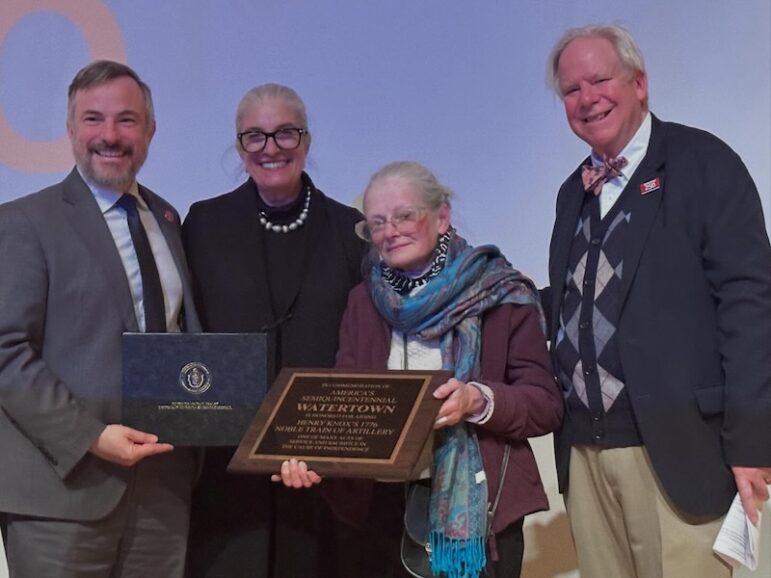
On Saturday, Feb. 28, preceded by fifes and drums, Colonial militia, and other re-enactors, a team of Clydesdales hauled a replica cannon lashed to a sled across Harvard Square to the main Cambridge Public Library. Representatives from Weston, Waltham, Watertown, and Cambridge celebrated the parts played by their respective towns and cities in the history of Knox’s trek.
Speaking for Watertown, State Representative Steve Owens delivered remarks as did Historical Society of Watertown President, Marilynne Roach.
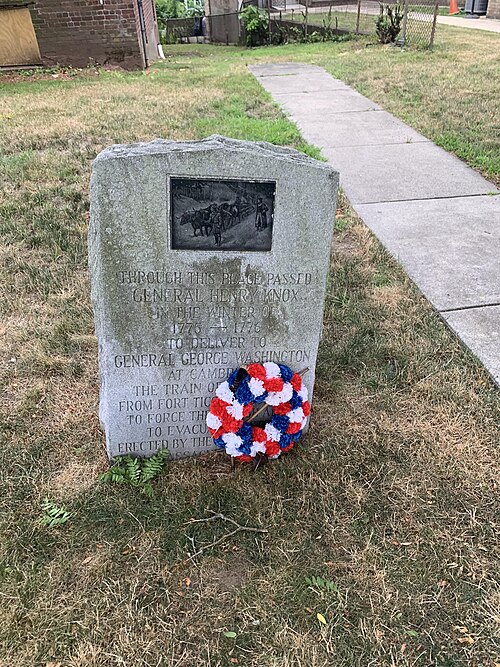
“A half-century ago I saw a reenactment with horses and oxen pass along Mt. Auburn Street, past the Knox Trail marker in front of the East Branch Library, to O’Connell Park where they camped overnight,” said Roach who accepted a plaque and citation on behalf of Watertown. Both items are now in City Hall.
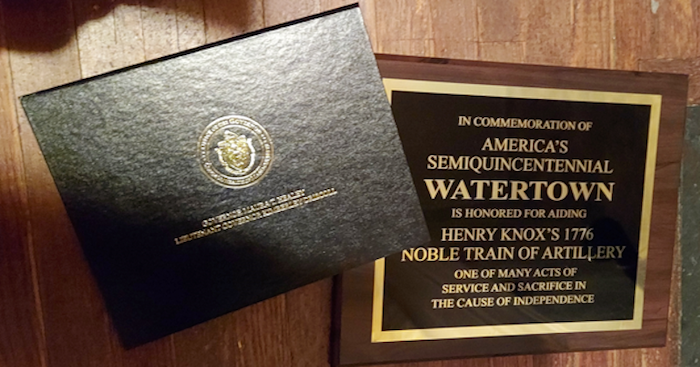
The months-long commemoration culminated on March 17th — the actual date of the first Evacuation Day — in a ceremony preceded by a larger parade in South Boston up to the summit of Dorchester Heights.
The replica sled (provided with wheels for 21st century paved travel) was hand hewn by students in the Washington-Saratoga-Warren-Hamilton-Essex Board of Cooperative Educational Services school in Saratoga Springs, New York.
Find out more about the Knox Trail and the Mass 250 events at:
Trail map: https://www.battlefields.org/learn/maps/knoxs-expedition-boston-dec-6-1775-jan-25-1776
Markers: https://en.wikipedia.org/wiki/Henry_Knox_Trail
Revolution 250: https://www.revolution250.org/250th-commemorations/knox/
Thanks, Charlie
Evacuation Day is often recalled understandably with a Boston-centric focus, but gaining Independence required years of work, sacrifice and commitment to a cause that needed thousands from every town and village near and far. We need to harness that spirit in every generation.
Marilynne Roach Deserves a plaque for a lifetime of work from our town. I feel honored to have attended your lectures in person and to be here now in Watertown. Looking forward to this June!
Thank you from a history fan who remembers the annual Minute Man patriots day parades in Lexington from 50 years ago.
Whitney Sands
Whitney Sands