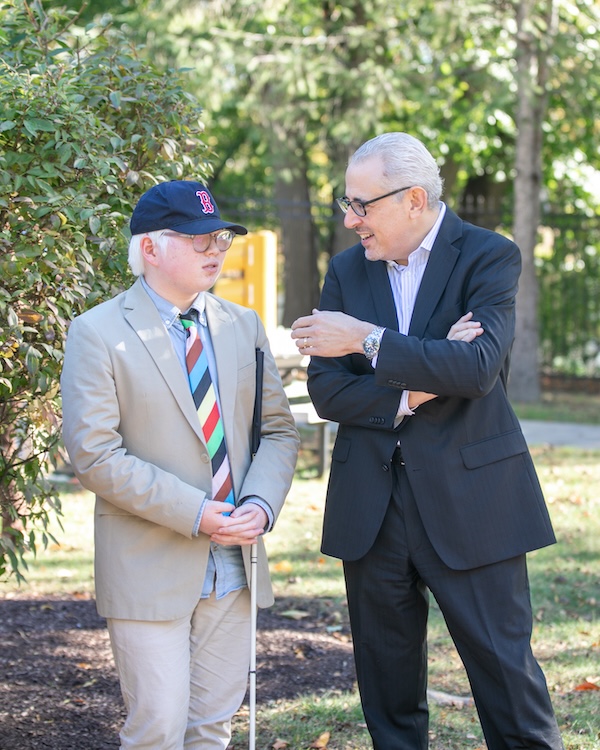
David Barth did not take the most direct route to becoming Perkins School for the Blind’s President and CEO, but he told Watertown News that the work helping some of the most vulnerable children get the education, services, and rights that they deserve is something he has done during his whole career.
Barth joined the Perkins team in September 2025, after many years working on behalf of children around the globe with the U.S. government (including USAID) and non-governmental organizations, most recently as Vice President of International Programs at Save the Children.
Barth is Perkins‘ 11th director, and he said taking over an institution with a long and storied history of work for the blind and visually impaired is an awesome responsibility.
“So this job is a privilege, because you get to conduct this orchestra of really, really, really talented people who are really, really committed,” Barth said. “It’s really hard work, so part of my job is you never want to take for granted that commitment. You want to make sure you’re creating an environment for people where they’re valued and celebrated and compensated.”
Students come to Perkins from near and far to get the services provided by the school.
“So what we do is we take the most challenging cases,” Barth said. “We take the cases where it’s a real challenge for the public schools to be able to provide a full suite of educational services because they don’t have the capacity — it can be very costly, and can be very challenging for school districts.”
While the uniting thing for students at Perkins is visual impairment, most have additional challenges.
“In terms of even very rare genetic syndromes, we probably have 20 different rare genetic syndromes that manifest in our students on campus, which we celebrate. I think this is something that’s hard for people to understand,” Barth said. “We think it’s a beautiful thing. That’s part of our diversity. You got 20 syndromes — make it 21. We will figure out a way to give that child everything we can give them because we want them to have access to high quality education.”
The school, founded in 1829 in Boston as the first school for the blind in the United States, Perkins moved to Watertown in 1913. Barth said the school continues to build on its legacy.
“When you’re anchored in a place like we are here, and you’ve got a history, it’s like those roots help that allow the tree to go strong. But I also think it’s because we’re curious people,” Barth said. “So we’re pushing on new technology. We’re always pushing on new technique. We’re always pushing on ways to think about, how do you multiply or amplify what we do? How do we reach more kids? How do we attract more people to this work?”
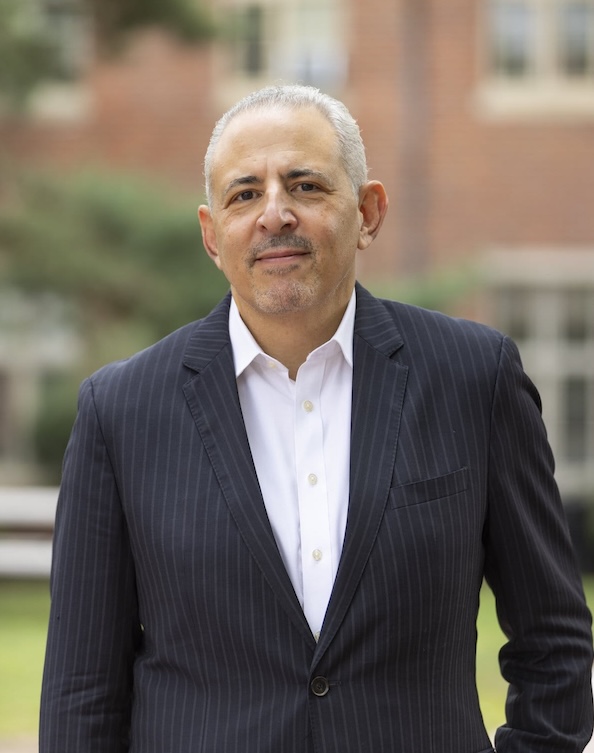
All of the 700-plus employees at Perkins support the school’s mission, Barth said.
“When we walk around here, you grab any one of these people from facilities, food service, the teachers, the medical staff, the caregivers. I don’t care who you ask, and everyone will tell you the same thing,” Barth said. “We’re here because we can give a better trajectory to these kids.”
Among those employees is Kim Charlson, the Executive Director of the Perkins Braille and Talking Book Library.
“Kim Charlson is a legendary leader and a leader here in Watertown,” Barth said. “She is the head of the Watertown Commission on Disability … and then she’s a national leader.”
Perkins’ reach spans far beyond the walls of its Watertown campus. The school works with schools and organizations around the globe. Barth estimates that Perkins’ efforts reach 2 million children worldwide.
“We have learned a lot here over 200 years, and the best thing we can do is be an asset to anybody who wants to learn more about how to care for these kids and to ourselves,” said Barth.
The overseas programs are not permanent, Barth said, and Perkins waits to be invited in.
“Whether it’s the ministry or the school districts, or it’s at the school level or its families, whoever wants to learn, we go there and we train, we train and we teach. But then, you know, we bring stuff back too. So we like to bring a lot of the world back here too, and it makes us richer,” Barth said.
In his time working internationally, Barth saw Perkins’ impact.
“I saw Perkins programming in action before this job was even open. I was working with a different organization, and I went to visit a school where Perkins had been partnering, and it kind of blew me away at the time,” Barth said. “So it’s one of the reasons why I wanted to be here again. I’m blessed. I had choices. I could have gone to other places. I’m lucky to have some choices. I wanted to be here because of it’s excellence.”
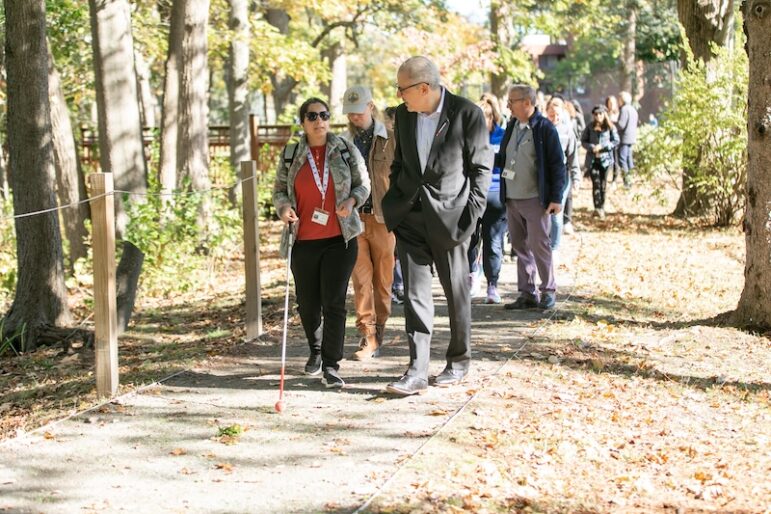
One thread running through Barth’s career is advocating for people with disabilities.
“I learned this early on, and have felt increasingly strongly about it over 30 years, that disability is a space that people are comfortable neglecting in a way that they’re less comfortable around other vulnerabilities and other other intersections,” Barth said. “That somehow we accept the disenfranchisement of people with disabilities in a way that we wouldn’t accept about other classes.”
Barth noted that disability rights activists literally had to crawl up the steps of the U.S. Capitol to demand the passage of the Americans with Disabilities Act (ADA). There are many ways to advocate, he said.
“There’s litigation and legislation and protest and but and the more subtle diplomacy of like trying to be in spaces and talking to people and reminding them right, somewhere between a quarter and a sixth of people have a disability in America, 100% of people will be touched by disability in their lives,” Barth said.
As Perkins’ bicentennial approaches, Barth wants to make sure the public knows that they are welcome on the school’s grounds.
“It’s an open campus, and we have, obviously, a security team like any other school. Kids are uniquely vulnerable in some ways, but it’s an open campus,” Barth said. “When we have people come in here, walking the dog, bringing their kids to the playground, we’re excited to see it.”
The school is planning for its 200th anniversary in 2029, which nearly coincides with Watertown’s 400th anniversary in 2030.
“We want to be able to present ourselves at that moment and say, ‘We’ve had a good 200 year run, but that’s nothing compared to what our next 100 years are gonna look like,'” Barth said