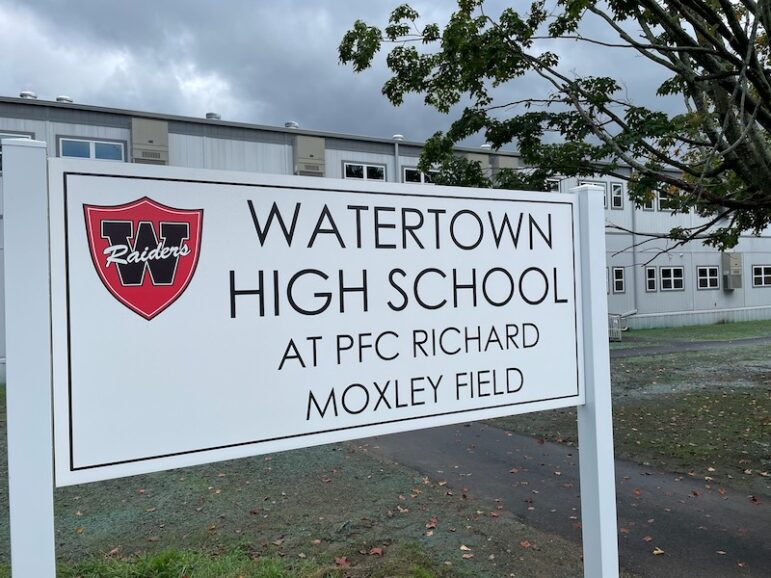
Watertown High School students, alumni, and parents of students who took part in the Armenian language program urged School officials to bolster the program for fear of losing the classes that are more than just about learning a language.
At Monday’s School Committee meeting, several people spoke about the Armenian classes, which are part of the World Language offerings at the High School. During the meeting, the School Committee also heard a report about the district’s World Language Program, a survey of what languages students and parents are interested in, and the progress of students who have been in the elementary school Spanish immersion program.
The speaker noted that the Armenian teacher recently resigned, and said that having students with four levels of proficiency in the same class is not something that other languages or subjects would have to do.
Some pointed to the Armenian classes as an important cultural asset, keeping the culture and language alive that has been threatened in years past during the Armenian Genocide and during Soviet rule of Armenia, as well as today when parts of Armenia have been under military attack.
The parents asked for at least a 0.6 FTE (full time equivalent) teaching position for the Armenian program to teach three periods, instead of the 0.4 in the budget, because it will be hard to find a person who can teach Armenian part time.
World Language Coordinator Adam Silverberg said that a candidate for the Armenian language teaching position has been interviewed and the school is in the process of hiring someone.
WHS Principal Joel Giacobozzi said he understands where the people who spoke are coming from. His grandfather came to the United States fleeing genocide in Armenia.
“So I completely and wholeheartedly agree with not only the comments about the history that involves the Genocide, but also the current atrocities that are happening in that country. We can’t forget that, and we won’t forget that,” Giacobozzi said. “With that said, we have infinite need and finite resources.”
He and Silverberg set up a meeting with representatives from the group that spoke, he said.
“We’re really discussing, listening deeply to the suggestions from the public,” Giacobozzi said. “We’re very proud of what we’re offering, and we can always do better, and we will continue to look at how we can do better in the immediate and in the future.”
World Languages Program
A survey about interest in World Language was sent out to students in grades 6-12 and parents of students in grades K-12. Currently, WHS offers Spanish, Italian, Arabic, and Armenian. The survey also asked about interest in French, Portuguese, Mandarin, Latin, and American Sign Language (ASL).
Silverberg said there was significant interest in adding French. The school previously offered that language.
“French was eliminated in my first year here as Arabic transitioned into the program, so we thought it was time to see if there were other needs or wants from the community,” Silverberg said.
Spanish is the most popular language, and Silverberg added that the Italian classes at the middle school are full, and there are six classes. The Arabic classes have dropped a bit to between 12 and 17 students per class.
The survey did not lead to any immediate changes to the World Languages program.
“We’re not necessarily recommending adding or subtracting the language,” Silverberg said. “We believe we have a solid core programming for the number of students and number of staff in our district, and I think it could be something that we look into in the future if we wanted to reintroduce French.”
With the strong interest in French, School Committee member Rachel Kay asked why the district is not starting to phase in the language. Silverberg said he could discuss that with the district, high school and middle school administration.
“I think we have robust offerings right now, and my fear would be if we were to add a language, would it hurt the other languages?” Silverberg said. “It’s by all means worth looking into, and seeing if there would be a desire.”
School Committee Chair Kendra Foley said she would not want the school to jump into a decision because it could have other impacts.
“This is one good data point. Certainly, I don’t want to make decisions based on one good data point. And we’re a small school, and sometimes we have to decide, make trade-offs, and so it’s already hard,” Foley said. “I know scheduling is very hard when you have small groups, and so if we were going to take a look at different options, there may be a need to phase things out if you add new things in.”
Silverberg also discussed the progress of students who started learning Spanish language in elementary school, which begins in kindergarten in the Watertown Public Schools. The first set of students reached the ninth grade, and tested at an intermediate range of proficiency in Spanish. Those scores were higher than ninth-graders in the Italian and Arabic classes.
Watertown High School students can earn a Seal of Biliteracy, and an average of 20% of students receive that honor each year, Silverberg said. In 2026, 37 students, which was 20% of the seniors, earned the Seal of Biliteracy.
See the slides from the World Languages update by clicking here.
While I appreciate your article, I want to clarify that 0.4 is less than part-time, merely 2 hrs scattered on a rotating schedule. Reducing Armenian to a single Class for 20+ years with all mixed levels (and Counselors deterring enrollment) has been a growth barrier and inequitable practices both for students and teacher. Last year we fought for the addition of a 2nd Class and Level IV and Honors was reinstated. We now ask for 0.6 FTE and a 3rd class for sustainability and equitable treatment and restructuring to re-instate Armenian Language in Middle School. The artificial barriers must be removed to allow for a Full Pathway Language Program as others. From 2023 to 2026 the Program has proven growth, interest, capability and potential (with even non-Armenian enrollment), matching Arabic numbers.
Another correction, due to Ethnic Cleansing, Wars, turmoil and political unrest across the globe there has been dismantling of many long-standing Armenian Communities in many Countries (not just in Artsakh/Armenia). Watertown continues to be the epicenter of the Greater Boston Armenian Community.
What is the average number of students in a language class? I was surprised by the Immersion class results, if starting in Kindergarten, and test results show intermediate range of proficiency by grade 9. It seems learning is cumulative and children should be beyond an intermediate phase of proficiency.
The elementary school program is not a full immersion (I corrected that) but they begin taking regular Spanish language lessons in kindergarten.