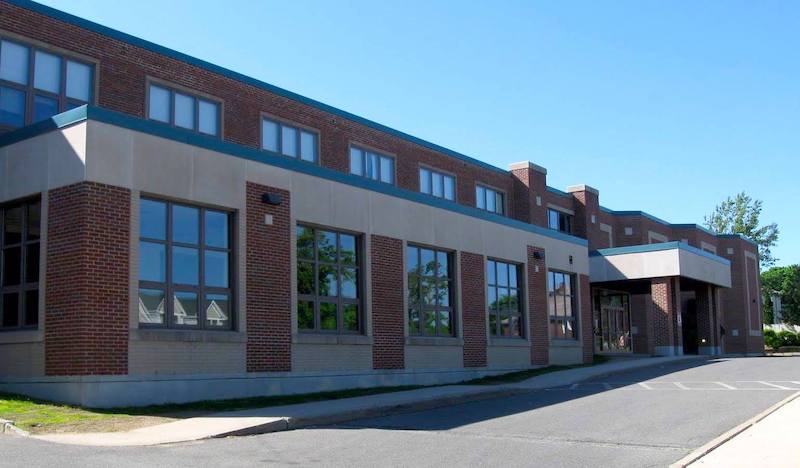
The City Council drilled down on what factors would determine whether to do a full renovation/rebuild of Watertown Middle School, or to do more basic repairs now and a bigger project later. After more than two hours of deliberation on Tuesday night Councilors had not made a decision and some key questions remain unanswered.
The City Council heard from City and school officials, as well as Watertown’s project management firm for school building projects. City Manager George Proakis outlined the financial implications of each option, and some of the hurdles that lay in the paths of even the lowest cost options.
In 2024, the City Council had a similar discussion, and decided to make a new Middle School a priority. However, that decision was based on the project costing $87 million, which could have been covered with $70 million in borrowing, and $17 million from reserves set aside for the schools plus money saved from planned maintenance projects at WMS.
Earlier this year, an architectural study found that the figure would be around $112 million, which would stretch the City’s ability to borrow money, and push off projects such as a new Senior Center and improvements in Watertown Square. If more tax revenues were available, that could reduce the reliance on borrowing, Proakis told the Council.
He added that in past years the City has received additional tax dollars from new developments, particularly in the life science industry. The market for those projects has slowed and he would not want to count on those to happen. In addition, borrowing $95 million, rather than the original $70 million, would be “tough on the Fiscal Year 2029 budget” and also have a significant impact on the City’s FY 2030 and FY 2031 budgets.
Another reason for the Council’s decision in 2024 was because the schools have the option of using the modular classrooms installed on Moxley Field for the construction of Watertown High School. That project is expected to be finished in the spring of 2026, and the temporary classrooms would be available for the middle school after that. The City, however, does not own the modulars and pays about $136,000 a month to lease.
The basic renovations option would cost between $13 million and $27 million, said Christy Murphy from Vertex, Watertown’s owner’s project management firm for the High School project who put together figures for the Middle School project. The work would include significant improvements to the main entrance area, upgrading and replacing elevators, and a new roof with solar upgrades.
The reason for the spread in cost, Murphy said, is that there is a limit for how much the City could spend on the project before hitting the threshold that would trigger bringing the entire school up to ADA accessibility for disabled people. The estimate would be $27 million, Murphy said. Proakis said that the number is based on 30 percent of the assessed value of the property, and the City would need a more exact number to figure that out. The number is calculated over a 36 month period, Murphy said, and if the cost would exceed it the City could delay some of the work.
Councilor John Gannon asked why the School would not be made ADA accessible, saying that it is a civil right. He also worried whether the state’s Architectural Access Board would provide a waiver for Watertown if the work did not make the building accessible. City Council President Mark Sideris said that proposed improvements to the entryway would significantly improve the accessibility and safety for all students.
Councilors asked Superintendent Dede Galdston what the difference would be between basic repairs and a total renovation or rebuild. She said the old part of the building, constructed in 1922, was built for a model of education where students all listened to a teacher in the front of the room. In 21st Century education, however, often breaks students into smaller groups, and the current rooms are small and not flexible so are not conducive to that type of learning.
If a new school is not an option, Galdston said the teachers and staff would do the most with the current school. She noted that that students attending the new elementary schools have shown leaps in progress.
“I think that the feeling of innovation and joy; I think as you walk through the building, ya you can go to school and you can learn — that’s going to happen because we have great teachers and kids that are eager to learn,” Galdston said. “We don’t have that real sense that we are going to see at the high school and that we see in our elementary schools with innovation and joy. So, I don’t know how to quantify that in a building project but I can tell you that is something that is missing without an actual new building.”
She added that students going to the two new elementary schools have shown dramatic improvement on statewide assessments. In 2022 Cunniff Elementary School was ranked in the 41st percentile and in 2025 the school is in the 73rd percentile; while Hosmer Elementary School was in the 53rd percentile in 2022, and in 2025 is in the 72nd percentile, Galdston said.
Galdston added that after the basic renovations, the Middle School would not be up to the standards of the new elementary schools and the new high school.
“I would say right now we need a new school, but will this buy us a little more time, sure. I don’t know educationally what this is going to buy us. It is going to buy us a better learning environment, it is going to buy us some more cheer — the kids, they will feel more joy going into a building that feels like a good solid renovation,” she said. “But, I don’t think educationally we are getting what a new building would be. So, I would say as soon as it is actually possible — if this is what we do — I’m the one that would advocate start planning now for when you actually want to do your new middle school. Start thinking about MSBA and all the things that would get you there, but I would not wait too long.”
Watertown received reimbursement to cover a large portion of the High School project, but Proakis said he is not sure when Watertown would qualify for another state-aided project.
The full rebuild or renovation would create a school designed for 630 students. Currently the school has just under 600 students. The design could accommodate up to 650 students, Murphy said, because the classrooms would be about 850 sq. ft., as opposed to about 600 sq. ft. now.
Council Vice President Vincent Piccirilli said the last time Watertown did an enrollment study was in 2017, and he said it might be good to do a new one that accounts for larger enrollment in the elementary schools in recent years and other changes in town.
Sideris ended the discussion after more than two hours and said there are some questions that need to be answered.
“There’s a couple more pieces of information that we want to provide the City Council. One in particular is, what is the assessed value and what kind of repairs are going to trigger this request for a waiver (from ADA requirements)?” he said. “That’s an important piece of what we’re talking about, because if we’re going to spend any money, we need to know that information.”
He added that Murphy will be looking into more options in regards to the modular classrooms, and report back.
Other concerns arose for Sideris, including what is the best value for the money, whether the City can handle the impact on the budget in FY 2029, and how to balance other priorities.
“Our challenge right now is how do we balance the needs of the school with the needs of everything else that is going on in the Capital Improvement Plan?” he said. “So there’s a lot to be determined.”
Sideris wanted to give the Council more time to think about how to proceed.
We need a new or fully renovated Middle School. The temporary classrooms are there. Costs will only go up the longer this is delayed. Part of the current school is over 100 years old and our schools are the future.
Speaking as a senior citizen and lifelong resident, the Senior Center and Square improvements can wait.
In “normal” times I’d be a Yes. However, I am a No this time. We are probably looking at a horizon of 5 yrs because if administrations change in 3, then we will need to 2 to ramp up. Right now, there is no money for big projects. Enough for a slew of small to medium but not for big. Not only is the money not there, borrowing at this time would put Watertown in a precarious situation, when it doesn’t need to be. Tomorrow, the Commonwealth loses a stream of $200 million/month from SNAP. This impacts 9% of veterans, 26% of elderly, 31% of persons with disabilities and 32% of children. Couple this with the layoffs that began in 2024 and continue (https://intellizence.com/insights/layoff-downsizing/major-companies-that-announced-mass-layoffs/), and things look a lot less positive.
We are already looking at, I believe, a 6% hike in property taxes if the State Legislature passes the home rule petition. Otherwise, the average may be 18%. How are resident suppose to save a rainy day to hedge off layoffs to clothes, feed and house their families, given this?
What about overruns? Prior to the pandemic, overruns occurred less and ran about 10-20 million. Some schools that have been built in this area since have seen 30-40 million in overruns. Per Bloomberg News, the new prices are not going away. These are very sticky prices. At 3 to 3.5%, other prices, like wage need to still catch up. I was running risk matrices in ChatGPT during the meeting – what is the likelihood and impact of overruns, right now, for School Building in the cities/towns outside of Boston, like Watertown and Burlington. Answer, high likelihood (4) and medium to high severity (3.5).
I really appreciated Superintendent Gladstone’s analysis and forthrightness. If it came down to a new school or a partially renovated one, plus the cost of updated pods, then she’d wait for the new school. It would be amazing to cluster students in pods and have more elbow room and in the halls of a shiny new building. My friend reminded me that student scores have gone up with new buildings, but the district also hired more teaches, aides, and staff. I don’t think that a new building could replace the loss of a teacher or housing.
In “Excluded: How Snob Zoning, NIMBYism, and Class Bias Build the Walls We Don’t See,” Richard Kahlenberg, highlights research on how a person’s neighborhood profoundly affects their life opportunities and outcomes more than access to high quality schools, lower crime rates, and social capital. A school in a wealthier town where there is no community and no watching out for children, is not as good as the school in a similar but less wealthier town where there their is stability, community and nuturing.
Even better is a community,where the council has enough financial scruples to know a new school, right now, is a forced error.