
A former industrial site where the U.S. Army burned and stabilized depleted uranium has been cleaned up and turned into a park at the intersection of Arsenal Street and Greenough Boulevard. State officials now want to know what features residents want to see in the passive recreation space.
On Nov. 19, the Department of Recreation and Conservation held a meeting about conceptual plans for site improvements to the former GSA Site.
“The project goals include creating a safe and welcoming passive park with trails and seating areas, connections to regional bike and pedestrian networks with safe access on Arsenal Street, universally accessible parking and pathways, nature-based stormwater management, landscape restoration including diverse vegetation, invasive species management, and improvements to site amenities and signage,” the meeting announcement said. “The improvements will enhance public access while preserving the site’s ecological features and mitigation performance.”
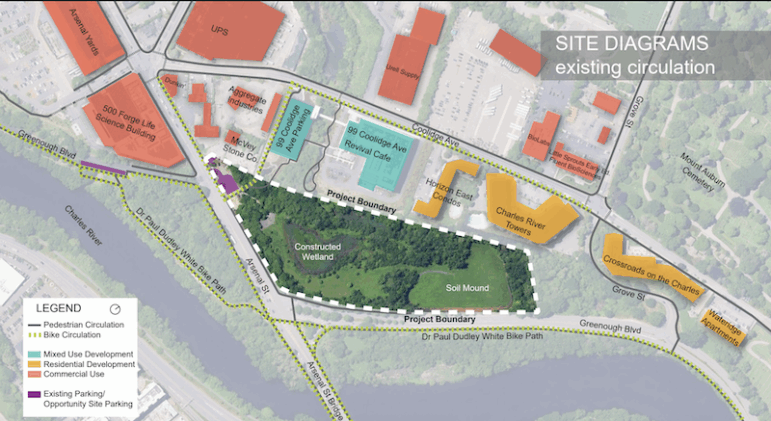
From 2012-14, the Army Corps of Engineers removed the most contaminated soil from the site, and covered the soils with lower levels of PCBs with a cap and dirt, forming a mound.
The park has been approved for passive uses, including walking, sitting on benches, or nature watching. More active recreation, such as sports or a playground are not allowed.
The proposal includes adding pathways around the site, a bike path through the area linking the Watertown-Cambridge Greenway to the Charles River, as well as a sensory pathway to make it accessible to the visually impaired. Signage about the history of the site have also been proposed.
The public will be invited to provide comments on the future of the park. The presentation will be available for viewing by clicking here. The deadline for receipt of comments by DCR of December 3, 2025. Comments may be submitted via the DCR public comment portal.
See the slides from the DCR’s presentation, click here.
View the video of the Nov. 19 meeting here.
What an incredible opportunity. From depleted uranium burn site to nature trails; PCBs to passive parkland. I applaud every suggestion, and would even add one: is there any way this project could include the environmental open wound of Sawins Pond? It abuts the GSA site, and suffered from the same ecological abuse. Let me rephrase my question as a strong suggestion: include Sawins Pond in the remediation. A toxic superfund site in a thriving part of town is an appalling anachronism and a shame upon our city.
Sawins Pond is not owned by DCR. The remediation to the former GSA site is completed; this project will develop that site into a park.
I repeat my question and my strong suggestion: Sawins Pond abuts the GSA land, and has been a blight for decades. I get why they haven’t; I don’t get why they can’t. It’s a terrific project as is, but it leaves a disgusting eyesore, hard by, as is. So close, and yet so far.
Again, it’s not a DCR property and the remediation to the GSA site has already been completed. It’s unlikely that there will be any federal funding for such a project given the state of things in Washington.
I seriously question Slide 13 which says –
In 1920, the US Department of War acquires
13 acres of land from MDC to expand the
Watertown Arsenal.
During WWII, the site was used by the
Army to store materials and equipment. A
concrete pad was constructed for burning
and stabilizing depleted uranium prior to
offsite disposal.
The second paragraph makes no sense. There was no depleted uranium in WW-II. All of the Uranium-238 was required to produce Plutonium-239. They may have burned 105mm main gun depleted uranium kinetic energy penetrator rounds where the explosive propellant burned and the penetrator then was disposed of as depleted uranium, but that would have been done after the 1991 Gulf War. The public should not be told that something happened in the 1940s when it didn’t. I have been researching depleted uranium since 2004 and still maintain a Google Alert that I long ago thought I would no longer need. Depleted uranium kinetic energy penetrator rounds are cannon fired and principally used to destroy enemy tanks. The US has not done that since the 2003 Operation Iraqi Freedom began, The 105mm main gun round was phased out after the 1991 Gulf War because the M-48 tank that fired them was replaced by the M1 Abrams Tank.