By Mark Pickering
MBTA service in Watertown has been in decline for years – even as neighboring communities have seen theirs maintained or even improved. Watertown has the worst MBTA service of any community bordering it and all of Boston’s neighborhoods.
One of the latest blows is the elimination of the so-called “Express” bus to South Station. The result: It took me and hour and a half to get to my former Boston Herald offices in the Seaport. And the single-fare rate for this terrible service is a bloated $4.25.
Elsewhere, the T has built or added to its subway and train lines, stations and dedicated bus lanes. A wildly successful example of this is the $2.3 billion Green Line Extension through Somerville and on to Medford.
Watertown’s poor service is noted, indirectly, by the recent MBTA Communities Act. The city is put into the “adjacent” category for the new zoning requirements. That’s because the city lacks modern public transit — some variety of subway, trolley or train
service.
The neglect comes despite steady growth that saw Watertown top 35,000 residents in 2024. In addition, the city has emerged as another hub for the region’s leading industry, life sciences. On top of that, the lack of a central MBTA station in Watertown Square makes it hard to make bus connections.
Not to mention that the old Green Line trolley and its Watertown Square station were both cut out in 1969. Not that the old setup there was good, but the T has failed since then to provide modern services.
The overall situation: Watertown is not well connected with the MBTA system. Looking into recent history, the old Green Line trolley and its Watertown Square station were both shut down in 1969. The old setup was not great, but the T has failed since then to provide modern services to Watertown, despite its proximity to Greater Boston’s urban core.
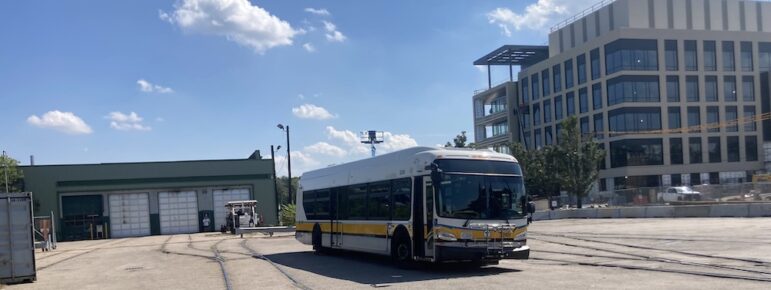
Now, I’m quite familiar with the Watertown Yard and its old car barn. For several years I commuted to Boston’s Seaport for work. So, on a recent rush-hour Wednesday, I tested out the latest setup, which eliminates my old “Express” bus route.
There are numerous reasons why the service was so bad. One problem: Extra walking time is created when bus stops for different routes are blocks away from each other. Also, my former pre-pandemic MBTA route, which took me directly to the South Station area. The new route goes first to Copley Square and then takes city streets to even get near to South Station.
The overall transit challenge: Trip involves numerous buses and walking around from one stop to another. These all add in extra time.
My recent “commute” officially began at a bus stop near me.
• 8:15 a.m.: Waited for the No. 70 bus, which did not arrive as hoped for.
• 8:30 a.m.: Boarded the No. 70 headed east on Main Street.
• 8:37: Exited bus at the Watertown Square bus stop (north side of the Charles River), walked a couple blocks to the T’s bus turnout, then through the Square’s wild intersection and past the forlorn car barn. There was still more walking in order to get to where the buses now stop.
• 8:47: Boarded 504 (south side of river).
• 9:25: Got off the 504 and walked the needed blocks to South Station.
• 9:30 Took Silver Line to Seaport.
• 9:45: Arrived at a former workplace.
To add insult to injury, a rider looking to get to the Seaport on the so-called 504 “Express” bus pays significantly more than those taking either a subway or “Local” bus.
The 504’s one-way cost ($4.25) is two and one-half times what a “Local” one charges ($1.70).
When taking the Red Line from Alewife Station to South Station, a commuter only pays $2.40, significantly less than the “Express” bus. And the distance from Alewife to South Station is estimated as just a bit longer than from Watertown.
That means that Watertown riders headed to the Seaport pay more and get less than Red Line riders from Cambridge.
The T’s press office said the agency is “currently evaluating MBTA bus and operational needs” for the Watertown Yard and its former car barn. The T’s website says the agency is “transforming our bus network with updated routes, more frequent service, and better transfer connections.”
Mark Pickering is a veteran of the local news business, having worked on the business desk and the opinion pages of the Boston Herald.
Thanks for the report, even if many of us are hardly shocked by the news. Most of my commuting is on the No. 71, to or from Harvard Square. At about 3.5 miles, it must be one of the shorter routes in the MBTA system. When it’s on time, it’s a dream. More often, however, it’s a nightmare. As we add to the population density of Watertown Square, without an equal expansion of automobiles, more people will be more reliant on all bus routes than ever. Phillip Eng has notably and heroically made the trains run on time. Buses will take a lot more “evaluating”, and a lot more buses. We have no trains, so it’s buses or cars for us. MBTA’s call. We’re used to waiting the odd half hour or two—unhappy, but inured—but not five years. Sooner would be nice.
Reminder to sign comments with your full name.
why would you not take the 70 all the way to central, red line to south station, and then silver line to seaport? you added about 30 minutes to your trip and added extra walking / waiting on the bus.
Thank you, Mark. I agree with all your points. I commute to Back Bay or the MFA on a weekly basis and it’s a 1.5 hour commute for me as well. I don’t even try with the 70 bus anymore and walk 20 minutes to Watertown Yard (when the river path is not covered in snow and ice). Then it’s a series of transfers plus walking to patch together an MBTA route. We are definitely underserved and the new housing being erected will exacerbate the situation. Will Brownsberger – we need some MBTA advocacy here. Bicycles are not the answer for commuting into Boston.
Reminder comments must be signed with your full name.