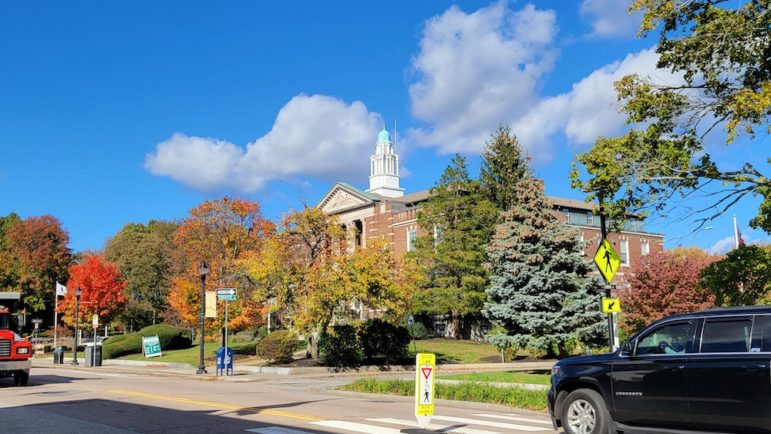
Photo by Charlie Breitrose Watertown City Hall
Despite uncertain economic times, Watertown’s Fiscal Year 2027 budget will maintain the City’s program and staffing from the current year, but keeps staffing “headcount neutral.” The City will be in better shape than many communities in the area, City Manager George Proakis told the City Council on Tuesday night.
Proakis presented the Fiscal Year 2027 Watertown Budget, which totals $226,212,930. The budget is 0.43% less than the revised FY26 budget. Pulling out of the other financial uses line (that includes using “free cash”) which fluctuates by year, the increase from FY26 to FY27 is 6.8%.
The FY27 budget kept the City staff and programs predominantly the same as the current year. Proakis said Watertown remains in better shape than many communities in Massachusetts. Many are seeking overrides or must make deep cuts into programs and staff.
“My primary responsibility has been to build a budget that reflects our community values and policy goals, but also to provide a long term strategy with strong budget fundamentals,” Proakis said. “That’s become more difficult with uncertainty, but we have the strong fundamentals, and we have the growth of some of our larger neighbors, but we run with a smaller, leaner staff for our size. And one thing that I remain focused on is ensuring we don’t lose flexibility.”
Uncertainties and Fluctuations
Watertown’s budget faces some uncertainties due to a number of factors, the foremost of which is the Home Rule Petition from the legislature asking to allow the City to shift tax burden from the residential to commercial and industrial properties. If it does not pass, residential taxes could increase more than 18 percent.
“We really need this Home Rule to pass, and I know our delegation is working hard to do this,” Proakis said.
If it does not pass, Proakis said the City will likely have to dip into stabilization funds that were set aside for projects like the Middle School and the Senior Center.
“If the Home Rule does not pass, and by October, November, we want to provide tax relief to our residential taxpayers, we’re going to have to do something that will impact our ability to hold on to those sort of stabilization funds, which is going to be very tricky,” Proakis said. “But my number one strategy right now is working with the Legislature to try to get this Home Rule to pass.”
Other areas that could fluctuate include a slowing of the growth in the life science industry, impacts of federal policies (including tariffs, international instability, and federal support of industries including life science).
An unexpected increase comes in the City’s pensions, which came in higher than projected.
“The actuarial consultant that works for the Retirement Board informed the City that essentially what we did is we filled our vacant positions faster and with more qualified individuals over the previous 18 months than he expected us to when he put together our numbers last year,” Proakis said. “Essentially, we outperformed the assumptions in their model.”
Proakis said this is due to filling long vacant openings in the Police and Public Works departments, sometimes with experienced people. The Police took the officers out of the Civil Service System, which allowed the WPD to hire transfers from non-Civil Service departments.
The City will allocate $12 million on pensions, which is about $8 million more than projected last year. The OPEB (other post employment benefits) will be nearly $2 million below the estimates, Proakis added.
“After much consideration, even though there was a suggestion that we could continue to spread the pension cost over multiple years, the auditor, and we the Manager’s office all felt it was best to fully fund the pension this fiscal year with one large payment and be done with this, because I do not want to slide back from a fully funded pension system,” Proakis said.
The wide fluctuations in the projections frustrated City Auditor Megan Langan and Proakis, who both agreed that an outside auditing firm should review the actuarial data to try to make the predictions more accurate.
The City faces higher than projected increases in energy costs, 30%, which officials are trying to fight.
“This is a particularly frustrating situation for us, because we signed a fixed-price contract with them, and we believe they are using a loophole in their legal language to try to push a 30% increase on us,” Proakis said. “We have filed a complaint and a request for arbitration with the Department of Public Utilities on this. But to be conservative and careful, we’ve budgeted the costs, including the 30% increase.” if we’re successful in our appeal,”
In a piece of good news, the City’s liability insurance and workers comp insurance costs are down even, despite the City’s health insurance costs going up. Proakis said the City worked very closely with the insurance company to make sure to minimize risk which resulted in the drop in cost.
Projects, Programs and Positions
The budget includes planning for replacing Watertown Middle School. Borrowing for the project has been built into the debt service line of the City’s budget, Proakis said.
“As you know, the most recent cost estimate that we had was $112 million when we started out looking for a project that was smaller than that, the capital improvement plan allowed for $98 million in borrowing for the project, which we anticipate,” Proakis said. “The rest can be covered with stabilization that we have put together.”
In FY27, the City will conduct a feasibility study for a new Senior Center. In future years, the City will work on replacing the East End Fire Station and finding a staging area for the DPW.
In a change to how budgets are created, Proakis said the City will set aside money from Free Cash to cover the cost of items in the City’s Capital Improvement Plan (CIP) to be funded with tax revenue. In FY27, that amount is $3.8 million, and Proakis said the City will keep the figure below $4 million so the City can also keep reserves at the expected levels. The move will also make the budget making process more predicable, Proakis said.
Proakis said the budget is “neutral head count.” There were some additions to the the City staff and some other funding requests, but some positions were combined or eliminated, such a two custodial positions, eliminating the network manager position, and eliminating the unfilled DPW administrative assistant position.
Budget requests filled in the budget for different departments include:
Police:
○ $67,000 for new in-cruiser video system. Expected to reduce to $32,000 in future years.
○ $49,396 for annual operating costs of a new drone that will enhance officer safety and aid in crime scene documentation and searches for missing individuals.
○ $29,691 for cell service for body-worn cameras.
○ $15,480 for BlueVoice, a closed-loop AI tool to support officers inquiring about MGL and department policies
Senior Services:
○ $19,184 for additional hours for bus drivers to operate a second van.
○ Additional $18,000 for Transportation Concierge program.
○ New full-time Administrative Assistant.
Human Resources:
○ $20,000 for unique professional development opportunities for City staff.
○ $3,000 for trial program to provide City staff with BlueBikes passes.
Information Technology:
○ $225,000 to move MUNIS into the cloud.
DPW:
○ Increase DPW Communications Coordinator position from part-time to full-time.
○ New Urban Forestry Heavy Equipment Operator.
Human Services:
○ New full-time Principal Department Assistant.
Library:
○ Increases part-time Hatch Assistant to full-time.
○ Increases part-time Reference Librarian to full-time.
Recreation:
○ Two summer interns to serve as Lead Counselors for parks program.
See the slides from the City Manager’s Fiscal Year 2027 Budget by clicking here. For the detailed FY27 budget, click here. The Budget Document Center can be seen here.