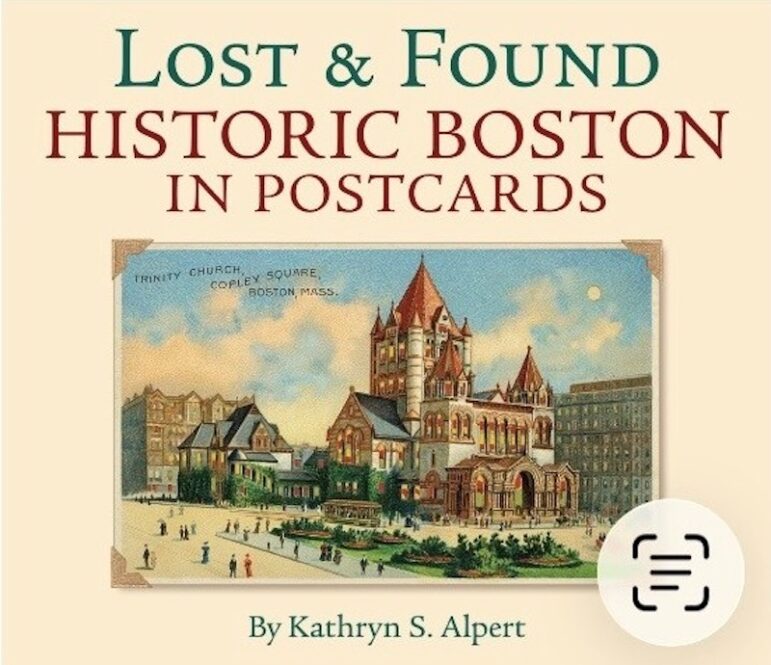
With a collection of tens of thousands of historic post cards, Watertown’s Kathryn Alpert had a wealth of choices for her new book “Lost & Found: Historic Boston in Post Cards.” Watertown News spoke with Alpert about the creation of her book.
Alpert worked in public relations for years, and was able to get a piece about one of her biggest clients, Tweeter, on the front page of the Wall Street Journal in the 1990s. Then she started a greeting card company in the early 2000s. She is also a member of the Ephemera Society, which focuses on historic items, mostly paper items.
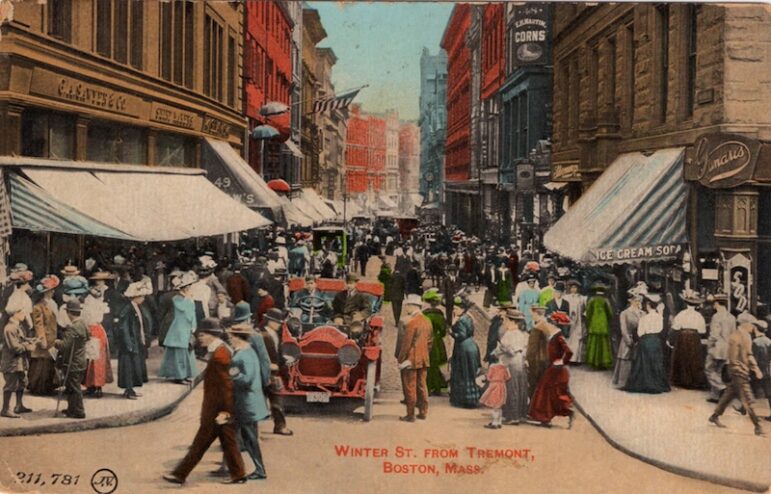
Her 206-page softcover book contains more than two-hundred colorful vintage postcards of historic Boston. Each image has a caption with historical information. Alpert had to put together the book in just a few months so that she could present it at the World Expo Boston 2026 at Boston’s Convention Center in the Seaport this past Memorial Day Weekend.

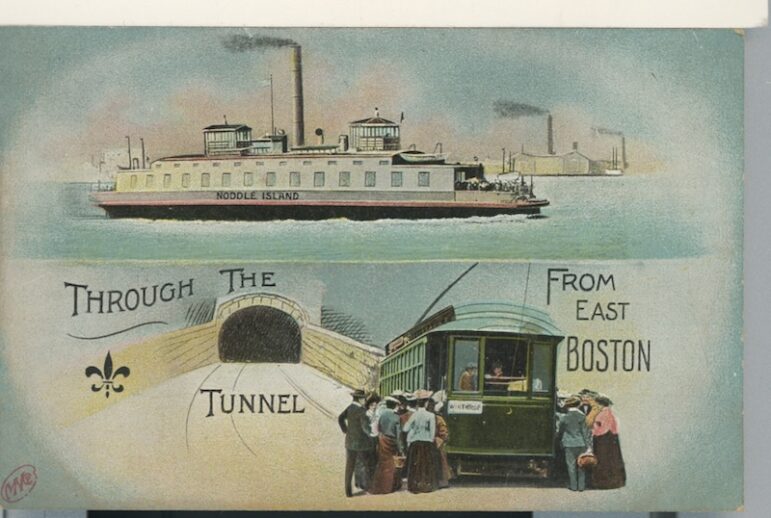
The book has sections focused on different sections of Boston: Beacon Hill, the Back Bay, Copley Square, and even the Charles River. Other chapters look at transit, maritime, restaurants, merchants, and beyond Boston. Select images have markings showing that they are part of either the Freedom Trail or the Emerald Necklace.
The Q&A
Watertown News: How long have you been working on this? It seems like it might be kind of intense.
Kathryn Alpert: It only took me about six months to write that book. I found out I had an opportunity to sell it at that Expo, so I said, “Okay, I’m going to do this,” and I spent the entire winter season just working on the book. I didn’t really do much else. … I didn’t have time to find an outside publisher. I found a printer that’s right down in Braintree, that was able to print the book and did a really good job.
WN: Have you done historical type books in the past?
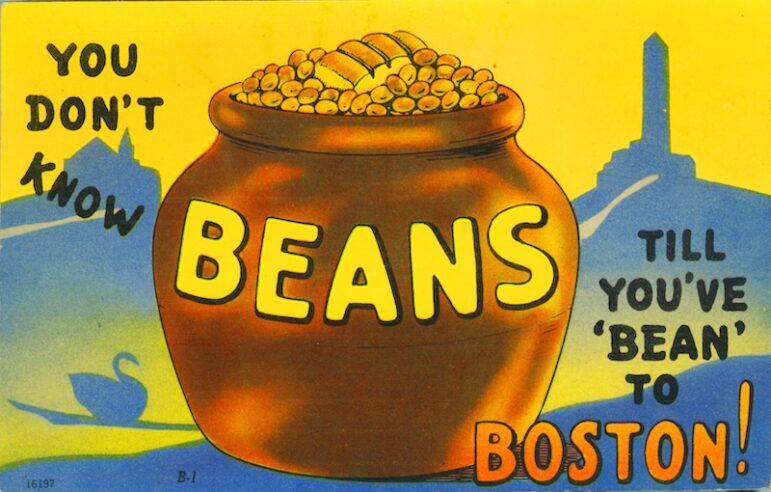
KA: No, but I did have a line of greeting cards about 25 years ago. I started a company called Postmark Press, and they were reproductions of vintage postcards as greeting cards, and they were sold in 500 stores across the United States. This could have been a card, because they’re really cute images from cats, dogs, bathing beauties, people carousing as they did back then with cocktails and things like that.
So that was fun, and then I put the message, because they have messages on the back of the cards … because when you first had postcards, you were not allowed to write a message on the back of the card. There was only room for the name and address of the person that was receiving a card. But as time went on, people were complaining, and they wanted to write a message, so they made room for the message. So that was in about 1907, 1908 and that’s when the golden age of postcards really took place. I mean, it was between then and the beginning of the First World War. There were literally billions of postcards exchanged. It was like the internet.
WN: Wow, oh my gosh. Did you always collect these?
KA: Yeah, when I was, when I was a kid, I found them, and my grandfather had a house in New Hampshire, and a farmhouse, and there was a barn attached. And on a rainy summer day, I went in there one day and discovered these postcards, and they had mysterious people and places, and there’s so many different kinds. I get phone calls from people sometimes that have these postcards that they want to get rid of, really cool postcards, but they’ve had them, and because I have this postcard club.
WN: How many do you think you have in your collection?
KA: Oh, I don’t know. I might have like 40,000 postcards, but I’m trying to reduce the number. What I’m trying to do is reduce the number of categories. I have about 200 categories.
WN: When you decided to do this book, first of all, how many are in the book? And how did you wean that down tot that number?
KA: Well, I have about maybe 1,200, 1,500 Boston postcards, and I didn’t have them all before I started working on the book. It gave me a reason to go out and find more, and so I found some at my postcard show. And then there’s actually a store outside of Harvard Square called Ward Maps. It’s on Mass. Ave., and he started out doing maps and products for the MBTA, and he’s doing all kinds of really interesting things in that store. He sells originals and copies, and he started selling postcards of Boston there. So I went in there, and I found I was able to fill in some gaps. There aren’t a lot of stores around the Boston area that actually sell old postcards, that’s why I created the New England Postcard Club, so that we’d have a place to go and buy and sell postcards.
WN: Where do you hold your events?
KA: Spellman Museum in Weston. The Spellman Museum of Stamps and Postal History. We’ve been doing it for three years now. We first went out there, they never really cared about postcards — the postal history community. They didn’t really think of them because they are focused on stamps. They were called penny postcards, it only cost a penny to mail them, so they always had that same stamp, I think it’s Benjamin Franklin — the green stamp on there. So, if they’re looking for stamps, they’re not going to look for postcards, because they’re all going to have the same stamp on it, but they have the postmarks from dead letter offices, and they have cancels, and there are things that postcards have that are of interest, too. They look at the other side of the postcard, the people from the postal history community.
WN: How did the book come about?
KA: I mentioned it to my friend, who’s the executive director of the Spellman Museum, his name is Brian Howard. It’s because of Brian that we actually have the club because he just came in and he wanted to make some changes and he thought it would be great to invite us to come in, and it has all worked out really well.
I was telling him about this book that I was working on, because I had already come up with the idea of writing the book, and the head of the the board of directors of the Spellman Museum heard about it and said, “Why don’t you arrange for her to sell these at the at the Expo?” There was this big expo Memorial Day weekend for the 250th birthday of the United States, and the show only takes place in the United States once every 10 years. Next year it’ll be in Prague. Ten years ago it was at the Javits Center in New York. This is a big deal, and they had asked all of the people who were coming, what do you collect, and a lot of the people said they collected postcards. They thought the book would be interesting, so they said, “Will you sell the book at the show?” So then I had no choice but to finish it. I had, what, six, seven months, eight months, whatever it was, and I got it done. I had the chance to debut it at that big event, which was very exciting.
WN: Did you have a presentation at the expo?
KA: I did a big presentation at the Expo, and I’m going to be doing another one at the West End Museum (on July 8), and another one at the Spellman Museum (on Sept. 12), and probably one at the (Watertown) Library for the Historical Society of Watertown. The Watertown Historical Society people came to the show, and they asked me if I would do something.
WN: How long have you been in Watertown?
Since the ’80s. I moved into the building that overlooks the Charles River. Beautiful. I mean, they actually used the view from my apartment as the cover for the Watertown Economic Development brochure in the early ’90s. I did a lot of work here in Watertown when I first moved here, and I had a PR business, and I worked on the brochure for the Economic Development thing. And I worked on the book, “The Images of America: History of Watertown,” the one that has the Calvin Coolidge on the cover. I was so disappointed that they chose that cover, because I really wanted them to have the cover of Star Market that had the grocer standing out in front, wearing an apron, and chickens hanging down from the front of the store, but they picked Calvin Coolidge instead.
WN: Did you get any Watertown ones in (the Boston postcard book), or is it strictly the City of Boston?
KA: Actually, I didn’t get Watertown, but I got Waltham in there, because I have a Beyond Boston, and I had a section where I happen to have a factory women (postcard). This shows factory workers in Fall River, and this shows them in Waltham.
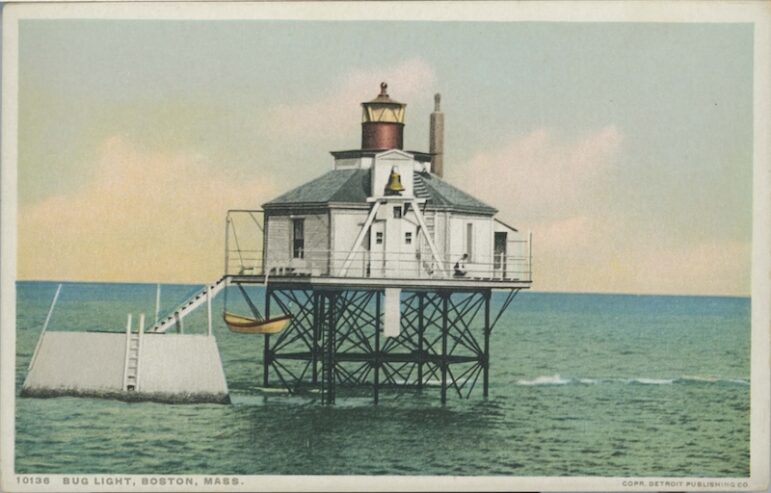
WN: Is there a favorite one of yours that made it in the book?
KA: Well, I love the Trinity Church on the cover. I mean, that’s such a beautiful church at in Copley Square, and all these craftsmen: famous, famous people from John La Farge, the stained glass window guy, and (Augustus) St. Gaudens, the sculptor, they all worked on the interior with Stanford White, the famous architect.
But, I wanted to use this on the cover. It’s something called Bug Light, it’s a lighthouse that no longer exists. It was down by Fort Point Channel, but it’s such a beautiful image. I really wanted to use that on the cover, but people are saying, “No, you can’t do that, because it’s not on land, and it’s not there anymore.” But the venerable Trinity Church is still there. It’s been there since, since it moved there, it was one of the first ones to move to Back Bay from downtown after the fire in the late 1800s and everybody wanted to be in Back Bay, all of a sudden, after that fire. I wanted to have Mount Auburn Cemetery in there in the worst way, but I couldn’t find a postcard of it.
The book is available by clicking here. See more about Alpert’s collection by clicking here.
Very interesting! Look forward to getting a copy of the book. Would make a nice exhibit too!
Belmont Woman’s Club will be celebrating 100 years in 2027 This would be of interest to them