
By Anahid Shahrik
In the wake of a recent tragedy in Watertown, the Armenian community finds itself grappling with a painful reality: Domestic violence doesn’t discriminate by neighborhood, income level or outward appearance. It exists behind long driveways in affluent suburbs just as readily as in apartment buildings where neighbors can hear through thin walls. And too often, it remains hidden until it’s too late.
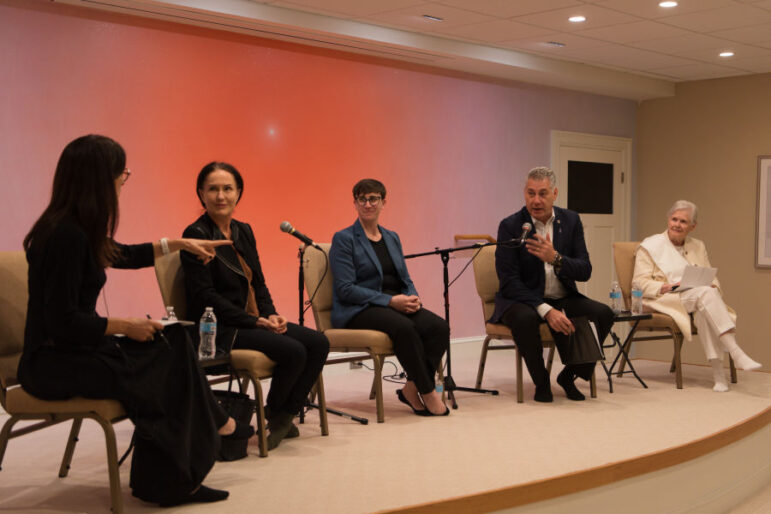
On Oct. 27, 2025, during Domestic Violence Awareness Month, the Armenian Relief Society Cambridge “Shushi” Chapter and the Brahma Kumaris Meditation Center co-hosted a community awareness panel in Watertown, providing a safe space to address what is too often left unspoken — a conversation our community urgently needs.
Moderated by Lenna Garibian, a board member of the Women’s Support Center in Armenia, the discussion brought together four experts with decades of combined experience: Attorney Wendy Murphy, adjunct professor of sexual violence and law reform at New England Law; Middlesex County Sheriff Peter Koutoujian; Lauren Nackel, director of operations and human resources at REACH Beyond Domestic Violence; and Rita Cleary, co-coordinator of the Brahma Kumaris Meditation Center.
Recognizing the Many Faces of Abuse
While physical violence — hitting, slapping, kicking or punching — is often what comes to mind, abuse extends far beyond the visible.
Emotional and psychological abuse can be equally devastating, including insults, isolation from friends and family and constant threats that erode self-worth.
Financial abuse is particularly insidious, and can occur in suburban communities where there’s a misconception that survivors must come from low-income backgrounds. “There are survivors who drive up in a luxury vehicle, who have an expensive purse or handbag, who get their nails done every week, but they have access to none of that money because all of it is controlled by their abusive partner,” Nackel noted. When a survivor is financially dependent on their abuser, fear of losing that income becomes a powerful barrier to leaving.
Spiritual and cultural abuse occurs when someone is cut off from their faith, community or cultural roots, a tactic used to deepen isolation and reinforce control.
Technological abuse has become increasingly common. What once required sophisticated technical knowledge to stalk or harass a victim is now as simple as using pre-loaded smartphone apps.
Sexual abuse is another form of violence. “Ninety-nine percent of domestic abuse victims are sexually abused, too; we just separate them for some reason,” Murphy stated. When a partner is coerced or forced into sexual activity, it is abuse, regardless of marital status.
Understanding different forms of abuse helps us see how they intertwine, trapping victims in a painful cycle that can feel impossible to escape.
The Cycle That Keeps Survivors Trapped
Sheriff Koutoujian elucidated the cycle of abuse, which is key to understanding why victims stay. During the tension phase, victims “walk on eggshells” as the abuser becomes increasingly irritable. This builds to an explosion, a violent incident that could be physical, sexual, verbal and/or emotional. The honeymoon phase follows, during which the abuser apologizes, makes promises, shows affection and expresses remorse, leaving the victim feeling hopeful relief. Finally comes the calm, a temporary peace the victim desperately wants to maintain — until tension inevitably builds again and the cycle repeats.
Nackel noted that every abusive relationship starts in the honeymoon phase. “If someone punched you in the face on the first date, would there be a second date? Probably not,” she explained. “There has to be this romancing that lays the foundation for future abuse. Abusive relationships are often intentional and move gradually so that a partner is invested — whether through children, moving in together, marriage or a mortgage.”
When invested, they’re not trying to escape the relationship; they’re trying to get back to what they believed was the “real” relationship. “All they really want is the best parts of that relationship, but that relationship can never be partitioned into the good parts and the bad parts; it’s all one really unhealthy relationship,” voiced Koutoujian.
Why Survivors Stay: It’s More Complex Than Love
Love is the most common reason survivors reveal for staying, according to Nackel, but it’s far from the only one.
Garibian opened the discussion, citing that fear of the unknown can keep victims from leaving. “For somebody to acknowledge that there is abuse in their home and to take that step — to make a phone call and walk into a shelter in a completely unknown world — is such an act of bravery,” Garibian remarked.
Other factors discussed include:
Loss of self-worth: “They’ve lost their trust; they’re not sure that they’re loved. They feel they can’t make it in that transition. Without self-respect and self-love, people will stay anywhere, doing anything just to feel they belong somewhere,” Cleary shared.
Immigration concerns: For those whose legal status depends on their partner, the fear of deportation can be paralyzing, especially in the current political climate.
Not being believed: Many survivors who tell friends or family are met with disbelief or dismissal. “[When there’s] lack of belief, it can become so much harder to name that experience again,” Nackel said.
Systemic failure: Murphy explained how repeated failures of the legal system lead survivors to stop seeking help. “That is the number one cause of recidivism. After the third or fourth call, [the victim] stops calling.” They must choose between living with abuse and homelessness. “We force women to choose between bad and worse, awful and terrible — and then, we try to blame them for not speaking up.”
The Role of Men in Ending Violence
While domestic violence can affect anyone, the statistics are clear: women are predominantly targeted by men.
“It matters that women are targeted; it matters that women are targeted by men and it matters that our legal system enables that to happen,” Murphy emphasized.
Research shows that when abusive men are honest about their motivations, they admit a sense of entitlement as the primary driver. Changing this requires examining how we socialize children. “We raise girls to be nice, and that has got to stop,” Murphy added. “We raise girls to be obedient, to be peacekeepers. We don’t raise boys to feel those same things. We are creating the imbalance that fuels that sense of entitlement.”
Nackel posed the question: “How are we raising our boys and holding one another accountable to have those conversations about what it means to be a strong man, a good man and why those two terms don’t line up together?”
Male involvement in prevention is critical, not to take over the conversation, but to model healthy behavior and hold other men accountable.
Koutoujian talked about the White Ribbon Campaign (WRC), where men pledge to help end domestic violence, adding that there’s still not enough male involvement. “It’s important that men speak about this and model good behaviors. It’s not for us to take over, but to be part of the solution — to be supportive, to lead by example and show what appropriate and healthy behaviors are in relationships.”
Nackel highlighted the Sudbury Wayland Lincoln Domestic Violence Roundtable as an effective men-led group that engages men and boys in monthly discussions and community activities aimed at creating a world free of abuse.
What Bystanders Can Do
Many of us have sensed something wrong: a neighbor’s bruised face at the grocery store, raised voices through walls, a friend who’s become increasingly isolated. But we hesitate, unsure how to help without making things worse.
The panel shared several ways bystanders can be advocates, including the power of private conversations. More often, the most effective intervention occurs outside the immediate crisis. Meeting a neighbor while taking out trash, inviting a friend for coffee and going for a walk create opportunities for safe conversation. Share what you’ve noticed, create space for the person to express what’s happening and provide resources without pressure, including REACH’s 24-hour hotline.
Nackel emphasized: “Never say, ‘You should leave this relationship.’” While well-intentioned, it can backfire. If they choose not to leave, they may not feel comfortable returning to you for support.
It is important to recognize that leaving difficult situations takes time. On average, survivors leave and return seven to 13 times before leaving permanently.
“That fifth time, that tenth time — whatever it is — could be that one time they were ready to step away,” Koutoujian said. “If you’re not there for them, they won’t have that opportunity.”
Hotlines aren’t just for survivors. Organizations like REACH welcome calls from concerned friends, family and community members seeking guidance. The most important thing you can say is, “I believe you. Thank you for sharing that with me,” stressed Nackel. These words can lay the foundation for a survivor to continue seeking support.
The Path to Healing: Going Inward
For survivors ready to begin healing, Cleary offered a spiritual perspective grounded in her own experience. “One of the main healing methodologies we can use is creating a meditation practice,” she said. While meditation might seem impossibly distant from the reality of abuse, Cleary emphasized that healing could begin by turning inward. “Meditation invites you to step away from what’s going on outside and turn your attention to that sacred space within, where you can recognize that we’re more than the body: there is a soul, a spiritual connection we can make with ourselves.”
This inner work reconnects survivors with their inherent worth. “Each of us has the same rights to a peaceful, loving, happy life as anyone else,” Cleary explained. Understanding this can break through the lies abuse has embedded and reclaim personal power: “In that connection with source, we recharge the battery of our mind, soul and heart — that’s where healing happens.”
The practice enables moving beyond trauma through “a purification process that gives you the power to say: ‘Past is past, and I’m not going to carry this for the rest of my life.‘”
Cleary acknowledged that spiritual talk might sound “airy-fairy” amid abuse but urged: “Remember, we all have that power: to stay aware that I am self-sovereign, to learn to love and empower the self again, to build courage and strength through remembering who we are as a whole being.”
Moving Forward as a Community
This discussion was an essential first step towards transformation.
Let’s be ready to listen without judgment when someone trusts us with their story, support organizations doing this critical work and examine our own biases about gender, power and relationships.
If we remain silent, look away or tell ourselves it’s not our business, we become complicit. But if we educate ourselves, reach out with compassion, believe survivors and support them through their journey — whether that takes one attempt to leave or 13 — we can begin to break the cycle.
Together, we can ensure that what happens behind closed doors no longer stays there, and that when survivors find the courage to speak, they find a community ready to listen, believe and act.
Resources
REACH Beyond Domestic Violence has a 24-hour hotline, available for survivors, friends, family members and concerned community members, at +1 (800) 899-4000.
Women’s Support Center Armenia has a 24-hour hotline, serving women and families in Yerevan, regions throughout Armenia and the diaspora, at +374-099-88-78-08.
National Domestic Violence Hotline: 1-800-799-7233 (SAFE)
If you or someone you know is experiencing domestic violence, please reach out. Help is available, and you are not alone.