Watertown became a magnet for life science companies in the last several years, and City Manager George Proakis said the building boom in that industry may be slowed, but other industries may be attracted to the same things: proximity to Boston and the universities in the area, easy access, and a nice place to be.
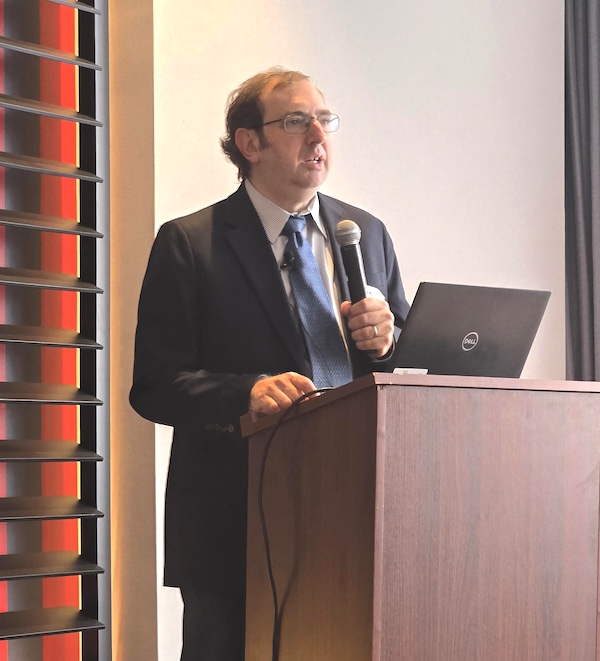
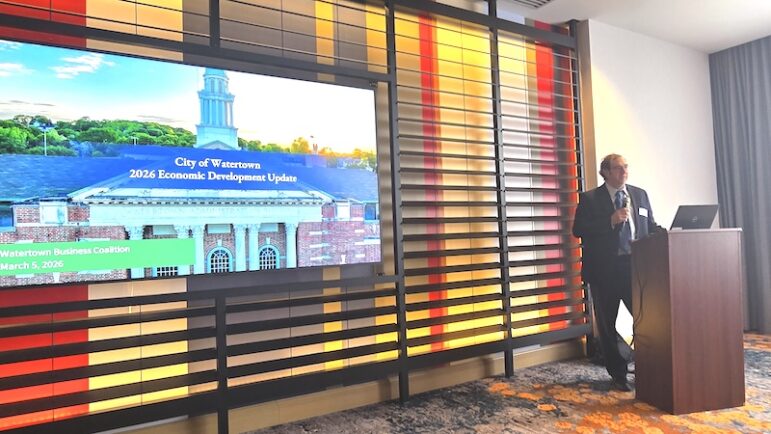
Proakis spoke about the City’s economic and financial outlook during the Watertown Business Coalition‘s City Update on Thursday morning at the Hampton Inn & Suites. His outlook for Watertown’s economic future was positive, despite the dip in the City’s most prominent industry: life sciences.
“We are still in a community, in a state that is well invested in new growth. We’re in a location in the Boston area that is more than appealing …,” Proakis said. “We are in the most ideal, perfect location to grow this industry. We have transit access to the greater Boston core, but we are still not so difficult to get to from the western suburbs that it is miserably unpleasant to commute. … And, honestly, that more than price, I believe it’s to our benefit over Kendall Square. Kendall Square is one of the most difficult places in the world to get to. Watertown is less so.”
Proakis noted that Watertown has been highlighted in a recent Real Estate Forum hosted by the Charles River Regional Chamber that focused on the implementation of the MBTA Communities Act, and in reports about the life science industry in the Boston area.
“Watertown was highlighted as a bright spot for the MBTA zoning strategies that we’ve done in Watertown Square,” Proakis said. “Boston Business Journal held up that Watertown is only behind Cambridge and Waltham for the number of Life Science spaces absorbed in 2025.”
He added that a recent report by Watertown Bio’s Sam Ghilardi found Watertown was ahead of those communities. Ghilardi, who attended the event, said “it depends who counted.”
The early 2020s was a boom time for life sciences in Watertown, and the spike can be seen in the permit fees collected by the City of Watertown, which peaked in 2022 with $14.4 million, more than $9.5 million more than any other year in the past 11 years, according to the statistics Proakis provided.
The new projects have helped add to the City of Watertown’s budget without increasing the property tax rates, Proakis said. The New Growth in previous years has helped pay for projects such as the new elementary schools, and the new high school without going for a debt exclusion override.
Changes in the industry resulting from a number of factors, including cuts in funding from the federal government as well as from venture capital firms, has slowed life science growth. Watertown has 11 life science lab buildings that have been permitted but which have not begun construction, and space still remains available in recently constructed lab buildings in and around Watertown.
“Regionally, my best estimate is there’s probably enough existing lab space in the greater Boston area that it would take in the range of five to six years to fill that space,” Proakis said. “So my strategy, where we do growth projections three years into the future, is not to depend upon the new growth revenue from these buildings being done, but also to work very closely with the owners of each and every one of these properties to make sure that we understand where things are going.”
Some may never become life science labs, and may shift to another type of technology, or another use, such as housing, Proakis said.
Watertown’s focus on being more climate resilient, including building a net zero energy high school and an ambitious effort to cut greenhouse gases, has been recognized by some people in green industries.
“One of the advantages of being a community that’s very well focused on climate as a priority is we have caught the attention of some folks who do the type of business around climate and energy,” Proakis said. “I feel like we’re building our next new industry cluster here around climate tech companies and clean tech companies, and there’s some real opportunities for us in that area as well.”
A representative from Tutor Intelligence, a robotics firm that moved to Watertown, asked whether the City has tried to attract robotics and other tough tech companies, which focus on combining scientific and engineering breakthroughs to solve real world challenges.
Proakis said: “We’re building on life science, but what’s the next thing? What are the other things that we can grow to have more diversity in our industries here, and tough Tech is a big part of that. The interesting challenge, I look at the Manley Way building, where they renovated an existing kind of storage type building into something that can have more people and more growth and more work in it. It is an ideal tough tech space.”
Some of the properties permitted for labs could become housing. Watertown has already seen more residential projects coming to town.
“The Watertown Square zoning has generated a substantial amount of interest in residential development,” Proakis said. “We have the building on Main Street that started under construction before that zoning started, 33 Mt. Auburn was approved with 40 units — this has been a hole in the ground for a very long period of time. The site where, for a while, people were talking about a single story retail building, and now we have a 40 unit project proposed.”
Community meetings have been held about a proposal to turn the plaza on Mt. Auburn Street that includes Dunkin’ and Subway into 153 residential units, Proakis and. Another project that recevied approval is a building with 52 condos at 108 Water St., right off Galen Street.
“So the residential side is showing some signs of movement. And like I’ve constantly told people, residential is the secret sauce to create successful retail, and then the retail district,” Proakis said. “And I think that this is good for the well being of Watertown Square, retail as a whole.”
The City’s major focus for direct impact on economic development is the redevelopment of Watertown Square, both the roadway and the business district. In the next couple months, Proakis said the consultants hired by the City will work on designs, and that will be followed by community meetings and discussions.
A major change could be the construction of a multi-story parking garage on the municipal parking lots behind CVS, as well as residential buildings.
“I know that parking garage, the idea of parking garages has had a lot of ups and downs in conversation in the community,” Proakis said. “I’m still a fan of this project and why I actually think this provides a lot of benefits.”
He mentioned that the recent snow storms brought up a benefit, that the garages don’t require plowing like surface lots do, and could be used for parking during snow emergencies.
“I’m not saying that’s the one and only reason to do this. The major reason to do this is because centralizing parking for a business district brings visitors in and has them have a known place where they can depend upon being able to leave a car. And making sure that you build a garage that is light and open and bright and friendly and welcoming, is doable, and there’s a way to make it work,” Proakis said. “And I think that there’s a lot of benefits to doing that. It also adds parking capacity for everything from events in the Square to the ability to grow business growth to even if there’s developments that are struggling to figure out how do we do parking on a small lot, you can potentially share and negotiate and work with it.”
The City also wants to make Watertown an attractive destination for tourists. The summer of 2026 will be a busy one in the Boston area, with the World Cup, Massachusetts’ 250th anniversary, and the Tall Ships all coming to the region. The City has produced a visitors guide, which will soon be distributed at hotels and other places.
Watertown has some celebrations of its own coming up, both this summer and in the next few years.
“One of the things that the visitors guide highlights is Treaty Day, July 18, 2026,” Proakis said. “For those who don’t know the ins and outs of the history of Watertown, Watertown was the site of the first treaty signed by the United States of America between Massachusetts and a series of native people in the region up into Canada, that helped them work collaboratively in the Revolutionary War. And in celebration of the 250th anniversary of the signing of that treaty, we have some really exciting things going on on the weekend of July 18, so we’re looking forward to celebrating that.”
Watertown has a milestone anniversary coming up in the next few years, and an organizing committee for the celebration of the anniversary recently met for the first time.
“Our 400th anniversary is the year 2030. If you go back through our annual reports and look at what Watertown did for our 300th anniversary in 1930, my goal is to make 2030 an even bigger event,” Proakis said. “And that was a very big event.”
Not all is rosy for the City of Watertown’s finances. While the City does not rely on federal grants as much as other nearby communities, cuts in funding impact industries in the region such as life science, universities, and medical research, will have indirect impacts on Watertown, Proakis said.
In addition, the costs of services have increased, he said.
“I’m sure anybody who runs a business is probably seeing things similar to what we are in local government, which is when you try to plug in what the employee side of insurance is, and you have got some challenges with increasing costs here in the Commonwealth,” Proakis said.
The City can increase taxes by 2.5% over the previous year, and add in any new growth, Proakis said, but the cost of insurance is rising at a rate of 7% and costs of other goods and services are up 4%.