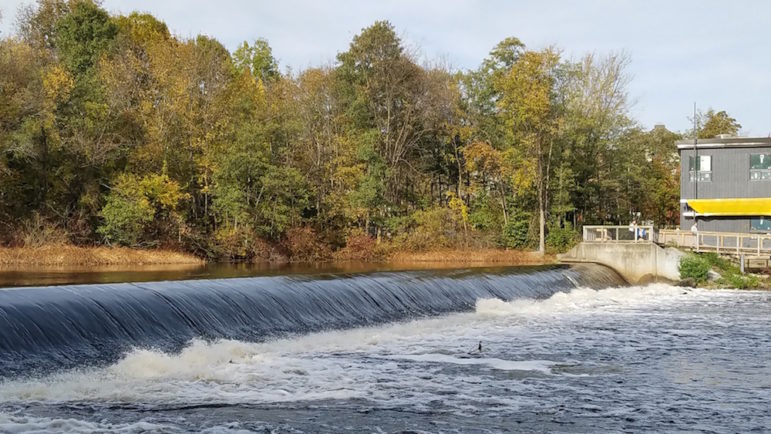
Charlie Breitrose The Watertown Dam near Watertown Square slows the flow of the Charles River. A group is advocating removing the dam.
The following announcement was provided the Charles River Watershed Association:
Charles River Watershed Association (CRWA) will host a free premiere screening on Jan. 8 at the Watertown Free Public Library of its new short documentary, Reconnecting Rivers.
Produced by CRWA and Turnaround Films, the documentary delves into the challenges posed by defunct dams on the Charles River – with a particular focus on Watertown Dam – and what is being done to address them.
A panel discussion on the documentary and defunct dams on the Charles will follow the screening. Panelists include Watertown Councilor At-Large John Gannon; Beth Lambert, Director of the Massachusetts Division of Ecological Restoration; Brad Chase, the Diadromous Fish Project Leader at the Massachusetts Division of Marine Fisheries; and CRWA Indigenous Consultant Hartman Deetz.
WHAT: Premiere Screening: Reconnecting Rivers
WHEN: Thursday, January 8, 2026 – 6:30 P.M. to 8 P.M.
WHERE: Watertown Free Public Library – Watertown Savings Bank Room (1st floor)
Charles River Watershed Association’s mission is to protect, restore and enhance the Charles River and its watershed through science, advocacy, and the law. CRWA develops science-based strategies to increase resilience, protect public health, and promote environmental equity as we confront a changing climate.
The removal of the dam is a terrible idea. It will waste money that could go to many other things. The dam is no problem or danger to anyone. STOP ALL THIS DAM REMOVAL NONSENSE!
Removing the dam would restore the natural environment. It would allow all fish, not just some, to spawn where instinct drives them. It would eliminate the greatest threat to downstream communities in event of a “hundred-year storm”: dam failure. As the Watertown Dam is only a spillway, it provides no protection whatsoever. Put a price on those benefits, and I’d pay it. Natick (and other towns) came to the same conclusion and secured a grant from the Commonwealth (we have a Dam and Seawall fund, who knew?) that covered most of the cost. The Watertown Dam is the first obstacle fish meet on the river, barely seven in from the Charles River Dam, and many can’t make it past. (I’m a volunteer fish counter every spring.) It starts—or ends—with us. The responsibility is ours.
PS: Ask the Nipmuc and other indigenous communities upstream if removing the dam is “nonsense”. I used to be indifferent to the issue. But then I started reading up on it. It’s all upside—for the environment, for aquatic life, for human life. It’s not a question of if but when. I say now. It’s already late, but not too late.
Well said Josh.
I encourage people to attend to hear facts and data on this issue and not just hyperbole.
The dam IS a problem and danger to native fish who are blocked from swimming upstream to spawn, it’s also a threat to the river ecosystem by blocking sediment from moving downstream (where it would create new habitat), by causing the water to heat up (thermal pollution), and to downstream people and property if it were to breach during a large storm. Let’s free the river!
Thermal pollution? Really? It is basically a pond so ponds are somehow thermal pollution? that’s an absurd stretch. If some fish aren’t swimming upstream then they adapt. It is such unnecessary extremism to say that the dam is such a menace. Where were you people when millions were spend on that hideous bridge built just a few years ago? What good is that ugly bridge going to be now?
This hysteria about returning the river to it old times has not convinced me that we need to do anything in the near future. The fish are doing just fine.
And your data are…?
That’s what I thought. Stagnant water heats up more than running water—fact—and fish don’t just “adapt” to manmade obstacles, they dwindle in number, maybe even die off. You ever wonder why gulls and herons flock below the Watertown “Dam” (which it isn’t)? The fish that can’t pass might as well be in a barrel. I understand the food chain, but make it a fair fight.
If your only argument is cost, fine: make your argument. But on everything else, you have no apparent argument. Now the bridge? What’s wrong with the bridge? No, wait, I don’t want to know. The hunk of concrete blocking the flow of the river is the issue. You are pro-hunk of concrete, got it.