
By Linda Scott
Watertown Resident
Looking at Trends
Looking back on the past few years, I see a trend:
1 – The Watertown Square Planning process was a plan to rezone our city core. The MBTA state Law that mandated zoning for 1701 new housing units was a major part of this process, and yet a plan for 1,701 didn’t even reach our councilors’ desks, not to mention the community. After community input for 1,701 units, the City came back with a plan for 6,320 units and effectively defined Watertown Square as an area that extended west on Main to Lexington Street and up Galen, almost to the Mass Pike.
The City ultimately “settled” for a number just over 3,000 (3,133) units. The response from our City government when this bait and switch was pointed out? Don’t worry. We’re zoning this way, but that kind of development will never happen.
For a more complete recounting of this process see Bruce Coltin’s “The Battle for
Watertown”: https://thebattleforwatertown.blogspot.com/2025/10/watertowns-crisis-of-mistrust-and-man.html
2 – Illegal signs plastered all around Watertown Square for a Watertown Square overlay and falsely implying that affordable housing is illegal in Watertown Square. These signs were put up during the 2025 Watertown election season and were taken down after a City cease and desist order.
These signs seem to indicate that a small but vocal political group isn’t interested in the compromise that was reached in the Square planning and zoning and is trying to end run that community process.
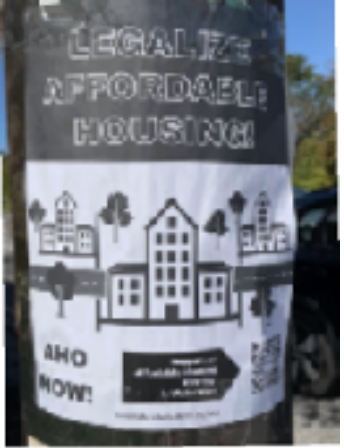
Overlays are rules that are written to stand on top of the zoning rules already there in a neighborhood. For instance, some overlays would supersede the Watertown Square zoning rules that we just put into place after many community meetings. For more on plans to overwrite the community’s zoning efforts, see #4 below).
3 – A verbal report from long time resident renters that their rents are being raised more than ever (in one case 10 percent). When they balk, they are told to just look around them at the new buildings … in other words … this old building is a bargain! Pay up!
4. A discussion at the Watertown Affordable Housing Trust meeting on July 15, 2025. To streamline this and get to the relevant portion of this meeting for our limited purposes here, I recommend that you start at minute 1:31:00 and go to minute 1:43:30. See http://vodwcatv.org/internetchannel/show/3989?site=3
An aside … I went back to the City calendar to go to this scheduled Watertown Affordable Housing Trust meeting to find the meeting documents. This meeting isn’t even listed on the Watertown City calendar. It is, however, available to people who have signed up for notifications, which means that many Watertown residents didn’t even know that this meeting was happening. Also, “a very detailed study done by Housing for All Watertown (HAW)” is mentioned during this meeting, but not available for the public to see. Where can the public see this report?
I think that the whole meeting might be an eye-opener for folks who haven’t been following this issue, and folks might be better informed by viewing the whole meeting. However, the sound in this room is very difficult and muddy, and the topic, reviewing a lengthy document, may be a slog. If you’re interested in reading the transcript for the entire meeting, here it is, but please be aware that it’s AI generated and quite garbled in its own right:
https://watertown.munitrac.ai/transcript/printable?id=2025-07-15_TownMeeting-0u390.mp4
In the selected video section of this Affordable Housing Trust meeting, http://vodwcatv.org/internetchannel/show/3989?site=3 minutes 1:31:00 through 1:43:30, Sam
Ghilardi, one of the leaders of that small but vocal political group (HAW) refers to a study that they have done (was there any housing expert involved in this?) and where city-wide re-zoning is recommended. Again, where is this report for community review?
The City Manager, George Proakis, who is not opposed to rezoning on its face, quite rightfully, asks if they “are ready to do that?” “That” being a recommendation by HAW that defies the City’s Comprehensive Plan. The defiance? Adding a housing overlay in areas defined in the Watertown Comprehensive Plan as low and medium density residential. To see where your neighborhood fits in, zoning-wise, check out pages 81 and 84 of the City of Watertown Comprehensive Plan. The link to that is below, under “Critical Questions.”
Mr. Proakis says, “The HAW request, which is very similar to what Cambridge has done and others have discussed, which is basically to allow affordable multi-family residential units on all parcels of land [in Watertown] by right, with the exception of open space parcels.” My Note: Let’s be clear here … we are not just talking about two and three family residences when the term “multifamily” is used. The manager, for instance, mentions a sixplex. By the way, to hear some of his suggestions, go beyond minute 1:43:30.
Rezoning the whole City is beginning to be discussed! In other words, the most affordable (and diverse) residential parts of our community are being discussed as places to double down on density, in opposition to the Comprehensive Plan and without our involvement!
I wanted reassurance … that’s not what I got:
Having considered all of the above, at a recent meeting hosted by the Watertown Business Coalition, I asked the panel of experts on Watertown development whether the goal was for all of Watertown to be zoned like Watertown Square.
Gideon Schreiber, Director of Planning and Zoning, of the Watertown Department of Community Development and Planning (DCDP), responded that those were City Council decisions.
Here’s the audio clip:
https://www.littlelocalconversations.com/episodes/watertown-s-open-the-state-of-development-in-watertown. See Minutes 54:11 to 57:20.
He and Andrew Copelotti (Arsenal Yards) went on to say that even if neighborhoods were zoned that way, building large multi-unit buildings in small Watertown neighborhoods would be difficult, given the numbers of different property owners to be dealt with. In other words, don’t worry. The City can rezone it, but development will never happen. It’s beginning to be a City of Watertown stock response.
Critical Questions:
In many ways, we are at a kind of crossroads here in Watertown. How can we continue to be generous and welcoming to individuals and families coming to our City without ruining what the City has to offer and the reason people gravitate and stay here?
I know that this is a concern for many residents in Watertown. How do I know? First, because Watertown’s neighborhoods are specifically written into the Comprehensive Plan as low and medium density. (See pages 81 and 84 of the Comprehensive Plan). https://portal.laserfiche.com/Portal/DocView.aspx?id=87541&repo=r-5ece5628
I know because when plans were being developed for a huge bio lab abutting a small West End neighborhood, voters from all over the City signed a petition to say, “Let’s protect our small neighborhoods from encroachment.” The beginning of this grassroots petition started like this: “The goal of this petition is to protect existing residential neighborhoods from the intrusive impacts of outsized and incompatible development on the borders of adjacent districts.” Over 400 signatures were gathered from all over the city (not just that neighborhood) in a matter of a few weeks.
Moderation and careful thought is sorely needed, as is your participation. It’ll make the difference between Watertown the community and Watertown the anonymous passthrough city.
Memories are short:
As Gideon Schreiber said at the Watertown Business Coalition event, bottom line, these will be City Council decisions. Perhaps it’s time to let your councilors know that you want them to live up to the commitment made with the City’s guiding document, the Comprehensive Plan. It never hurts to review this plan and send a reminder!
Where is your neighborhood going? Shouldn’t you be part of that conversation?
Thank you, Linda, for your research and clear reporting. Anyone paying attention can hardly be surprised.
Housing advocates are to be congratulated: their single-issue advocacy is paying off. Watertown is one of the most densely populated communities in Mass, but not THE most densely populated. Some look at Somerville (2x Watertown’s density) and ask “Why?” HAW seems to look at Somerville and ask “Why not?” Rezoning the entire city could turn Watertown’s diverse housing stock into triple-deckers or, what’s the word, a “sixplex” (sounds like a multiscreen movie theater).
Councilor Airasian’s perspective will be sorely missed on the Council. I don’t see that it has been replaced. Nothing is off the table if there is no opposition to radical change. I suspect there is such opposition, but it has to be heard—seen and heard. The rationale behind the MBTA housing program was to increase housing density near transit hubs. Watertown Square qualifies—barely (a bus yard is hardly as useful as a T or commuter rail stop). The rest of the town, not so much. Was MBTA just a foot in the door? As we creep up on Everett, Chelsea, and ultimately
Somerville, how are our tightly packed neighbors going to get around? People are begging for winter parking spots already. Last, if Housing for All Watertown really wants to earn my support, they would team up with Trees for Watertown. A ratio of several trees for every new unit might actually constitute healthy growth, instead of congestion and claustrophobia. The housing crisis crowd joining forces with the climate crisis crowd: my gift to the community.
Hi Josh,
Thanks for your responses. They really add to the conversation!
It should be noted that George Proakis’ first reason to not “go there” with city wide rezoning was that the Comprehensive Plan, a document painstakingly developed with community input, would be violated. He’s been in Watertown long enough to know that there are a significant amount of residents who aren’t interested in turning Watertown into an ant farm.
As regards your tree comment, that’s a good thought. I would add that in the planning of these new buildings that consultation on the appropriate trees would be a bonus, so that in five or ten years owners aren’t tempted to take down a perfectly healthy tree. The right tree in the right spot would be tremendously helpful and could avoid a lot of neighborhood issues.
Also, don’t forget the green patches, as small as they are, that go away after developers are done with a lot…there’s only money in square footage of a house, not lawns. In a conversation with one prominent HAW member a few years back who bought a single family home in Watertown, I asked her if she’d be willing to live in a two family. She said, “Sure. As long as my kids had a backyard to play in.” From what I’ve seen and has been reported to me about new two family homes being built in small neighborhoods in Watertown, there’s not much chance of a backyard. As small as those green patches in front of and between current properties are, they count towards environmental impact!
As regards car ownership, some would argue that those buses would be late because of traffic, a valid point. But it’s a chicken or egg situation…most people would not give up their cars for commuting until there’s a suitable “other” transportation option.
By the way, I admire folks who can commute using their bikes, but I believe that they are a small subset of our residents. When we just updated our contract with Blue Bikes, for instance, wasn’t it mentioned that bike use was significantly lower than expected? Here’s Steve Magoon’s explanation in the Watertown News reporting on the new Blue Bike contract:
“We don’t get the revenue from riders, that goes to Lyft. With this new contract, while it’s not been finalized and signed, obviously, it is looking like that operational cost to the communities will go away,” Magoon said. “That’s pretty significant the way it’s structured now. Operational costs are paid depending on the ridership of the docks and basically how many riders you get. And while some of the stations met that threshold in Watertown, most of them don’t. So we would end up paying to lift an operational cost each year.”
Even the HAW person that I mentioned above, who wants a backyard for her kids, drives her car a few blocks to Council meetings in inclement weather. How do I know? She felt the need to explain herself to me as she unlocked her vehicle…no explanation was necessary.
“As regards car ownership, some would argue that those buses would be late because of traffic, a valid point.”
I take the No. 71 only occasionally, and would need to gather more data to be definitive. BUT the 71 has a pretty straightforward route, one that doesn’t go through the Galen St bottleneck. If it can’t shuttle between Watertown and Harvard Squares relatively routinely, what hope is there for thousands of new residents in the WSq area? I believe the “road diet” planned for Mt. Auburn street gives precedence to buses and bikes, so those commuters may be happy. Automobile drivers trying to access the Pike or the riverside roads will continue to crawl.
I was just thinking that Cambridge was carved out of Watertown many years ago, and now it feels like Cambridge is colonizing Watertown.
Hi again, Josh.
I see your point. I was talking in general terms about how cars affect public transit. I have heard numerous complaints from folks taking public transit up Galen Street. As you mentioned, it’s a mess.
I haven’t been keeping up with the plans for work in Newton Corner…that should be fun.
Thank you for bringing this to our attention. I am all for specific locations of denser housing(as we are doing in the Square) but the bomb was dropped at 1:40 in the video(thanks for that) to recommend opening ALL zoing areas for denser(triple or more) as right! I’m not for this and have a friend in Cambridge who owns a home which just put up a 5 story apt building right next door to his house(the street is full of houses). I do not want this mix of housing in Watertown and chose Watertown instead of Cambridge/Somerville for this reason.
Hi Kate,
Thanks for your comment. Yes, this “bomb” came as a surprise to me as well. I was busy looking for the meeting where I had heard a member of the Affordable Housing Trust comment that they wished that all of Watertown could be zoned like Watertown Square. I found this meeting instead, which I mentioned wasn’t even listed on the official city website calendar. Sometimes you just have to wonder…
I thought that it was worth letting the community know what was being discussed. We’re often the last to know! This letter in Watertown News is one opinion…mine. I’m sure that others can share theirs with Councilors as well as with others in the community who, for whatever reason, are out of the loop in these matters. HAW does not represent the opinions of all of Watertown’s residents and should not be treated as such.
Great reporting. I sure do not want Watertown to become the next Somerville. No insult intended. It s getting harder and harder everyday to get through the square. I expect it to get worse every year with the changes already planned. If you want to live in industrial packed housing area, there are already many other towns for that.
Thanks, David,
I know what you mean!
There was reporting out last week that the plan for redevelopment of the Alewife MBTA Station in Cambridge is being terminated. The cause: current unfavorable market conditions:
https://mass.streetsblog.org/2026/01/12/mbta-terminates-alewife-redevelopment-plan
When do you think that they’ll get around to Watertown Square??
Then there’s the planned major rerouting of the streets in the Square. Many folks have suggested that we give that a trial run before permanently committing to this major reworking of roads. This was done in Somerville, I believe. Our City Manager ends the conversation with a simple “No” every time a resident brings the topic up. No reason has been given for not giving these traffic patterns a try before we commit the tremendous money and resources and pain to our citizens to make this proposed traffic plan permanent.
I hope that there are realistic resources in place to support our businesses in the Square through this turmoil. It seems to me that Watertown Square may be someplace people will want to avoid for quite a long time.
“If you build it, they will come.” Sound familiar? Changing zoning is just a temporary “hold” on building more, higher, denser in neighborhoods that currently have 1 and 2 family houses. It’s just a matter of time before the offer is right, and people will sell their homes. My little street is one block from Main Street and Waverley Avenue, an area recently designated as part of Watertown Square. The houses on my street and the streets on either side are 1 and 2 family. Over the past year I have received a number of inquiries asking whether I want to sell. Just this past week I received 2 texts from someone, addressing me by my name, and telling me he wants to buy my home. My neighbor has also received these texts. I’m guessing other neighbors have also received inquiries. We’re pretty sure they are from a developer who plans to push the envelope requesting a variance because we are contiguous to Main Street and the increased density zoning. Connect the dots. Dominoes at work. Urban sprawl.
Thank you Linda, for your tireless defense of neighborhoods! I’m tired of trying to be vigilant against developers and (hopefully) well meaning councilors. Watertown is small and easily bullied unless residents like you and others speak up.
Thanks, Anne.
Yes, that does sound familiar…so much for “Don’t worry, we’ll zone it, but nobody can afford to develop it!”
I’m sorry that you and your neighbors have to put up with this constant badgering. Apparently, “no thank you” is not a sufficient response.
I might add that if we are to build considerably housing that more transit service is required. This is the flaw in the MBTA Communities Act. There is a mandate for more housing but mo promise of more transit as a reward for compliance. In reality, there is a sizable stick, but not even a puny carrot.
To greatly increase density in Watertown without substantial increases in transit service would result in dystopian levels of traffic. If you think traffic is bad now, just wait.
Not that I am against more housing if it is done in a thoughtful manner which allows Watertown to enhance quality of life, not erode it. But hat the “small, but vocal minority” seems to believe that unrestrained development will bring about affordability. This is simply naive. It will take extraordinary market pressure to even slow the growth of housing costs.
We are facing problems that have no simple, effective solutions. Solutions that will improve residents’ well being will require much thoughtfulness and a great deal of political will.
Hi Joe,
Yes, I think that you’ve stated the problem clearly. I refer you to my comment to David about plans for Alewife Station. It’s all an overwhelming mess!
Also, I’m not in any way claiming that I think something wrong is happening, but one of the leaders/steering committee members of Housing for All Watertown (HAW) has formed a super PAC:
“as the statewide group (Abundant Housing) sees resistance at the local level, two of its supporters are turning to what’s become a mainstay vehicle in politics: a super PAC.
Molly Goodman, a founding board member, and Josh Rosmarin, a Democratic political operative, filed paperwork this week with campaign finance regulators setting up the super PAC, which can operate with few restrictions on its fundraising and spending.”
The article goes on to say that Molly and Josh are expected to turn to developers and biotech firms for money. This news was announced in July of 2025.
Can we agree that this situation (operating with few restrictions on fundraising and spending) is not ideal? It would be interesting to see how much of this money ends up in Watertown to counter, as the article calls it, “resistance at the local level.”
See: https://massterlist.com/2025/07/17/a-yimby-super-pac-enters-the-arena/
Hi Linda–Wow! I think that the real estate industry has enough political voice in the Commonwealth. The last thing that is necessary is to give them a conduit for lobbying money through a Super PAC. To rely on developers to solve the affordable housing problem is to punt on the issue.
Why the market economy no longer provides housing for middle and working class folks is a complicated problem. Removing zoning will not solve the problem. Deregulation, in the 45 years since Ronald Reagan, has resulted in the most massive inequality in the history of our nation. Don’t tell us that more deregulation is the magic bullet. We have heard that before.
With regard to transit, I think providing better service will help meet traffic reduction goals. The bus lanes are part of that. But we must also lobby the MBTA for shorter headways between buses and better real time management.
The 71 bus now has 15 minute headways. If that were reduced to 10 minutes and the service was reliable, many more folks would ride. If one can walk to the stop and a bus will arrive in 10 minutes or less, that would incentivize use.
If we could get just 15% of single occupant vehicles off our streets, that that would result in a noticeable improvement in travel times for automobiles. Watertown, historically, is a classic streetcar suburb. The town we now know was built around streetcar lines. I believe that we can return to a more transit centric reality and we would all be better off, including those who must drive.
I hope the Town Council and the Zoning Board are listening to all of this. As for the theory that building in a re-zoned area won’t necessarily happen, if it’s remotely possible to build on a lot some developer or other will be attracted to it.
Hi Marilynne,
Thanks for your response. I bow to your expertise in this area…faithfully and effectively serving for so many years on the Watertown Historical Commission. This is what I suspected, but you’ve now confirmed it!
There has been a constant rise in new housing over the last several decades.
There has been no reduction in the cost of housing to go along with all that new housing.
In fact, it is very clear that new housing is more expensive housing and increases the cost for everyone. You know when housing was going up the least? When there was less development.
New housing does not lead to more affordable housing. It just leads to more people and more issues.
Linda, once again you have done an excellent job of informing Watertown residents of what is going on, especially the people who don’t regularly attend or Zoom into the city meetings. So much change is being pushed upon us with very little input from the majority of our citizens.
Many people moved to Watertown to escape overly crowded and regulated cities, like Cambridge, and I am one of them. Now we hear more and more people saying the same thing, but are our leaders listening? I think not. They are thinking of dollar signs and claim it is to reduce rents, but in actuality it seems that they want more tax dollars.
The new apartments coming on board won’t be affordable and that seems to be a consensus.
Watertown is not the only city that is going through forced changes, but as an extremely small city, we will feel the effects much more than others. If we don’t accommodate the needs of people who need cars to go to work, shuffle family members to appointments, traveling to interesting places, shopping and generally live their lives in a free society, we are catering to the few that might be able to function without cars and want to push their lifestyles on all of us.
As Anne mentioned, I too have received numerous text messages and some postcards asking if I would be willing to sell my house. A neighbor also has raised this issue. As we live on a small street with all single-family homes, what do these real estate agents or developers know that we don’t know? What plans might be going on behind the scene? More bigger developments?
The American dream for many is to work hard and, hopefully, be able to purchase a single-family home with a back yard to enjoy some outdoor space, maybe have a vegetable and/or flower garden. enjoy the singing birds, and have a place to gather with family. If some people with other agendas have their way, this dream won’t be a reality for many.
Rezoning carefully may be helpful in some circumstances, but we need to encourage our Councilors to think of the broader good, not give in to developers who want to just make money by increasing the density wherever they can and changing the quality of life for many. Our city leaders need to be sure they are following the Comprehensive Plan, especially where you point out that Watertown neighborhoods are listed as low and medium density.
We know with more density there will be more traffic. Even at the first Watertown Sq. meeting with Mr. Speck it was casually mentioned that with the new plan traffic around the square would naturally find its way onto other streets, but that just creates more problems for the side streets in neighborhoods. And if we don’t have enough parking in new buildings, there will be more parking issues on those streets. If there isn’t enough parking for businesses, they will move out and that will benefit no one.
I encourage more people to follow your articles and speak up. A few hundred people’s input at a meeting is not the majority and the city needs to listen to the majority. If that takes other measures, then let them know your ideas. It’s now or never!
“Information is the currency of democracy.” Attributed to Thomas Jefferson
Hi, Josh: You write “if Housing for All Watertown really wants to earn my support, they would team up with Trees for Watertown. A ratio of several trees for every new unit might actually constitute healthy growth, instead of congestion and claustrophobia. The housing crisis crowd joining forces with the climate crisis crowd: my gift to the community.”
Trees for Watertown enthusiastically shares your vision. For the healthiest, happiest urban future, every new development approved by Watertown should meet the 3-30-300 Rule: that every resident can see at least three mature trees from their home, live in a neighborhood with at least 30% tree canopy cover, and be within 300 m (about a five minute walk) of a high-quality green space.
To achieve this Watertown needs to explicitly honor and protect the many services that our mature neighborhood trees provide. Over and over we’ve seen developers destroy beautiful healthy trees that serve the whole neighborhood.
Developers would surely design their projects differently if they could feel the acute loss that neighbors report to TFW when these beautiful, protective presences are destroyed. In the absence of that native empathy, our city needs to step in to protect our existing neighborhood shade trees better, as surrounding cities are doing.