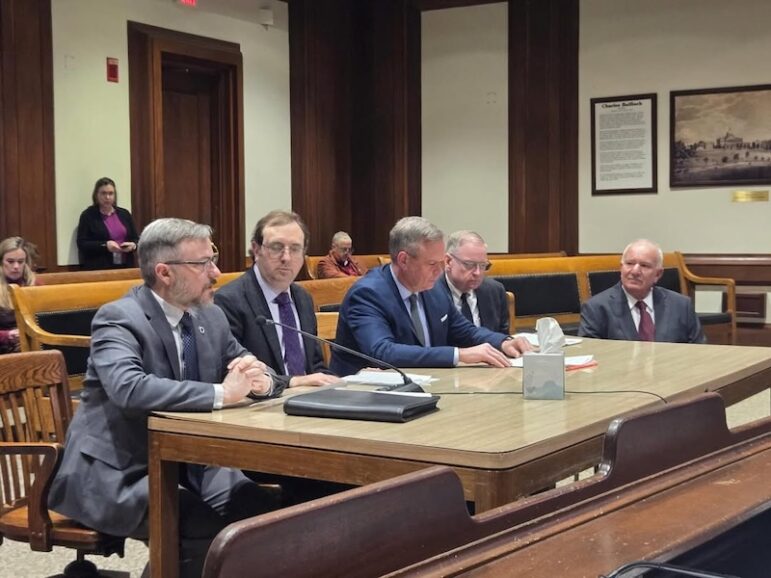
City officials from Watertown joined state representatives on Beacon Hill to request an extension to a bill that allowed Watertown to shift more of the property tax burden from residential properties to commercial properties. The shift would allow a 50/50 split, instead of the current requirements of state law to have 61 percent of the tax levy coming from residential properties.
City Manager George Proakis, City Council President Mark Sideris and City Assessor Earl Smith testified to the Joint Committee on Revenue on Jan. 27 about Bill H.4687. They were joined by Watertown’s two state representatives: Steve Owens and John Lawn, who co-sponsored the bill.
The City is in the third year of a three year agreement approved by the State Legislature that allowed the 50/50 split. If it lapses, however, Watertown homeowners would see a significant tax hike next year, Owens said.
“The City estimates that if this does not go through, the average residential tax bill will increase by 18.4 percent,” Owens said. “That’s about $1,300 per resident.”
If the 50/50 split is allowed to continue, the tax increase will be around 4.2 percent, Proakis said.
State law allows communities to shift up to 175 percent of the tax burden on commercial, industrial and personal property (CIP) and they can have CIP make up as much as 50 percent of the taxes. When the tax shift was put into Massachusetts law in the 1980s, however, it froze the maximum ratio for the residential vs. CIP at the time of the law was adopted. In Watertowns’ case, 61 percent fell into residential and 39 percent in CIP.
Sideris said he worries that without making the shift permanent, Watertown residents will be heavily burdened by property taxes.
“State law does allow us to do the 175 percent shift, and we’re here requesting that we get a permanent opportunity to get to that point and stay at that point, because the residential taxpayers of the community, as in every community in this Commonwealth is facing burdens that we never thought were possible,” Sideris said. “We have people that have a hard time staying in their homes. They’re living on fixed incomes, and we want to do any little thing we can to help them.”
Over the years, Watertown has seen a growth in commercial development, Lawn said.
“Watertown is a much different place than it was in the early ’80s, when proposition two and a half came into play,” Lawn said, adding, “Watertown has experienced a great deal of commercial development, alot by life science businesses, and it’s put us in a unique situation. We’ve had a lot of success … We now are a bit of a victim of our own success in terms of being stuck with this formula.”
Proakis noted that in 1982, the federal government owned the U.S. Army Arsenal, which makes up a significant portion of the Arsenal Street Corridor. Those have been redeveloped into Arsenal on the Charles, Arsenal Yards, and other developments.
“It was not in our tax base, and today it represents 8 percent of Watertown’s total value of the tax levy,” Proakis said.
The City changed the zoning for areas along Pleasant Street and Arsenal Street, which resulted in a growth in commercial developments, Proakis said.
“This new zoning yielded the type of growth that I think many communities would be seeking. But as that happened, our commercial, industrial and personal property class, the CIP class, increased from 18.87 to 28 percent while the residential class percentage of our assessed value went from 81 to just under 72 percent. Beginning in 2022 we started to hit upon an unintended consequence of this growth, an obscure lever in the tax code from chapter 200 of the acts of 1988 of Mass General law was triggered.”
In Fiscal Year 2022, Watertown could only shift 159 percent to CIP, not the full 175 percent, Proakis said. The following year it was down to 150 percent.
The senators and representatives on the committee asked Watertown’s contingent about the City’s finances and the impact if the bill was approved. One asked about how businesses would be impacted by a shift to commercial and industrial properties.
Sideris noted that the shift has been in place since 1995, and be believes the tax rate has factored this into their business models. Lawn said that significant land owners, including national companies such as Alexandria Real Estate (which owns the Arsenal on the Charles and other properties in Watertown) would get a significant tax decrease while residents would absorb the increase.
Smith said Alexandria pays about $19 million in taxes now, and if the legislation expires they will pay about 15 percent less.
“So we’re talking like $3 million, $2.9 million to be absorbed by the residential taxpayers,” Smith said. “And I meet with Alexandra every year. We go through everything. They are super corporate neighbors, and we always have a good working relationship.”
Owens said that the agreement to allow Watertown to make the full 175 percent has not hindered Watertown’s growth in recent years.
“I think it was in the Boston Business Journal, it said we have the second most — only to Cambridge — of new lab space coming on even in this kind of down downturn of the lab economy,” Owens said.
Lawn added that Watertown has done its part to add housing, by going above what was required in the MTBA Communities Law and zoning to allow not the minimum of 1,701, but more than 4,300 units. Also, the City has been able to build three elementary schools using just local property tax dollars and avoided going to the Massachusetts School Building Authority (MSBA) for millions of dollars for those projects.
Proakis said if the shift was not allowed, it could have a negative impact on housing in Watertown.
“I’m actually a little worried that if we start shifting more and more of the tax burden back on the residential side, we’re making it harder to build new housing, as much as we’re also making it harder for the residents that live there,” he said.
The Watertown officials were also asked about how much Free Cash reserves the City has, and why so much.
Proakis said currently it is between $20 million and $25 million. One goal he was given by the Council is to have between 8.5 percent and 15 percent of the total annual budget in reserve. On a $220 million budget that comes to between $18 million and $33 million.
Sideris said the bond rating agencies have pointed to Watertown’s reserves as one reason why the City has the top bond rating, which saves the City when it borrows money for projects.
The bill still needs to be approved by the House, the Senate, and signed by the governor.
Many thanks to our Reps John Lawn and Steve Owens, Council President Mark Sideris, City Manager Proakis, and Assessor Earl Smith for looking out for Watertown residents.
In these crazy economic and political times being thoughtful and finding an appropriate taxation balance between residential and commercial properties is critical to the health and welfare of all in our community. We are facing many challenges. Let’s pull together and as my favorite townies say – Be Watertown Strong.
Gratefully,
Elodia
We Are All Watertown
All the elected representatives as well as city managers deserve huge thanks and support for letting our voices be heard and the case to be made as strongly as possible. Let’s all hope that – if the facts are weighed properly – and this is a slam dunk – the Legislature and the Governor will support the measure. Further, Watertown, could be a model and exactly the kind of good financial stewardship we want to create where possible across the Commonwealth.