The students taking Advanced Placement classes at Watertown High School have become more diverse, and more students come from low-income backgrounds. The total number of students in AP classes increased, too.
On Monday, the School Committee heard a report from the WHS AP Pathways Working Group, which presented the outcomes of efforts to expand access to advanced courses and make the process more transparent.
Casey Andrews, the Grade 9-12 English Language Arts Coordinator, presented the data.
The Working Group found that 177 students are taking at least one AP class, which is 24.3% of the WHS enrollment. The number is an increase of 63% since 2022, and 14% more than 2025. The proportion of students identifying as a race other than white was 32.2%, up 42% since 2022. The percentage of Hispanic/Latino students was 15.8%, a 73% increase from 2022. Students from families designated as low-income made up 24.9% of AP students, a jump of 91% over 2022.
Data on AP Enrollment
2026 vs. 2022
- 177 unique students enrolled in an AP course, and expected to take the exam in May
- 24.3% of WHS students are taking 1+ AP courses
- 63% increase since 2022
- 32.2% are non-white
- 42% increase since 2022
- 15.8% are Hispanic/Latino
- 73% increase since 2022
- 24.9% have a low-income designation
- 91% increase since 2022
2026 vs. 2025
- 24.3% of WHS students are taking 1+ AP courses
- 14% increase since 2025
- 32.2% are non-white
- 4% increase since 2025
- 15.8% are Hispanic/Latino
- 87% increase since 2025
- 24.9% have a low-income designation
- 3.2% decrease since 2025
(Source: Watertown Public Schools. NOTE: % increases are standardized by school population changes)
Andrews said the Working Group looked at multiple factors.
“What we’re thinking about is: How does every student get that rigorous instruction? What are the levels of support that they need?” Andrews said. “Really not limiting AP or advanced coursework, just as students who already have access to some kind of internal support systems, but really opening it up for all students who might want to be in that particular class.”
The school created guidelines for how a student can qualify to take an AP class.
“So the language here — it still looks very rigid, but it’s much more flexible in practice — is that you are automatically qualified for an AP course if you have a teacher recommendation and a B or higher in a comparable course, or A- or higher in a level, to move from one level to another,” Andrews said.
Another change made by the High School that helped was changing the naming convention and course sequence pathways, Andrews said.
Efforts were also made to make it clear to students the appeals process, and students learned about AP Courses through a slide deck made by each department.
Andrews said she looks forward to continuing progress in making advanced courses more accessible.
“This is not the end point for me,” Andrews said. “For me, this is the start. We’re kind of at the starting line now, but it’s really exciting that we’ve shown that we can do it successfully.”
The Working Group also looked at the success of students in AP Courses.
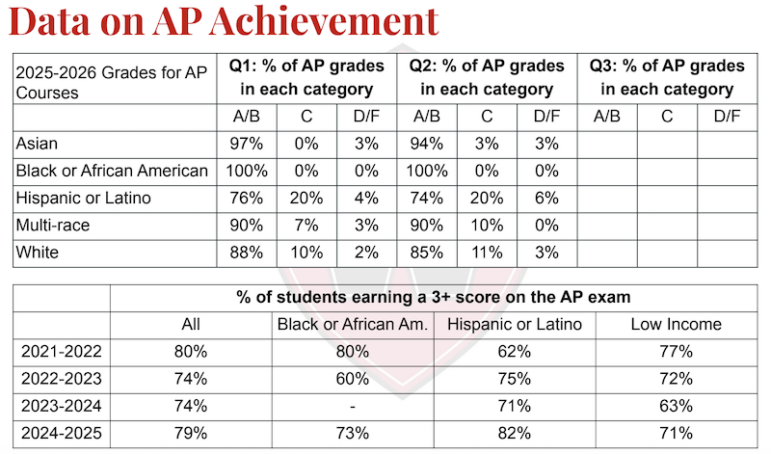
A majority of student in all groups earned passing scores on the AP exams. Andrews said the grades go down over the course of the year.
“I think this is a feature of the stress of a high school semester,” Andrews said. “The seniors, even in my class, it gets harder as the year goes on and you get closer to the test, but in most cases, if you look at the demographic rows, there is not very much variation between demographics in terms of what grade students are earning.”
The Task Force recommended that the data be tracked each year in AP classes, and look at the whole school to identify opportunity gaps and proposed interventions. The group also requested professional development for AP teachers to use differentiation in teaching to meet individual student’s needs, and continued guidance and coordinator collaboration on the enrollment process.
City Council President Mark Sideris, who is also on the School Committee, applauded the progress and said the schools seek more improvements.
“I do feel that we’re moving in the right direction by increasing enrollment, and you’ve identified some areas of concern that I think we should focus some on that,” Sideris said.
School Committee member Rachel Kay said she was impressed by the work that has been done.
“I think it’s amazing the work you’ve done, both the thinking about it and how do we promote the AP and discuss it in an equitable way,” she said. “And then getting the numbers up, and they’re still passing. So it’s, you know, it’s not like we’re increasing people and then they fail, but they’re we’re still passing.”
Kay was also concerned about making the courses available to multilingual students and those with disabilities.
Andrews said she is also passionate about that, too.
“I think the committee shared that passion in terms of figuring out what to do in our particular interventions,” Andrews said. “We felt, I think, that a lot of student responses from the survey of students who were not enrolled in advanced coursework was what I also think many of us may have experienced in subjects we weren’t as passionate about, which was lack of knowledge.”
School Committee member Lisa Capoccia said she does not want to see Watertown become like other districts where students feel pressure to take as many AP courses as possible. Andrews said she shares that concern.
“I feel, as a current teacher in Watertown High School, that it’s not an overly AP culture, but I share your concern — we don’t want to over emphasize this,” Andrews said. “We wanted it to be a more equitable picture of who’s enrolled in these classes, and we’re not really trying to add too many more APs. We don’t want every student to take four. We want every student who wants you to be able to take at least one.”
See the slide presentation from the WHS AP Pathway Working Group by clicking here.