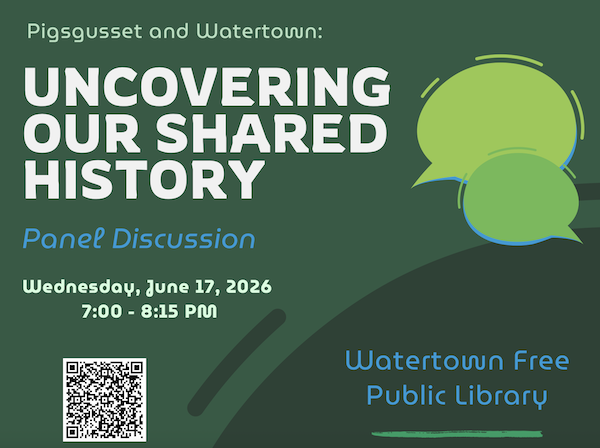
The following announcement was provided by the Pigsgusset Initiative:
How much do we truly know about the ground beneath our feet and those who lived here for thousands of years? Before it was Watertown, this place was known as Pigsgusset — “the meadow at the widening of the river.”
Community members are invited to go behind the scenes of the groundbreaking new public history tool, “Pigsgusset and Watertown: What You Might Not Know About the original Peoples and the Founding of Watertown” on Wednesday, June 17th from 7-8:15 p.m. at the Watertown Free Public Library. Members of the Pigsgusset Initiative, a working group of Watertown Citizens for Peace, Justice and the Environment, will host a panel that will describe the creation of an online StoryMap and will preview the soon-to-be released history tool.
Mishy Lesser, co-founder of the Pigsgusset Initiative and Learning Director of Upstander Project, will facilitate the panel. She will be joined by Marilynne K. Roach, President of the Historical Society of Watertown, and Jennifer Wolfrum, coordinator of the Pigsgusset Initiative. Together they will share their experience working together over the past three years to bring this history project to life. Participants will be able to preview the most recent version of the StoryMap and there will be time for questions and discussion following the presentation.
The Pigsgusset Initiative is dedicated to healing and justice through the un-erasure of Indigenous peoples from the place now called Watertown. Pigsgusset, or something that sounds like that, is the name for Watertown used by its original inhabitants from the Pequossette band of the Massachusett people. This is an English language corruption of an Algonquin word, which to the best of our knowledge, means “the meadow at the widening of the river.”
For more information, contact Jennifer Wolfrum at jenniferwolfrum13@gmail.com.
I’ll be out of town and won’t be able to attend in person. Will this be recorded for viewing after the event? Will it be streamed during the event itself?
A few years ago, I volunteered for the Charles River Watershed Authority (CRWA) to count fish swimming upriver at the Watertown Dam. I’ve been back every year since. I saw right away how arduous their journey was and how useless the “dam” was. (It dams nothing; it stops migrating fish and it creates a stagnant backwater upstream.) I also saw how communities upstream, indigenous and colonial, were robbed of literal scads of fish returning to spawn. This goes back almost 400 years. This link to the CRWA website tells the history.
https://storymaps.arcgis.com/stories/62917edcb76c4e10868cbb7a79638282#ref-n-dMK7U3
There are several expendable dams on the Charles River, none more so than Watertown’s. It’s the first barrier the fish encounter after the Charles River Dam, and for too many, the last. Those who believe in restorative justice—and environmental justice—must stand for the removal of the dam.