
Watertown residents will see an increase of 4.5% in both the water and sewer rates for the fiscal year that began on July 1, 2026, which is slightly higher than forecasted a year ago. However, the future increase could be significantly higher than projected due in part to an error made calculating future year revenues.
Last year, the City’s consultants, Weston & Sampson, projected a 4% increase in water and sewer rates in FY 2027. The actual increase will be half a percent higher, said Department of Public Works Director Thomas Brady.
With the 4.5% increase, residents using 1,800 cubic feet of water will increase $5.10 per quarter ($115.28 to $120.38), and the sewer bill for using 1,800 cubic feet will increase $9.54 per quarter, from $213.48 to $223.02. The overall increase would be $14.64 per quarter.
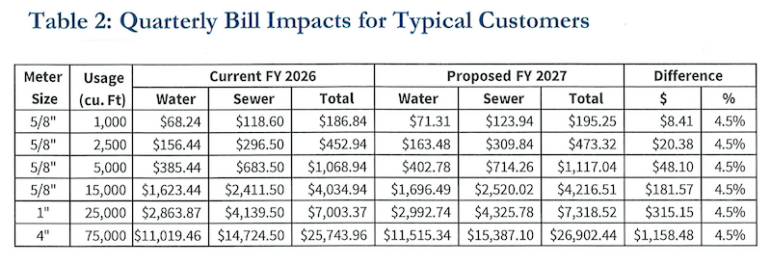
The City’s water and sewer expenses are in enterprise funds, where the money to cover the costs of running and the upkeep of the system are covered by the money from ratepayers.
In future years, the revised calculations show rate increases of 6% for water and 8% for sewer to cover the anticipated rising costs. One reason for the larger increase is an error in a model done last year, Brady said.
“The rates were 4.5% in 2027, as we were looking at them, and look working with our consultant team from Western Sampson, … it became apparent that there was a fairly good-sized divergence between where the revenue was going versus our costs, and that definitely caught our attention because it was markedly different from last year at this time,” Brady said.
The DPW’s memo said: “Our consultant recently informed us that the FY 2026 rate study contained a modeling error that contributed to the differences between FY 2026 and FY 2027 financial outlooks for the Enterprise Funds. Building the model on FY 2024 actual user charges revenue, the consultant used the FY 2025 rate increases that were higher than those adopted (5.5% for water and 6.0% for sewer vs. the 3.5% adopted for both), which overstated projected revenues and understated the rate increased needed in FY 2026 and future years. After correcting the FY 2027 rate study, higher rate increases were required to maintain healthy reserve levels.”
Brady said he would like to study the numbers more closely to come up with better forecasts for future year water and sewer rates.
“So, what we’d like to do is to set up a working group, however the Council deems appropriate, and get that rolling very soon, probably in August, and really take a much closer look at where we’re looking for expenditures versus revenues moving forward,” Brady said.
City Councilors asked Brady why the costs were increasing. Brady said the costs include more than just providing water and sewer service.
“It’s kind of challenging to live in this particular part of our country,” Brady said. “Our infrastructure is very old, so so we need to maintain it. And those costs, you’re exactly right, continue to climb.”
Councilor Theo Offei asked if there is any way that rates can be discounted for people having trouble affording the rate increases, such as seniors or low-income residents.
Brady said the tiered structure is set up to provide a lower rate for using a lower amount of water, and if people have a concern with their bills the City has an appeal process.
City Council President Mark Sideris said water and sewer rates are always a bone of contention with residents, who will call to ask why their bill is going up if they are using less water. He added that the City must find a way to prevent larger rate increases.
“I feel, and the Manager (George Proakis), you and others have pointed out, we need to be less aggressive with our capital improvements in order to give the residents some sense that we’re not doing everything 100 miles an hour,” Proakis said. “We’re going to slow down a little bit because that’s the only way we’re going to be able to provide some relief, and 8% increases are unacceptable.”
In prior years, when Watertown residents faced increases of more than 5%, the City added a fourth tier to give some relief to the average homeowner, said Council Vice President Vincent Piccirilli who is chair of the Council’s Budget & Fiscal Oversight Committee. He said he thinks that committee would be the right place to discuss ways to address the increases.
Councilor Caroline Bays asked what the City and the DPW will be doing to make sure that it does not happen in the future. Brady said the working group will drill down to make sure that inadvertent mistakes do not occur.
Councilor Nicole Gardner said this is the second time in six months the City has discovered an error made by a consultant.
“It may make sense for the City administration to consider some process by which we pressure test significant modeling that’s being done by consultants on a regular basis,” Gardner said.
See the Water and Sewer Enterprise Rate documents by clicking here.