A building along the Charles River in Watertown where textiles were once made has a new tenant involved in manufacturing. Tutor Intelligence creates AI robots that are used by companies from coast to coast.
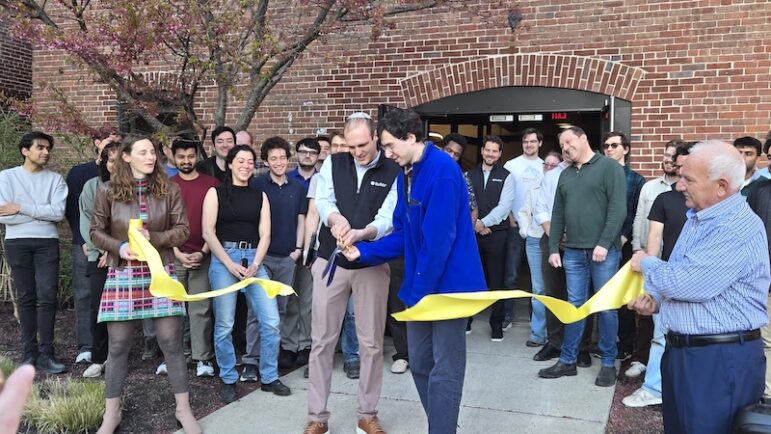
On April 23, Tutor hosted a grand opening at its offices in Riverworks, a building on Pleasant Street that was previously home to Boston Scientific, and prior to that was known as Aetna Mills.
The company spent most of its first five years on the other side of Watertown in a space on Coolidge Hill Road under Eastern Clothing. Tutor outgrew that space and looked for a larger facility, said Tutor’s CTO Alon Kosowsky, who co-founded the company with CEO Josh Gruenstein. The company had about 30 employees when the moved to town, and now there are nearly 90.
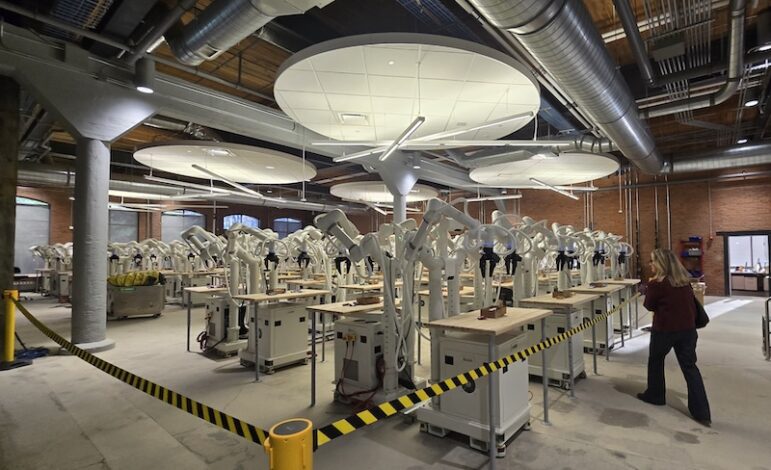
“We had a good spot. I think we were about 10,000 square feet. At one time that felt really big. But when we were at 60 employees, that was starting to feel pretty small,” Kosowsky said. “We were doing all of our manufacturing in location, we did all of our robot testing in spot, all of our machining, everything was done in that one spot. We expanded out to here. We now have enough room to have 100 robots all set up for data collection. We have lots of other robots that are driving around. They need their own space, room for R&D, and we still do our manufacturing out of that older space.”
During the open house, City Council President Mark Sideris said he was glad to see that Tutor was staying and expanding in Watertown.
“We couldn’t be any happier to host you. We couldn’t be any happier that all of you people who work here love it here, from what I understand,” Sideris said. “It’s a great facility, and we’re hoping that you’re here for a long time, and we’re here to offer our service.”
One of the attractions was the location. Tutor’s offices have large windows looking out onto a calm stretch of the Charles River. Kosowsky said he and other employees go fishing near the office, and the company holds meetings on a grassy area along the river bank. Watertown has other advantages, he said.
“Watertown is a fantastic spot. Starting a company out of Boston, my co-founder and I are out of MIT. We have a strong connection to the university, and I think it’s really great to have a place like Watertown, because it’s so close to the city, but still has spaces that are big enough to actually do real work,” he said.
Emily Spector, Tutor’s head of business operations, said the company is continuing Watertown’s tradition of manufacturing.
“One thing we love, actually, this is the site of one of the oldest manufacturing sites in the United States. This was a mill building. In the 1600s there was a mill here. …” Spector said. “Watertown has such an industrial history with all the armories and the Cold War research and all of that. And so we really enjoy the full circle image of bringing it back around, back to tough tech.”
Tough tech blends technology with real-world applications. In Tutor’s case that is creating robots that companies use in manufacturing and logistics. The company uses AI to teach the robots how to handle different tasks, and to adapt.
“Robots have been part of manufacturing for a very long time. However, they only really get to do things in manufacturing where the job doesn’t change year after year, even as long as decade after decade,” Kosowsky said.
Tutor uses a different model where, rather than owning the robots, companies lease them by the hour.
“The automation provider, they’re going to do a good job, but they’re done usually after the first day, or maybe there’s a service contract, but their incentive is to get you something in and then set it up and then let it go. If it gets used five years later, that’s not really on them,” Kosowsky said. “Tutor is very different. If you stop using our robots after a couple years, that would be a bad outcome for both of us. And our business model is basically designed to reflect that.”
To have customers keep using their robots, Tutor enables the devices to be able to switch to do different tasks, Kosowsky said.
“We teach robots how to do new things quickly, so that the robots are able to adapt to new environments. The robots are able to adapt to new environments, new products, new lines,” Kosowsky said. “And that way our customers — who are unable to buy robots because they just don’t have the same consistency that is traditionally really high volume — we’re there to provide it.”
Riverworks
Riverworks on Pleasant Street is a former textile mill, and more recently housed Boston Scientific.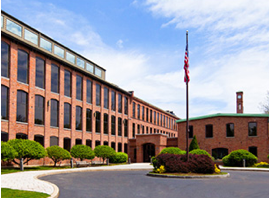
Most of the customers use the robots to help in the packaging process, said Spector.
“Our customers are almost exclusively in CPG — consumer packaged goods. So that’s packaged cosmetics, home goods, with customers manufacturing candles for major candle brands, for home goods brands and the cereal you walk past in the grocery store, and all the snacks and your alcohol,” Spector said. “All of that is a good fit for the robots.”
Tutor’s robots learn from each other, which is where the AI comes in.
“We believe that it is impossible to do the best research or do the best deployments, without that feedback loop where each field is kind of enhancing and guiding and directly powering the other,” Spector said.
The familiar AI services, such as ChatGPT or Gemini, are based on spoken language as its data set, Spector said, but that is not the same data that Tutor’s robots need.
“What robots need is, they need visual data about the world,” Spector said. “They might need 3D data about the world. They certainly need joint angles, right? Truly what shapes through space they need to make. They need end effector data, of like, how do I actually approach some object? And then, of course, you actually need directions, that’s part of the data set, too. What does the action mean? What was the robot asked to do?”
The company has 100 robots in one room. During the open house, they were picking up small packages of snacks and placing them in a box, and generating information. The space is known as Data Factory 1, or DF1, but that is not the only way to get more information for the robots.
“This DF1 place is a data generation facility so that we can sort of be our own customer and create data that will be used to train the models,” Spector said. “Now, because we are also a deployment company, we have access to the best and most valuable data in the world, which is real, live production data. Our systems are in factories across the country, from Boston all the way out to California and back again.”
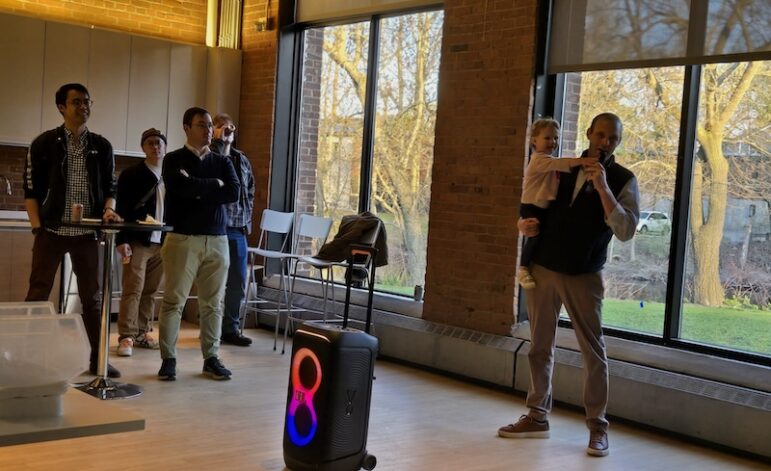
As he welcomed the visitors into Tutor’s new home at Riverworks, Kosowsky reflected on the journey.
“We’ve come a long way since our days in the spare bedroom, when I’m looking for a seed investment of $8,000 to buy one robot arm. We could not get jobs, Josh and I, so we started a company instead,” Kosowsky said. “We’ve been in a lot of places since then.”
The company moved from Kosowsky’s spare room to MassRobotics, an incubator in Boston’s Seaport. They spent the first year there working with other start-ups, and with access to tools and networks and other things to help get the company off the ground.
The company has come a long way since its time in the Seaport, said Joyce Sidopoulos, co-founder of MassRobotics.
“We came here, (MassRobotics Executive Director) Tom (Ryden) and I, a couple weeks ago, and we were actually jealous,” Sidopoulos said. “You’ve really built an amazing team, and couldn’t be prouder, congratulations.”
The company then made the move to Watertown, and when they outgrew the space they moved again, to the former mill building along the river.
“I’ll say this one is a lot more exciting to show off, as we have, I think, built something quite spectacular,” Kosowsky said.
Thank you for the excellent article about Tutor Intelligence.
Previously I had no idea what went on within that enterprise.
For sure, I wish them the best success.
Great story. Thanks for choosing Watertown. Keep innovating and staying focused.
100% agree! I hope they attend STEM tomorrow night @5;30, Watertown Middle School and/or talk to WHS Robotics Team (https://wcatv.org/whs-robotics-2024/) to develop some future employees.
Welcome Tutor Intelligence. You are what Watertown needs – a growing company with innovative ideas and manufacturing based. Bringing manufacturing back to this area is significant and, hopefully, many other companies interested in adding to this industry will look to our city to set up their companies after hearing your story.
I have encouraged some of our city leaders to consider encouraging new business types to move here to provide diverse jobs and opportunities. I saw coverage of your company on the local news recently and was so impressed with your operation and its potential. Wishing you continued success here.