By Katherine Patterson
Watertown Resident
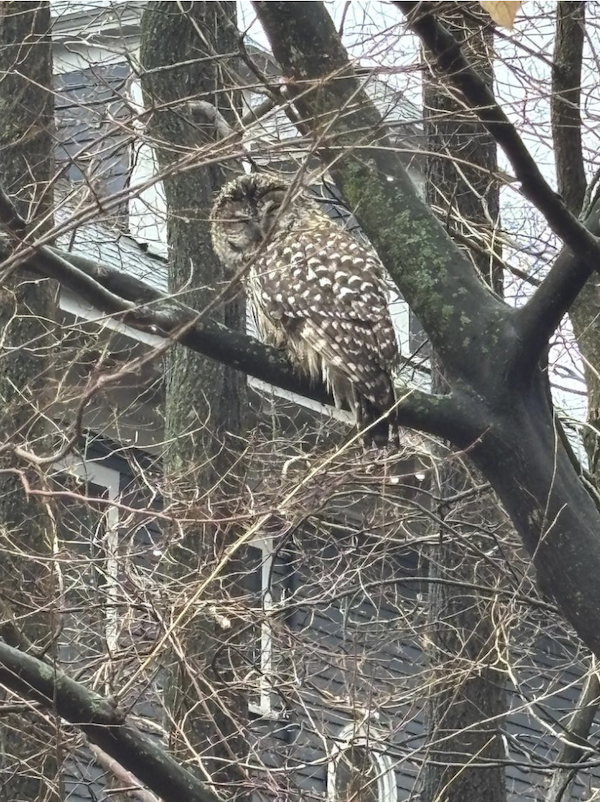
On Sunday, January 11th, we were amazed to see a beautiful barred owl sitting on a low branch in our backyard. We live next to Whitney Hill in Watertown, and had been hearing barred owl calls in the evening over the past few weeks (“who cooks for you?!”).
After an hour our excitement turned to concern. The owl was now completely still, unbothered by any nearby noises.
We tried to reach a wildlife rehabilitator, with no luck. We spoke with the Massachusetts Environmental Police, and though they shared our concern, they could not come out for the owl.
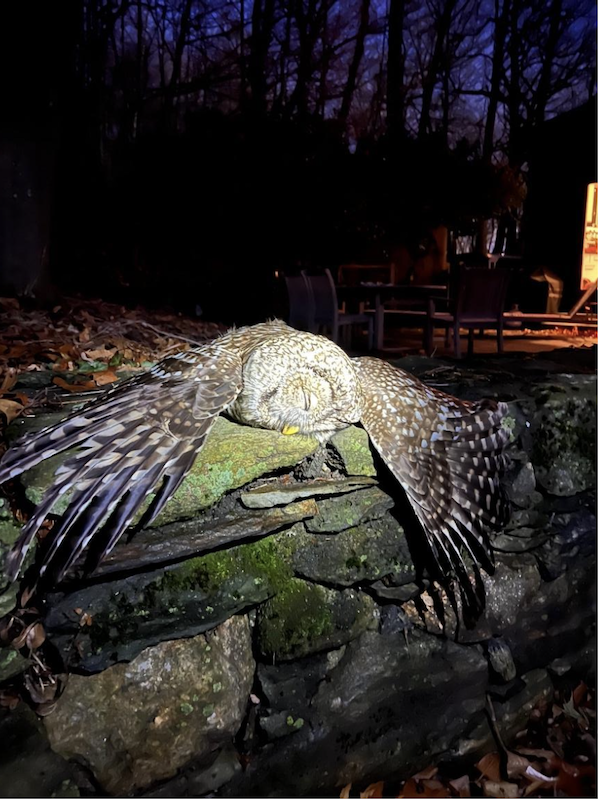
As the afternoon light began to fade, we noticed the owl had left. Our relief was short lived, as we soon spotted its body face down on our stone wall. It had literally fallen out of the tree dead.
The people I had connected with to try and get help for the owl told me there was a good chance that the owl had suffered secondary poisoning from anticoagulant rodenticides, unfortunately a common cause of death for owls, raptors, coyotes, and foxes. There are several well-publicized cases of this, including a family of great horned owls, the bald eagle MK in Arlington, and Flaco the escaped Eurasian eagle owl in New York City.
I wanted to know whether the owl in our backyard had suffered from rodenticide poisoning, but most wildlife centers I called said they unfortunately cannot test every animal. They are very aware of what a huge problem it is. A 2020 Tufts Wildlife Clinic study tested samples from 43 red-tailed hawks in the northeastern United States and found anticoagulant rodenticides present in ALL of them.I have since learned more than I ever wanted to know about rodent poisons.
Anticoagulant rodenticides (second-generation anticoagulant rodenticides, or SGARs, are potent and commonly used) can take up to 10 days to kill a mouse or rat. As the rodent slows down and becomes ill, they are easier prey. Though eating one poisoned rat will not kill an owl, raptor, fox, or coyote, the anticoagulant rodenticide accumulates in the body of the predator. These toxins build up after each exposure, leading to chronic illness, immune system suppression, and eventually a long and painful death.
Secondary poisoning of the very animals that help to control rodent populations CAN be avoided. Integrated pest management strategies are straightforward and effective:
First: Block rodents (seal up entrances, use non-toxic repellents).
Second: Starve rodents (remove trash and food sources).
Third: Use non-poison methods to remove rodents (snap traps, carbon dioxide sprayers, etc).
Finally, if poison is needed for a serious infestation, cholecalciferol (vitamin D3) can be used instead of an anticoagulant rodenticide. Cholecalciferol does not cause secondary poisoning in predator species.
Many Massachusetts towns and cities have organized around this issue and no longer use anticoagulant rodenticides on municipal property. Watertown’s stated policy is to follow an integrated pest management strategy, and to use the vitamin D3 formulation in bait boxes on any municipal property. There is currently legislation in the Massachusetts Senate to more carefully regulate anticoagulant rodenticides on the state level, which will limit the use of these rodenticides by licensed exterminators on private property as well. Save Watertown Wildlife is active on this issue, and the Mass Audubon Rescue Raptors program has been supporting these efforts across the state.
I hope that the owl can be tested for the presence of SGARs. But even without knowing the definitive cause of death, I am committed to working on this issue to protect the predator species that we are lucky enough to call our neighbors.
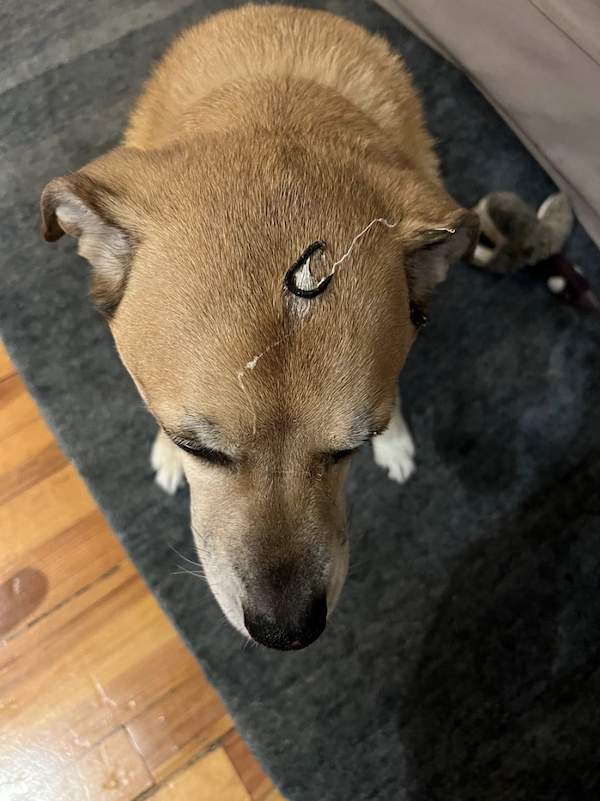
A few nights ago, while walking my dog, I heard another barred owl in Whitney Woods. I sat down to watch, and it flew closer. Eventually the owl perched on a branch directly above us. At this point I was talking to it continuously, somewhat nervous that it might dive bomb my dog! After carefully inspecting us for a few moments, the owl flew off.
When I got back inside and into the light, I realized that the owl had pooped on my dog’s head. I’m taking that as a sign from the raptors to keep working on this issue.
Thanks for bringing this to our attention. Indeed we must consider the effects of poisons on our wildlife.
We have a pretty robust rat problem here in the East End. I would love to hear town officials reaction to the unfortunate tale of this barred owl. We must explore ways to solve the rodent issue without killing desirable wildlife.
In the first half of the twentieth century, Massachusetts was deprived of much of our native wildlife by any number of careless practices. Presumably we know better now and will take better care.
An owl is a great neighbor in part because it consumes undesirable critters. They are beautiful birds as well. Let’s protect them.
I had a large rat that decided to make it self at home in my back yard. I only knew this as I saw it scooting behind my car one evening. I also saw tracts in the snow. So I used a have a heart trap to catch it. Not knowing what else to do, I left it to die of the cold.
I did not want it to be living in my yard and of course there is no place that I know to take them to. I guess that is the “have a heart” way as I know it.
A few years ago, I was sitting on a bench on the Charles River behind the dam, when a red tail hawk swooped in and perched in a nearby tree. Soon another came (her mate) bearing a prey gift. The red tails nested in a big fir tree a short distance down the river. A woman who was a raptor expert set up her camera and many users of the reservation were treated to the sight of the red tails as she invited passersby to take a look. The birds laid three eggs, and all the eggs hatched. The parents worked diligently to raise the chicks. Soon they were fully-feathered fledglings and could be heard calling for feeding. When they fledged they flew from the nest to a huge nearby fir tree — back and forth. The parents continued to feed them. Then one morning the raptor lady found one of the young red tails dead under their nest tree. Then we saw through her telescopic lens another youngster with its breast feathers striated red from internal bleeding. All the young red tails died. The raptor lady took them to be necropsied. The result: All had died from rodenticide poisoning. The parent red tails stayed in the nest tree for a week or so. Then they were gone. They could not have known that the prey they were feeding their young was laced with poison and might kill them, too. Please, please don’t use rodenticides on your property and support legislation to ban the stuff.
What a sad story. We need to spread the word about the impact of these rodenticides, and do better by our wildlife! If you want to support the current bill in the MA legislature, you can call or email Christine Barber.
Contact the House Chair, Rep. Christine Barber:
The Senate version of the bill to phase out the use of anticoagulant rodenticides, An Act Restricting the Use of Rodenticides in the Environment (S2721) was given a favorable report by the Joint Committee on the Environment and Natural Resources (ENR) and referred to the Senate Committee on Ways and Means. The House version (H965) is still under consideration by the ENR committee with an extension to March 18 for the House ENR committee members to vote on the bill.
Thanks for writing this!
I was just thinking of owls the other day and how to encourage them in this area because I’ve heard neighbors complaining about rats in East Watertown. I’ve seen a red-tailed hawk around here frequently, though it may also be pursuing rabbits and pigeons.
A couple of years ago I found a dead hawk in my yard, and at the time thought the avian flu might have been behind its demise. It’s good to have a reminder of the dangers to wildlife health that we have control over in our choices about what pesticides to use, if any. I hadn’t heard of the vitamin d3 alternative and hope groups make the switch beyond just on municipal land.
Raptors dying from eating rats that have ingested poison has been occurring for a while. A few years ago an eagle was found in Arlington (near the Mystic Lakes) from ingesting poisoned rats. The female eagle fledged from a nest in the Mount Feake Cemetery in Waltham. An owl was also found dead due to the same issue in an Arlington Cemetery. More recently, I had heard that a Red Tail was found dead near the Gore Estate.
In speaking with our city officials, they indicated that for the city controlled traps the correct bait is used to limit the death of birds of prey by ingesting these rats. But, they cannot control the bait used by Contractors in the City. Maybe there should be an amendment to one of our City Ordinances to limit what contractors can use to bait these traps. At least until the State does so!
Hi, Leo,
Thank you for writing! I agree that a home rule petition to allow Watertown to amend a City Ordinance to limit what contractors can use would be a good idea. As you likely know, there is a bill in the state legislature right now to restrict the use of SGARs across Massachusetts; calls or emails to Representative Christine Barber, House Chair of the Environment Committee, would help move this bill along: christine.barber@mahouse.gov. Save Watertown Wildlife, mentioned in the article, has a website – savewatertownwildlife.org – and an active group if you’d like to work on this issue.
What’s in the traps lashed to virtually every telephone pole in town? Perhaps if we had fewer of those, we’d have more owls, raptors, coyotes, and foxes. And fewer rats as a result.
Hi, Josh,
Thanks for writing! Watertown, MA, uses vitamin D3 (cholecalciferol) in bait boxes on municipal properties. You are absolutely right that fewer SGARs should lead to more natural predators, and fewer rats. A bill is in the state legislature right now to restrict the use of SGARs across Massachusetts; calls or emails to Representative Christine Barber, House Chair of the Environment Committee, would help move this bill along. christine.barber@mahouse.gov. Save Watertown Wildlife, mentioned in the article, has a website – savewatertownwildlife.org – and an active group if you’d like to work on this issue.
Sorry but we have to kill the rats. Chemicals are harsh but have been getting better. The problem with environmentally friendly solutions is that they do not work when you have a rat infestation. I even hired an environmentally friendly exterminator during COVID to deal with the rat infestation in my house, and unfortunately the exterminator with the harshest chemicals worked. Before the exterminators came, we tried the solutions mentioned above and some others (peppermint, baking soda and sugar, raw sweet potato)not mentioned. They failed miserably and a lot of money went down the drain.
Have some birds died – yes, will they continue to die, probably, but when you weigh what a rat infestation can do to a house, the costs, and the possibility of spreading disease which rats are excellent at, you have to figure what kindS of solutions don’t wipe out the entire population of birds and keep the rats at bay. Rats are not rabbits. If we could easily hunt them with guns, then I’d be for it. We cant though.
I know that raptors feed on rats but the rat problem far outgrew that method. Also raptors are not dying only due to chemicals – natural predators, habitat loss, pollution, climate change, human food, etc. So there also needs to a balance approached there.
I would not be in favor of any legislation/petition that outright bans solutions that work. I do favor an integrated pest management strategy in which all options are on the table, especially when it comes to my own property and properties in the city. One sighting of a hawk does not make up for the rats I saw over 18 months, nor would it ever make up for catching something like Leptospirosis or Hanta virus.
The legislation being considered in MA acknowledges the public health threat of rat infestation, and does not propose an all-out ban on SGARS, just more significant regulation. The activated Vitamin D3 formulation (cholecalciferol) which can be used as an alternative if poison is needed is an incredibly potent rodenticide (which needs its own regulation as it is harmful if directly ingested by any non-target animal). However, cholecalciferol has the benefit of NOT causing secondary poisoning in predator species. In other words there are highly effective options (even if you need poison) that have been proven effective and have less impact on owls/raptors/coyotes and foxes.
Vitamin D3 is almost too effective as it is untreatable because it shuts down the kidneys very quickly. If pets or a child consumed it, death would almost be the result. If it is used it should be used in limited areas of a building like inside a wall or attic per one of the exterminators. It should not be placed outside. Kids and dogs are notorious for picking up things and putting them in their mouths. When I suggested outdoor cats in another forum, someone said that was very bad for the birds and a big NO NO. Again, they kept rats and mice away. I have hard time prioritizing other animals over human children and pets. Maybe the raptors should be migrated away from cities because in Watertown their presence is a very recent phenomenon. Even they turkeys which were brought up here from Pennsylvania have been around for just twenty years.
Groundwater and runoff into the water system is circulating the toxins into our bodies. Continuing to seek solutions that are safe and effective must not stop due to fear mongers and financial pressures.