The following announcement was provided by Mount Auburn Cemetery:
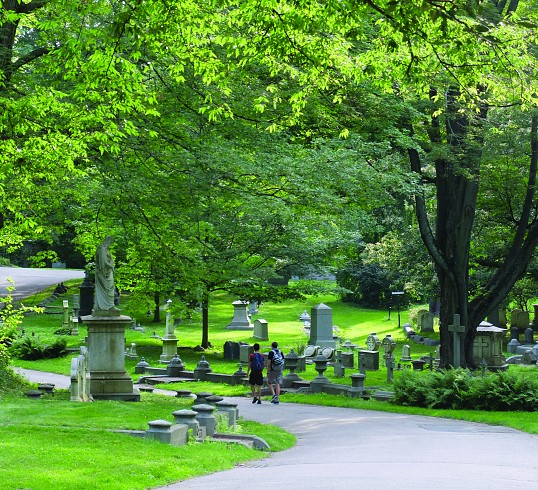
Mount Auburn Cemetery, the American Green Zone Alliance (AGZA), and Quiet Communities announced that Mount Auburn has become the first cemetery in the United States to earn AGZA Green Zone® Certification, cutting carbon emissions by 16 tons annually.
The designation marks a shift from gas-powered handheld landscaping equipment to battery-powered tools, creating a cleaner, quieter, and healthier environment for people and wildlife alike and offering a model for how cemeteries and other large landscapes can operate more sustainably.
The AGZA Certified Green Zone program is a four-level program designed to transition landscape maintenance operations away from fossil fuel-powered equipment to battery electric-powered equipment and other low impact alternatives. AGZA and Quiet Communities implement the program for parks, municipalities, institutions, and businesses across the country, providing education, training, support, and metrics that demonstrate reductions in emissions, noise, and other impacts over time.
“As the first garden cemetery in the United States, we have a responsibility to continue leading in how landscapes like ours are cared for,” said Matthew Stephens, President & CEO, Mount Auburn Cemetery. “This commitment reflects our leadership and vision in preserving and enhancing the beauty of our landscape while prioritizing sustainable practices that strengthen its long-term value for the community. Cambridge and Watertown are cities deeply committed to environmental stewardship, and as a shared resource for both communities, we’re continuing to expand our sustainability efforts, including how we care for our landscape and the tools we use to maintain it.”
Mount Auburn’s Level 1 AGZA Green Zone certification indicates that routine maintenance is performed without using gas-powered handheld tools, including leaf blowers, string trimmers, hedge trimmers, edgers, and chainsaws. Level 2 certification involves phasing out non-handheld equipment like mowers, and higher levels integrate broader sustainable landscape practices. Mount Auburn plans to continue its transition towards higher certification levels.
AGZA and Quiet Communities estimate that Mount Auburn’s transition to Level 1 will eliminate approximately 16 tons of carbon dioxide emissions annually, equivalent to the carbon absorbed by 660 mature trees. Other estimated reductions in impacts from gas equipment include:
● Elimination of 8,981 pounds (4.5 tons) of toxic and carcinogenic emissions annually
● Substantial reductions in noise using electric equipment that is 2 to 4 times quieter than gas counterparts
● Decrease of 361 gallons of fuel spilled into soil and groundwater annually
“Mount Auburn Cemetery is demonstrating what the future of landscape care can look like,” said Dan Mabe, President, American Green Zone Alliance. “By transitioning from gas-powered equipment to cleaner electric tools, Mount Auburn is protecting the health of its staff, visitors, and neighbors while significantly reducing emissions and noise pollution. We hope this milestone inspires other cemeteries, parks, and institutions across the country to take similar steps.”
“Mount Auburn’s initiative is a win for all – worker health, staff and visitors, eco-systems, and our planet,” added Jamie Banks, President of Quiet Communities.
Mount Auburn will mark this achievement with a special ceremony on Thursday, May 28, in partnership with AGZA and Quiet Communities, bringing together staff, including horticulturists using the new battery-powered tools, as well as municipal and community leaders and visitors.
About Mount Auburn Cemetery
Mount Auburn Cemetery was established in 1831. Within a forested landscape nestled between Cambridge and Watertown, its founders created an extraordinary place—one where the living could find solace and the public could find inspiration. Home to more than 100,000 permanent residents, Mount Auburn welcomes more than 140,000 visitors each year and is open 365 days a year. Recognized as one of the most significant designed landscapes in the country, Mount Auburn was listed on the National Register of Historic Places in 1975 and designated a National Historic Landmark in 2003. www.mountauburn.org.
About American Green Zone Alliance (AGZA)
AGZA was founded in 2013 and helps transition the landscape maintenance industry safely and responsibly to lower impact technologies and operations. Through workforce training, property certification, and impact data reporting, AGZA takes a solutions-based approach educating the industry to seek more sustainable paths that are economically, and workload feasible. https://agza.net/
About Quiet Communities
Quiet Communities is a national nonprofit 501(c)(3) organization dedicated to helping communities reduce health and environmental harm from noise and pollution with evidence-based approaches and solutions. Its land care program focuses on helping to transition the outdoor power equipment industry to low-impact alternatives to protect public health, worker health, and environmental quality. https://www.quietcommunities.org/
Dear Editor,
Who is the author of this article and who supplied the story? While this sounds like a positive item, the organization behind it is problematic. It’s not like the stewards of Mt Auburn Cemetery need this kind of recognition. They are already doing amazing work in preservation, landscaping and community programming. They recently honored the grandsons of Paul Revere, one who died at Gettysburg and one who died at Antietam. Given its size and location, quiet is, in general, a natural attribute.
The Noise Project, an organization that studies gentrification, voices the inherent social and political injustices in “noise pollution” and is funded by the National Science Foundation needs a plug here as well. So I ask people to go to https://noiseproject.org/.
Both are national projects and if I am not mistaken have been around for a decade or about that. However, the Noise Project addresses inequity and noise, and correctly recognizes noise as noise and excessive noise. They have found that noise ordinances are economically inequitable as they benefit high income households – in general, homeowners, caucasians, work from home individuals, etc. They have also found that noise ordinances are socially inequitable as they benefit those who are not persons of color, persons with disabilities, minors, marginalized cultures, etc. This group along with groups particularly concerned with the environment finds that the group in article does not accomplish its stated purpose, and can harm environmental goals. Some see the group as a thorn in the EPAs side as the group redirects funding away from the most impactful environmental solutions. One example in particular speaks volumes, that of public transit. Sometimes the focus on “noise pollution” reduces public transit or advocates for less. And sometimes they exempt public transit especially where is it is near low income neighborhoods, thereby raising “noise pollution” for those households. Pickleball is another target. In a country in which we have loneliness and obesity epidemics, this is not wise. The science has not beared this out but I suspect that the rise of colon cancer in 30/40-something is linked to our more sedentary lives at an earlier age.
This caught my eye because we are amending our noise ordinance right now, and we need to be super careful since Watertown, to our shame, ranked at the bottom of the Fair Housing Report last year. We need to also be aware of how this impacts persons of color , those with disabilities and youth. With ICE lurking about and carte blanche on the rights of Americans who are black, being cognizant is critical. Right now, the end result is not just a fine but a potential life threatening situation. The cynical part of me sees this award going to Oakley Country Club next. If that is not the definition of tone deaf, then I don’t know what is. Thanks for provide the space.