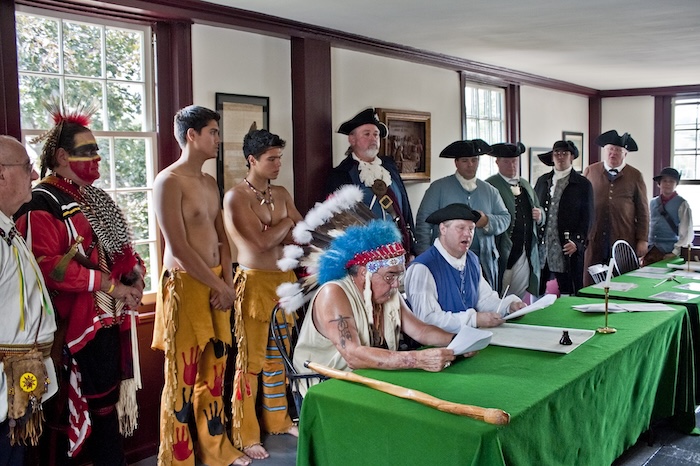
In the days after the former 13 colonies declared their independence from Britain 250 years ago, Watertown had a moment. The town outside Boston became the center of government in Massachusetts, and two historic firsts took place right near Watertown Square. However, these occasions got lost in the ether somewhere between George Washington and George H.W. Bush. It took some people with long memories to rekindle the connection between Watertown and the indigenous tribes on both sides of the Canadian border. This July 18th, Watertown will celebrate the 250th anniversary of these historic moments with the ancestors of those present in 1776.
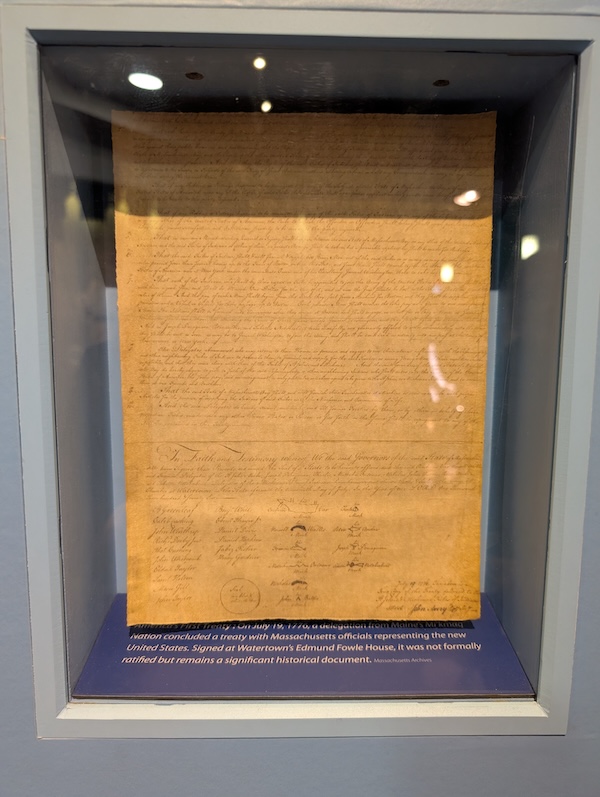
The City’s contribution to America’s 250th anniversary will be Treaty Day, marking the signing of the first treaty by the newly independent nation on July 19, 1776. The treaty was between the United States and the Mi’qmak and Maliseet tribes. As the sides worked on the treaty in the Edmund Fowle House, a copy of the recently signed Declaration of Independence reached Massachusetts and the public reading took place in Watertown on July 18.
The house served as the headquarters of the executive branch of the Massachusetts government from July 1775 to September 1776. While it now stands on Marshall Street, it was originally on Mt. Auburn Street but was moved to Marshall Street in 1871. It serves as the home of the Historical Society of Watertown.
Treaty Day 2026
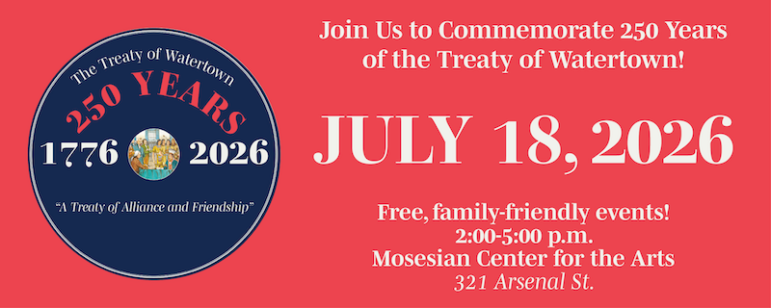
After the rediscovery of the Treaty of Watertown in 1987, the Historical Society of Watertown decided to mark the anniversary with a celebration, with the first one in 1996. For the 250th anniversary, the Historical Society of Watertown has teamed with the City of Watertown, and the Mosesian Center for the Arts to put together a grand celebration. Members of the tribes that signed the Treaty will travel to take part in the celebration that will take place on July 18, 2026 from 2-5 p.m. at the Mosesian Center for the Arts, 321 Arsenal St., according to Erin Rathe, the City of Watertown’s Senior Planner for Economic Development.
“I was approaching this with that lens of, what does Watertown have that is unique about the 250th anniversary of the Revolution,” Rathe said. “So many municipalities around the state are having big Fourth of July celebrations, which is totally appropriate, but Watertown has this treaty. When I learned about this last summer at the last Treaty Day, I started working with the Historical Society. (Public Arts & Culture Planner) Liz Helfer and I both said, you know, this is what’s really special about the 250 for Watertown — it’s unique.”
The celebration will begin with a performance by a group of young women from the Mi’kmaq tribe who are apprentices in traditional drumming.
Indigenous storytellers and educators will be showing people how to make wampum (traditional beads) and corn husk dolls in the classrooms at the Mosesian Center.
A replica of the Treaty of Watertown, and an exhibit of artifacts and artwork made by indigenous people will be displayed in the Mosesian Center.
Watertown Cable Access TV put together a documentary after interviewing members of the Maliseet and Mi’kmaq when they visited for last year’s Treaty Day. The video can be viewed in the Dinah Lane Theater, the MCA’s black box theater.
The formal part of the afternoon will take place in the Charles Mosesian Theater.
“We’ll have speeches from the Massachusett tribe, the Mi’kmaq, the Maliseet, people from Watertown on the history of the Treaty,” Rathe said. “A couple of people will present what the Treaty means today, and how the tribes use it to secure those ongoing rights. Then, prayers, and songs from the Grand Chief of the Mi’kmaq.”
A color guard from the Watertown VFW will honor Mi’kmaq and Maliseet veterans of the U.S. Armed Forces, and will include the Mi’kmaq and Maliseet flags.
The Revels choral group will perform a piece written by William Billings at the time that the Treaty was signed.
“When the Provincial Congress moved to Watertown out of Boston because of siege, he wrote this song, ‘Lamentation Over Boston,’ from the perspective of now being in Watertown, looking back as Boston is burning and lamenting: will we ever be able to go home again, and what is going to happen to our people? It mentions Watertown in the song,” Rathe said. “Then we’ll invite everyone back outside for a musket salute by the Watertown Provincial Guard, and more drumming from the Mi’kmaq Young Women’s Drum Circle.”
This event is free and open to the public but people are encouraged to RSVP for planning purposes. Click here to register.
While the main celebration will be July 18, an associated event will take place at the Watertown Free Public Library on July 15 from 7-8:30 p.m. The Upstander Project will host a panel on indigenous views of the origins of the American Revolution. Panelists include Watertown resident and co-founder of Pigsgusset Initiative, Mishy Lesser; Chris Newell (Passamaquoddy author, educator, musician, and culture-keeper), and Graham Marshall (Mi’kmaq educator, musician, and culture keeper). The evening also includes drumming and a screening of Upstander Project’s short documentary, Bounty. See more information here.
On July 17, members of the tribes traveling to Watertown and others will attend an invitation-only dinner at the Commander’s Mansion. Food will be prepared by Sherry Pocknett, the first Indigenous woman to win a James Beard Award for Best Chef.
Celebrating Re-Discovered History
The 250th anniversary celebration of the Treaty of Watertown may not even be taking place, if not for a contingent from the tribes that signed the Treaty that ventured to Boston in the 1980s, said Joyce Kelly, a member of the Historical Society of Watertown’s Council.
“How we first found out about the Treaty was back in 1987 a whole group of Mi’kmaqs came down to the State House to reenact the signing of the Treaty,” Kelly said. “They were looking for some rights to be held up on the treaty up in Canada — not from this treaty, but another treaty — and they weren’t being upheld. So they came to the Mass. State House to bring this treaty up, our treaty, and there was a reenactment of a signing there of it.”
Someone at the State House reached out to the then-Town Hall in Watertown, which contacted the Historical Society of Watertown.
“At that time Paul Brennan was president. He had been president for two months and was brand new to all of this. He was 27 years old,” Kelly said. “So, of course, he went to different people in the Historical Society, like Charlie Burke, who’s a town historian, and Charlie had never heard of the Treaty. Nobody had ever heard of the Treaty. It was not even in (the 1980 Watertown history book) ‘Crossroads on the the Charles.'”
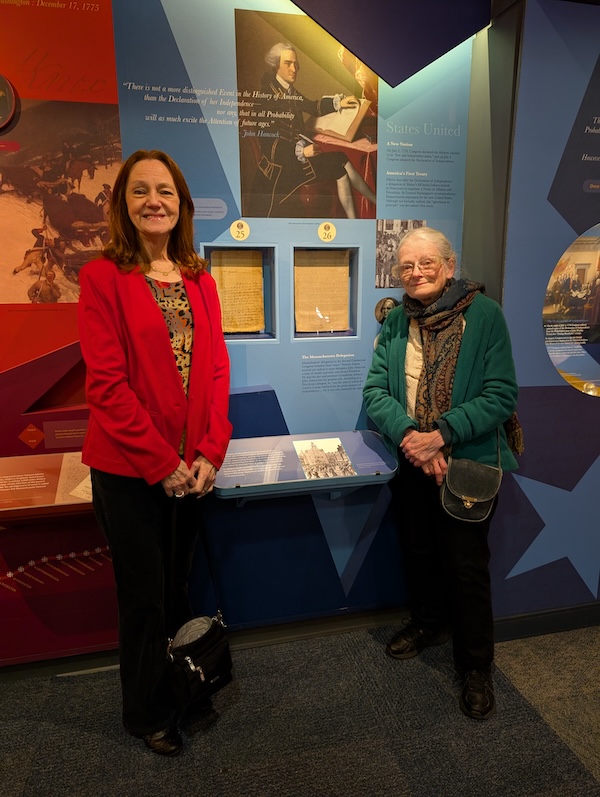
The primary focus of the Treaty was to secure a military ally against the British, but it also provided rights for the tribes over land and fisheries in what is now Maine and Canada.
Brennan attended the event at the State House and learned about the Treaty, Kelly said. Watertown’s Treaty Day Celebration, however, would have to wait another nine years.
“I just spoke to Paul on the phone about this the other day, asking him what happened, and how come it took nine years to get the Treaty Day going,” Kelly said. “It’s because he had been president for two months. He was 27 years old. He had a job, and the (Edmund Fowle) House was in disrepair.”
Through Brennan’s efforts, the Historical Society got tax exempt status, and renovated the Edmund Fowle House, Kelly said.
The Historical Society’s Treaty Day celebration has taken several forms
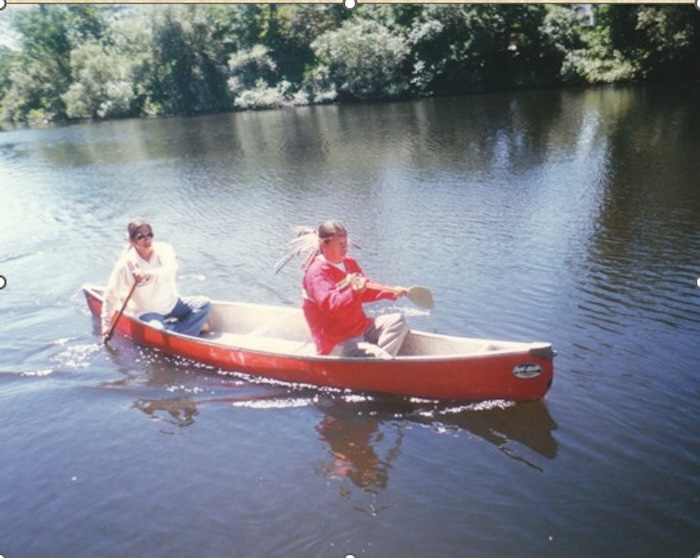
“Yeah, it’s changed over the years. It started out with a couple of Native Americans in a canoe down at the dock (in Watertown Square), and people met them there. Then there was a parade at Mount Auburn Street that ended (at the Fowle House), and we had a cookout in the backyard and drumming,” Kelly said. “That’s how the first few years were, and then in 2000 we had it with Faire on the Square on Saltonstall Park, and they actually camped out overnight there.”
The Historical Society hosted a powwow in the early 2000s, Kelly said, on the field in front of Hosmer Elementary School.
“The Native Americans and the Colonists camped out for the whole weekend there with fires and all, a reenactment,” Kelly said. “A powwow and a Colonial encampment is how we billed it. That was a lot of fun. There were lots of vendors there: Native American and Colonial vendors. It was, it was a huge event.”
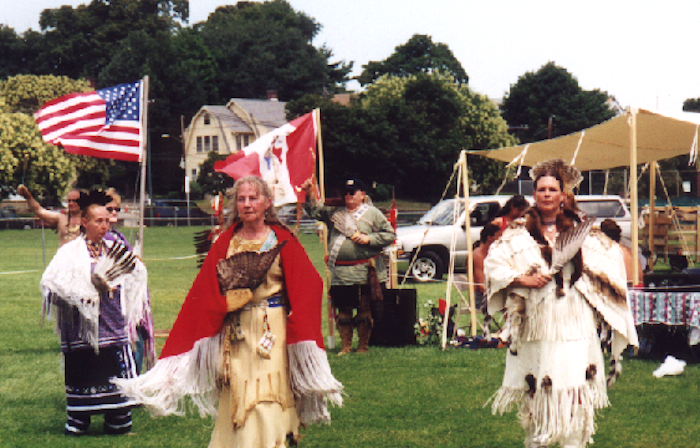
The powwow and encampment lasted about eight years, Kelly said.
“Then we found out that the Declaration had been read out the front window (of the Fowle House), and so we said, let’s get back to that,” she said.
Historical Society of Watertown
Bob Childs reenacted Porez Mortin by reading the Declaration of Independence from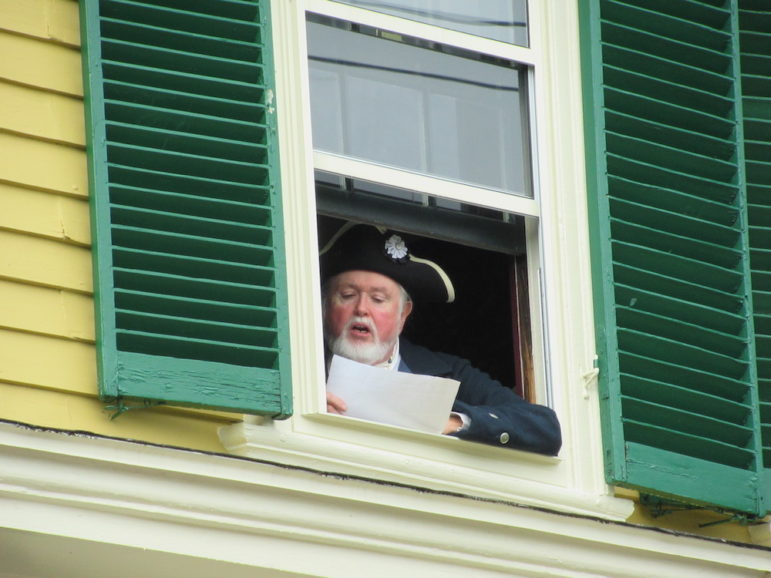
the Edmund Fowle House upstairs Council Room window in 2018.
Kelly learned about Watertown’s connection to the Declaration of Independence in 2008. She ran into fellow history buff Hue Holley while she was attending Harborfest in Boston, and he told Kelly about an article he found about the first reading of the Declaration in Massachusetts taking place in Watertown. The article mentioned it was read to the public from a window on the second floor of the Council Chamber of the Edmund Fowle House on July 18, 1776.
“I looked into it, and and found a newspaper article from back then, and that’s how we discovered that,” she said.
Starting in 2009, the Historical Society reenacted the reading of the Declaration from the Fowle House, and also invited members of the Mi’qmak and Maliseet, as well as local tribes to take part in the celebration of Treaty Day.
For many years, Watertown’s Marilyn Petitto Devaney took part in the event in her role on the Governor’s Council, which descends from the group that signed the Treaty on behalf of Massachusetts in 1776.
Charlie Breitrose
Members of the Mi’qmak Indian tribe sing and play drums in 2015 during the reenactment of the signing of the Treaty of Watertown – the first foreign treaty signed by the United States.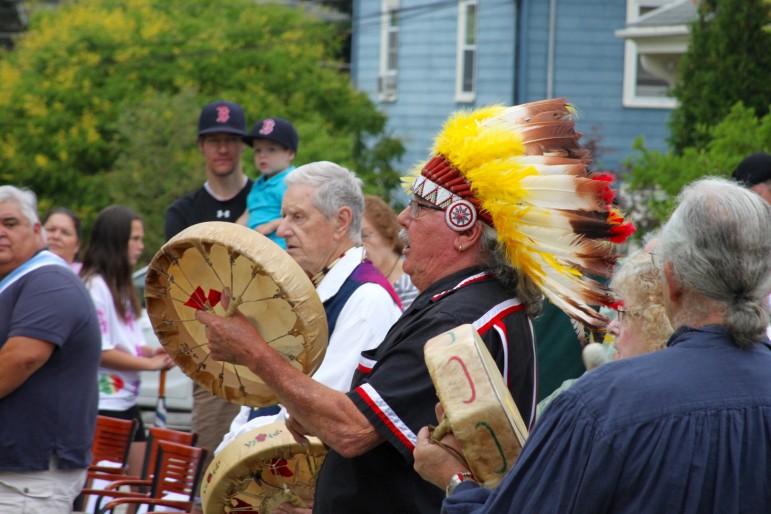
A few years ago, after the Pandemic, the reading of the Treaty and Declaration at the Fowle House was abandoned.
“Certainly I would like to do that, but we cannot do it in July. It is just too hot,” Kelly said. “I would not want to be sitting out there right now listening to someone read the Declaration of Independence.”
The past few years, Historical Society President Marilynne Roach has given a presentation about the Treaty at the Watertown Senior Center, which sits across the street from the Fowle House.
This is not the first year that the City (or Town) has been involved with the Treaty Day Celebration. The then-Town government provided financial assistance for the first few Treaty Day celebrations. Kelly recalls meeting with members of the Town Council.
“We’d meet in Town Hall, and they appropriated like 700 bucks for us to do Treaty Day,” Kelly said.
After a few years, the Historical Society took over the event. With the Treaty’s 250th anniversary, however, the decision was made to do something bigger in 2026.
“It’s fantastic that the City is doing all that they are doing, they’re spearheading this, and they came up with some great ideas, and they followed through on them,” Kelly said.
The 250th celebration started with a conversation with the then interim-Executive Director of the Mosesian Center for the Arts, Roberta Miller.
“It was Roberta who said, ‘Oh, you could use our facility,’ and (City Events Team Manager) Tammy McKenna says, ‘Yeah, you could have a supper at our house at the Commander’s Mansion,’ and the Library said we could get books on it,” Kelly said. “Everybody was wonderful. We were blown away. We thought it was how nice of everybody to chip in for one thing.”
Find out more about the 250th Treaty Day celebration at https://watertownmaculture.com/treaty-day-250/