The City Council approved the Fiscal Year 2027 budget, but the City’s financial future could be darkened if the State does not approve a tax relief legislation submitted by the City.
The Council unanimously approved the $226.21 million budget on Tuesday night without any changes from the one presented by City Manager George Proakis in April. During the meeting, the Council also heard an update from State Reps. Steve Owens and John Lawn.
The Home Rule Petition asks for Watertown to be allowed to shift more of the property tax burden from residential properties to commercial properties. If not passed, homeowners could see property tax increases of as high as 18% in the fiscal year that begins July 1, 2026.
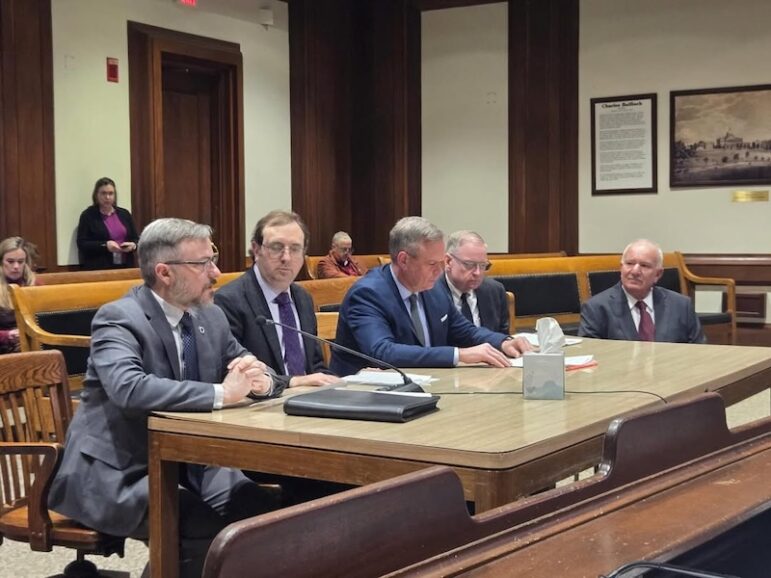
In January, Proakis, Council President Mark Sidiers, and City Assessor Earl Smith joined Lawn and Owens to testify in front of the Legislature’s Joint Revenue Committee. Owens said the request got more questions from the committee than any other item on the docket.
The Home Rule Petition asks to allow Watertown to do a 50/50 split of the total tax levy between residential and CIP (Commercial, industrial and personal). Under current requirements of state law to have 61% of the tax levy coming from residential properties.
The City of Boston has made headlines for seeking its own property tax relief, but Lawn said while there are some similarities Watertown’s request is very different. Boston’s request would have tax shifts onto commercial projects that went beyond what Watertown has requested.
“So we’re confident that in the next few weeks to months we should see that legislation pass, and Rep. Owens and I, working with Sen. (Will) Brownsberger as well, are in weekly contact explaining how urgent this is for the City of Watertown.”
Right now the House is scheduled to decide by June 26, but Owens said he and Lawn are advocating for it to be decided sooner.
Brownsberger represents not only Watertown, but also parts of Boston (along with Belmont and parts of Cambridge). He gave an update to the City Council on April 14, and said he strongly backs Watertown’s request.
“I do want to underline my 100% support for the tax classification Home Rule petition that you do have pending, and I very much hope that that will come over from the House, and I look forward to moving you through the Senate expeditiously,” Brownsberger said.
Sideris asked what happens if the bill is not approved by the end of the Legislature’s Formal Session on July 31, 2026.
“So it can pass in an informal session. Our goal, though, is to have this done before the session ends at the end of July,” Lawn said. “We talked to the Ways & Means Chair over the weekend and we are trying to really express and continue to express how important this is to the City of Watertown.”
State Funding

Watertown’s Chapter 70 education funding has increased over the past dozen years. Brownsberger said that when he was first elected in 2012, he spotted inequities in the formula used to determine how much money each community receives.
“So for example, Wellesley was getting 17 or 18% of its budget from the state, whereas Watertown was consistently getting only about 13%,” Brownsberger said. “When I looked into that, it became clear that this was not on purpose. There was no reason for this. It was that people had lost sight of the complexity of the Chapter 70 formula, and which were short changing Watertown.”
Since Fiscal Year 2014, Watertown has received $21 million in additional funds due to the changes in how Chapter 70 is calculated, Brownsberger said.
The Chapter 90 “pothole funds” for roads will be about $950,000, Owens said, which is more than $200,000 above Fiscal Year 2025.
Brownsberger has also submitted earmarks in the Senate’s version of the State’s Supplemental Budget of $100,000 for after school transportation from Watertown schools to the Watertown Boys & Girls Club, $200,000 to help run the shuttle on Arsenal Street, and $150,000 for “extraordinary” special education costs for the Watertown Schools.